
Websites & Ecommerce · UK Guide 2026
Fragile Product Packaging Trial: A Checklist for UK Sellers
JASOTO · Updated 5 November 2026 · 1,608 words
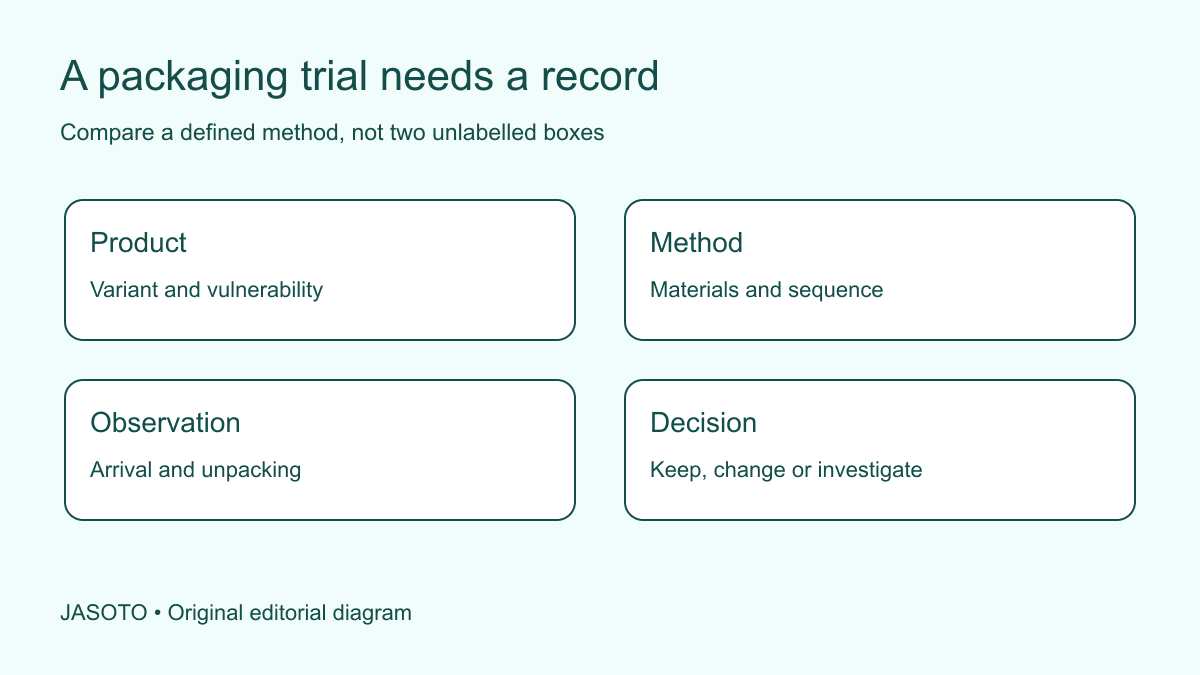
Original JASOTO editorial diagram. Its complete workflow is explained in the article; no actual customer outcome is depicted.
To compare packaging for a fragile product, define the item, chosen delivery service and packing method, then record what you observe during a representative trial. Assess arrival condition, packing effort and the recipient's ability to unpack safely. A small trial can reveal weaknesses and unanswered questions; it cannot guarantee every future delivery or certify a design merely because one parcel arrives intact.
This guide is for UK small sellers comparing ordinary dispatch options. It is an editorial planning method, not a formal laboratory test procedure. Carrier conditions, product restrictions and compensation exclusions need checking directly. Specialist goods may need specialist advice. Start with the requirements for the actual product and service rather than choosing a box because it looks reassuringly thick.
The practical answer
- Define the product and delivery service before comparing materials.
- Record the complete packing method, not only the outer box.
- Compare condition, packing effort and customer unpacking experience.
- Treat small trials as learning, not certification or a guarantee.
Define the product you are trying to protect
List the product variants included in the decision: dimensions, weight, materials, separate components and parts vulnerable to movement or contact. A cup with a handle presents a different packing problem from a solid item of similar size. If the trial uses only the easiest variant, its result may not answer the question for the rest of the range. Identify which variants require separate consideration.
Record the condition before packing, using a clear description and relevant photographs. Include the accessories and presentation materials that will travel with the product. A loose insert or second item can change what happens inside a package. Do not borrow specifications from a similar product unless they genuinely apply. The objective is to give a packaging provider an accurate brief and preserve enough information to understand the trial later, when the original item is no longer on the packing bench.
Read the requirements of the chosen service
Check the carrier's current packaging instructions, restrictions and relevant compensation conditions. Parcelforce's guidance says labels such as fragile do not replace adequate packaging and that orientation markings do not guarantee how an item remains positioned. Those are useful constraints when discussing a design with a supplier. Do not turn a general guide into a claim that a particular product or method is covered by a particular service.
Save the relevant provider reference and date checked in the trial record. Ask for clarification where a product category or material is uncertain. If you change carriers or services, revisit the assumptions rather than transferring a successful trial result automatically. A package designed for one handling environment may leave questions in another. Your seller-facing checkout information should describe the delivery arrangement you actually offer, not an imagined level of careful handling that the provider has not agreed.
Write a packing method someone else can follow
Document the outer package, internal protection, separation of parts, sealing method and label position. Identify material specifications or supplier references, not just words such as “strong box” or “plenty of padding”. Where a supplier recommends a design, ask which product details and service assumptions it used. Keep the advice with the method so later changes can be discussed intelligently.
Have another person follow the instructions using the intended materials. Watch where they need to guess. A method dependent on one experienced packer's intuition may be hard to repeat during a busy period. Record a photograph of the stages where that helps, without presenting it as proof of protective performance. The point is consistency of assembly. Whether the package protects the goods adequately is a further question that the trial and any required specialist assessment must address.
Choose a comparison that answers one question
Decide what you want to learn: whether components remain separated, whether the unpacking sequence is clear or whether the proposed materials can be assembled consistently. If you change the box, insert, product arrangement and sealing method all at once, it may be difficult to understand why the outcome differs. Keep a version identifier for each complete packing design and make changes deliberately.
Avoid creating a false sense of experimental precision. Real delivery journeys vary, and a small business trial may not control every condition. State those limits rather than inventing a statistical conclusion. For formal testing, ISTA publishes information on distribution test procedures; discuss the appropriate approach with a competent specialist or laboratory. A few trial dispatches and an improvised demonstration are not interchangeable with a correctly performed recognised test or a certification claim.
Agree the recipient's observations in advance
Tell the trial recipient what information would help: the external package condition, whether the correct product arrived, visible movement or contact and the unpacking sequence. Ask for observations before conclusions. “Handle found detached inside wrapping” is more informative than “courier careless” if nobody witnessed the cause. The same principle applies to a successful delivery: record what was checked rather than simply marking a happy face.
Use an appropriate way to share photographs and keep unrelated personal details out of the trial record. Agree how the recipient should report a problem and what to do with damaged goods or packaging through your proper process. Do not instruct someone to handle broken or hazardous contents for the sake of a photograph. A useful observation protocol should help the business understand a result without creating a new risk for the person opening the parcel.
Compare effort and complete cost honestly
Record the materials used and the actual packing steps. If you time the process, distinguish a first attempt from a familiar repeated task and state the conditions. A trial that uses one prepared kit on a clear table may not reflect a normal dispatch shift. Do not multiply an optimistic packing time into a claimed annual saving before the process has been tested in the relevant setting.
Include storage, preparation and disposal questions in the comparison where they matter. A low unit price may be less attractive if a design needs large storage space or inconsistent manual cutting. Environmental claims also need evidence appropriate to the claim; do not label a packaging choice sustainable merely because it uses less visible plastic. Ask suppliers for specific material and disposal information and communicate it accurately, without turning a small operational trial into unsupported marketing proof.
Worked example: separating two ceramic pieces
Imagine a seller sending a ceramic cup and saucer together. This is an invented example, not a tested product recommendation. The seller asks a packaging provider about a method that keeps the pieces from contacting each other. The trial record identifies the actual item sizes, the complete materials and the packing sequence. It also records which service is intended and which carrier questions still need clarification.
The recipient reports that the goods arrived intact but that the internal arrangement was difficult to unpack. The seller records both observations rather than treating the absence of breakage as complete success. A revised method is considered with the supplier, maintaining the product separation while addressing unpacking. The decision remains bounded: the trial has exposed a usability issue in that version, while future-route performance and any formal testing requirements remain separate questions.
Keep failures connected to the design version
If a trial fails, retain the record of the exact packing method, product and delivery conditions known. Compare the observation with the intended protection. Was a component omitted during assembly, did the instructions leave room for interpretation, or does the design need reconsideration? A supplier can investigate more effectively when the question is specific and the evidence is linked to the version used.
Do not quietly amend the method and then describe earlier results as belonging to the new design. Give the revision a new identifier and explain what changed. JASOTO businesses can help you find packaging or logistics providers to discuss the problem. If a supplier or laboratory visit is necessary, research travel options after agreeing the purpose, appointment and destination. A visit should answer defined questions rather than substitute for a usable product brief.
Prepare the method for ordinary dispatch work
Once you choose a method, place the instructions where packers use them and make the correct materials identifiable. Separate superseded inserts or boxes so they are not used accidentally. Confirm how new staff will learn the process and who answers questions when a product does not fit the expected arrangement. A good trial can be undermined by an unrecorded substitution during the first busy week.
If volume creates a sustained staffing need, explore operations and packing jobs. Decide whether the problem is labour capacity, material availability or unclear instructions before recruiting or buying software. Give staff a simple way to report a mismatch without improvising a new design. The dispatch record need not reproduce the entire trial report for every order, but it should connect unusual cases and approved changes to the person responsible for the packing method.
Review real deliveries without claiming certainty
After introduction, review damage reports, corrections and customer unpacking questions against the design and product variants. Record the number of relevant deliveries if you compare rates, and explain what was or was not reported. A quiet inbox does not necessarily mean every package arrived perfectly. Avoid publishing a performance percentage without reliable observations and a clear definition of the outcome.
Set a review point when products, materials or services change. Keep a rollback option if the new method creates a practical problem, such as returning to a previously approved method while a supplier investigates. The useful outcome of a packaging trial is a repeatable decision supported by documented observations and clear limits. It helps you ask better questions, improve instructions and decide whether more evidence is needed before a larger commitment.
Put the guide into practice
- Identify representative products and their known vulnerabilities.
- Read the chosen carrier's current requirements and exclusions.
- Document each trial kit and packing sequence.
- Review delivery evidence and unresolved questions before ordering in volume.
Frequently asked questions
Does a fragile label provide enough protection?
No. Parcelforce's guidance says a fragile label is not a substitute for adequate packaging. Select a packing method suited to the product and the chosen service, and verify the provider's current requirements.
Does one successful delivery prove a packaging design works?
It gives one observation under the conditions of that journey. It does not establish how the design performs across every route, product variant or handling event. Record what remains untested and seek suitable specialist testing when needed.
Should I run improvised drop tests?
Do not substitute unsafe improvised tests for a suitable assessment. If formal distribution testing is required, discuss the product and route with a competent packaging specialist or laboratory and use an appropriate procedure.
Explore JASOTO tools
Discuss the actual product, service and evidence required.
Explore packing and operations roles →Consider staffing if dispatch preparation has become a sustained workload.
Plan a supplier or laboratory visit →Research a journey after confirming the appointment and destination.
Continue with JASOTO
Compare your next step
Discover UK businesses, compare services and request written quotes before making a decision.