
Business Growth · UK Guide 2026
Compare Packaging Suppliers Through a Garment Dispatch Test
JASOTO · Updated November 5, 2026 · 1,622 words
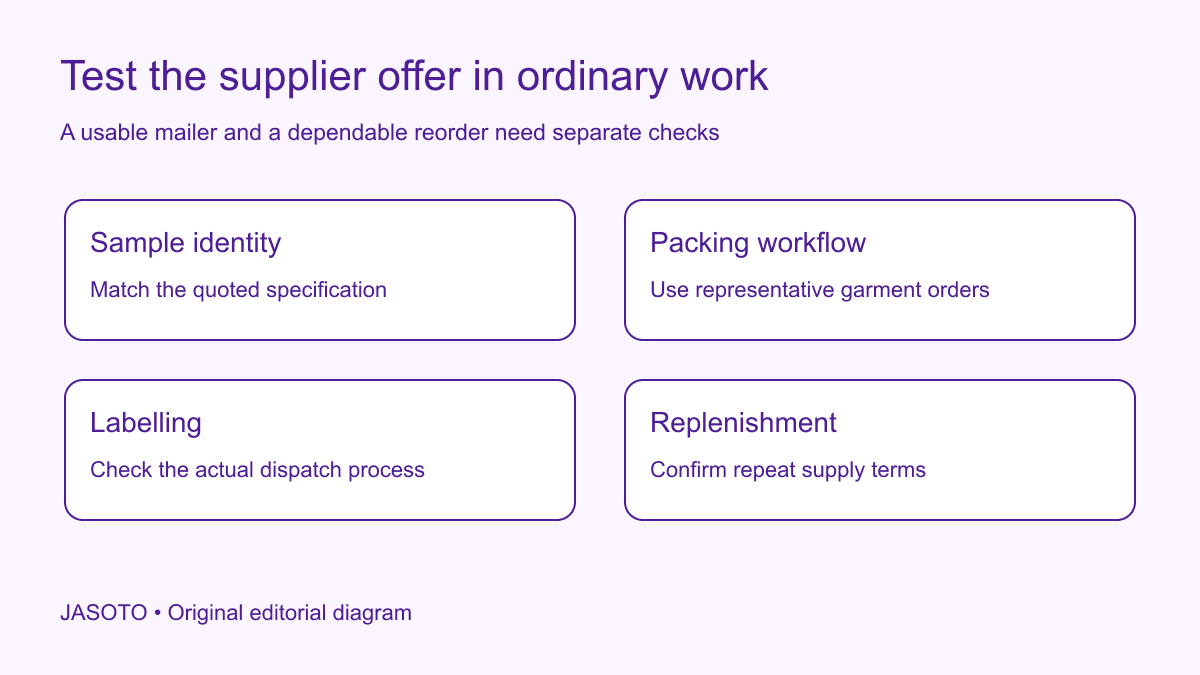
Original JASOTO editorial diagram. Its complete workflow is explained in the article; no actual customer outcome is depicted.
Compare packaging suppliers by running their identified samples through the same representative dispatch workflow and recording the practical differences. For a small clothing retailer, that means checking how the actual garment order mix fits, how staff identify and label the mailer and what repeat supply requires. Keep those observations connected to the quoted specification rather than choosing by appearance or unit price alone.
This guide is an original purchasing trial for small businesses in the United States comparing garment mailers. It focuses on supplier consistency, ordinary workflow and replenishment. It is separate from specialist protection testing or certification. Use appropriate packaging expertise for requirements the business cannot establish through ordinary observation, and check the actual carrier's current rules for the intended service.
The practical answer
- Compare supplier offers against the same real order mix.
- Record the mailer reference and received sample condition.
- Observe ordinary packing and labelling without inventing performance certification.
- Include supply terms and replenishment in the purchasing decision.
Define the order mix the mailer must support
Choose representative actual order types from the business, such as one folded shirt, a small combination of garments and an order containing a separately supplied insert. Use suitable trial contents and preserve their references. Do not compare one supplier with an easy single-item order and another with the largest awkward combination, then describe the resulting difference as a fair assessment.
Identify which orders remain outside scope. A mailer suitable for the chosen clothing items may not be appropriate for accessories or other products. Avoid treating the trial as approval for the entire catalogue. The purchasing decision should say which order types the evidence supports and which need another suitable packaging arrangement or further specialist review.
Match each sample to the quoted offer
Give samples a supplier and product reference, and retain the relevant specification. Ask whether the sample represents the material, dimensions and closure supplied in the quoted production order. If a sample is a nearby size offered only for illustration, record that limitation. Do not let a convenient trial piece become an assumed exact match merely because the later product has a similar name.
Check the commercial unit too. A quoted pack, carton or order quantity can represent different numbers of mailers. Record the actual basis before comparing totals. If the supplier offers several grades or finishes, identify the one tested. The person placing the eventual order should not need to infer which sample the team preferred from an unlabeled pile left beside the packing bench.
Review the delivered sample batch
Record what arrived, the relevant quantity and any visible difference from the agreed sample request. Use factual observations rather than a general quality score. If several pieces appear inconsistent, ask the supplier what evidence is needed to investigate. Do not assume that an attractive single piece represents the entire received batch, or that every variation has the same operational consequence.
Keep inbound supplier performance separate from the mailer's dispatch performance. An incomplete sample delivery raises a question about the supplier process, while a closure problem raises a question about the product or use. Both can matter, but merging them into one unexplained rating makes follow-up difficult. Name the actual issue and ask a focused question that the supplier can answer.
Check the carrier context before dispatch
Use the actual service and current carrier requirements for the intended packages. [USPS's domestic package guidance](https://www.usps.com/ship/packages.htm) covers preparation, packaging and postage in its own service context. Confirm the relevant details for the carrier and shipment you will use. Do not assume a supplier's general suitable-for-posting claim resolves every service, size or contents requirement.
Ask the responsible dispatch person to confirm how the trial fits the business's authorised process. This article does not prescribe technical packaging design or approve restricted contents. If a requirement is unclear, obtain suitable advice before using real customer shipments. A purchasing trial should operate within appropriate service rules rather than discovering basic eligibility only after a parcel is refused or delayed.
Observe the ordinary packing task
Have the appropriate staff use the agreed representative orders and the supplier's relevant instructions. Record practical questions: can the correct size be identified, does the garment combination fit as intended and is the closure process clear? Avoid unusual improvised tests that do not represent normal authorised work. Keep the observations tied to the actual method so another colleague can understand what was done.
If effort is compared, use a consistent approach and label the limits. One first attempt by a new employee is not a dependable universal packing-time estimate. Note familiarity, preparation and any interrupted work. The aim is to discover meaningful friction, such as confusing size labels or repeated rework, rather than manufacture a precise productivity figure from a tiny informal trial.
Test the label and document workflow
Use the actual appropriate label format and dispatch documentation in a controlled trial. Check whether staff can apply the label and identify the shipment correctly through the normal process. Record observed problems and ask the supplier or carrier for an appropriate answer where needed. Do not declare a material universally compatible with every printer or adhesive based on one successful example.
Check that the chosen mailer does not confuse the package count or order association when several orders are prepared together. Keep fictional or appropriately controlled test details where possible. A package can look neat while carrying the wrong order reference. The trial should examine the handover between product packing and shipment identification, with the actual operational owner involved.
Agree observations for a suitable real dispatch
If the business uses an appropriate actual shipment for the comparison, plan what will be recorded and by whom. Preserve the package reference, mailer specification and ordinary dispatch method. Use the proper customer and recipient arrangements. Do not burden a customer with an elaborate undisclosed test or ask them to perform an unsafe or technical inspection.
Record relevant arrival observations factually and acknowledge what they cannot prove. A recipient can report the package's visible condition and whether the expected contents arrived, while technical performance may require another method. One route on one day does not establish all delivery conditions. Keep the evidence useful without turning a successful parcel into an unsupported reliability guarantee.
Compare supply terms alongside the trial
Review minimum order quantity, lead time, delivery charges, storage implications and how the specification is identified on reorders. Use confirmed supplier information and label provisional answers. A mailer that works well can still be impractical if the business cannot accommodate the required purchase quantity or obtain the same specification when it needs replenishment.
Ask how the supplier handles substitutions and changes. The next order should not arrive in a different material or closure configuration without the business understanding the change. Record the communication and approval route appropriate to the purchase. Avoid assuming that a familiar product code guarantees an unchanged specification forever; give the supplier a clear contact for relevant updates and discrepancies.
Worked example: two mailer offers for shirt orders
Imagine a small clothing retailer comparing two suppliers for a defined mix of shirt orders. The team labels each sample, checks its relation to the quote and uses the same representative garment combinations. It records an unclear size marking from one offer and asks for clarification. The label workflow is reviewed through the actual dispatch process before an appropriate shipment observation is considered.
The buyer then compares repeat-order terms and usable quantities rather than selecting the sample that looked most polished. This invented example claims no saving, damage-rate reduction or product endorsement. It shows how a real workflow can expose both operational and supply questions while keeping the evidence narrower than a formal performance certification.
Make the purchasing decision traceable
Plan how the first larger order will enter ordinary work. If two suppliers' mailers remain in the packing area, staff need to distinguish the selected specification from trial leftovers. Use the business's appropriate stock and instruction process, and avoid an unrecorded mixture that makes later delivery observations impossible to interpret. Preserve which mailer was used for which relevant comparison shipment. Otherwise a customer report may be attributed to the selected supplier when another sample was actually dispatched.
Keep a fallback decision visible where the business needs continuity of supply. An alternative supplier may require its own verified specification and review rather than automatic substitution under the same packing instruction. Record what must be checked before switching. The purpose is not to guarantee uninterrupted supply, but to prevent a hurried reorder from bypassing the distinctions the original trial established. Revisit the fallback when the product range or intended service changes.
Save a concise comparison with the requirement, observed result, source reference and unresolved question for each meaningful criterion. Avoid a single weighted score unless the business can explain its basis and trade-offs. A strong closure in a small trial should not conceal an unanswered supply question. The authorised buyer should understand what is supported and what still needs a decision.
Record the chosen specification and any conditions before placing the larger order through the actual purchasing process. Ask the receiving colleague to check the delivered reference against that decision. Keep the trial record available for later questions. If the incoming batch differs, investigate the actual mismatch rather than assuming the earlier sample approval settles the issue.
Use JASOTO businesses to discover packaging suppliers and verify the relevant offer directly. If methods and supplier checks become ongoing work, explore dispatch operations roles within a staffing review. For an agreed sample collection or review visit, research travel after confirmation. A useful trial connects the supplier's exact offer to ordinary work and leaves a clear basis for the first order and the next reorder.
Put the guide into practice
- Define representative garment orders and comparison criteria.
- Confirm sample and quoted production references.
- Record practical dispatch observations and limitations.
- Review usable quantity, service fit and repeat-order terms.
Frequently asked questions
Does one successful dispatch prove a mailer is reliable?
It provides evidence about that shipment and method under its actual conditions. It does not establish every future outcome or replace appropriate testing for consequential requirements. Keep the observation narrow and review comparable real deliveries over time.
Should the cheapest unit price win?
Compare the actual offer, usable quantity, delivery terms, operational effort and replenishment requirements. A lower headline price may refer to a different size, specification or order quantity. Use confirmed figures and avoid inventing precise savings from an incomplete trial.
Can a sample differ from a later production order?
Ask the supplier what the sample represents and preserve the relevant specification. Confirm how changes and discrepancies are handled. A trial should not silently turn a showroom or hand-selected example into proof of every later batch.
Explore JASOTO tools
Discuss the actual garment order mix and repeat supply requirements directly.
Explore dispatch operations roles →Consider staffing where packing methods and supplier checks become ongoing work.
Research a confirmed supplier visit →Plan travel after agreeing the sample review or collection appointment.
Continue with JASOTO
Compare your next step
Discover UK businesses, compare services and request written quotes before making a decision.