
Travel · UK Guide 2026
Write a Group Travel Update After a Venue Change
JASOTO · Updated 5 November 2026 · 1,611 words
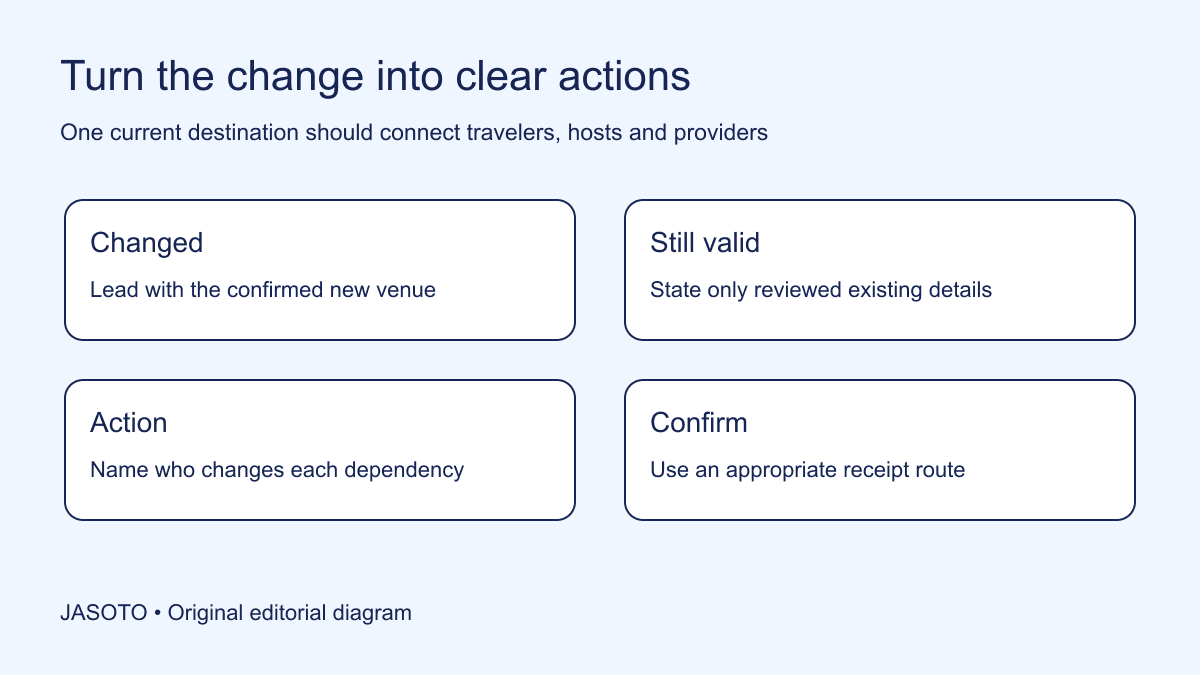
Original JASOTO editorial diagram. Its complete workflow is explained in the article; no actual customer outcome is depicted.
A group travel update after a venue change should state what changed, the confirmed new destination, which timing details remain valid and what each traveler must do next. Lead with the change and action. Update the maintained itinerary and relevant invitations, then use the agreed contact route to make sure people affected by the change receive a usable instruction.
This guide offers an original message structure for UK work or community travel. Google Calendar documents options for emailing event updates to guests and notes that settings can affect how updates appear. That is a useful reminder to check the actual communication route. A changed calendar field alone should not be treated as confirmation that every traveler understood a new address or has altered an affected booking.
The practical answer
- Lead with the new destination and action.
- Review dependencies before saying details are unchanged.
- Assign provider changes to an authorized owner.
- Replace old active directions consistently.
Establish the confirmed change before drafting
Ask the authorized host or organizer to confirm the new building, full address, entrance and appointment time. Identify whether the change is final or still a proposal. Do not send a decisive-looking group message based on an informal suggestion that the venue might move. If a provisional alert is useful, label it as provisional and state when the next confirmed instruction will follow.
Record what remains unchanged. The date, meeting purpose or some transport legs may still apply, while the final local route changes. Distinguish those facts from assumptions. A venue moving within the same town does not establish that pickup times remain workable, and a new room at the same site may still have another entrance. The message writer needs the actual scope of the change before telling the group which parts of the old plan to retain.
Map the affected travelers and providers
Identify who uses the shared transfer, who travels independently and who is already en route. Include people who receive the group through reception or venue coordination. A message sent only to the original invite list can omit a driver or a colleague who was added later. Use the maintained travel record to check the audience, with personal contact details handled appropriately.
Separate traveler communication from provider changes. Telling passengers the venue moved does not establish that a booked vehicle's destination has changed. Name who will contact the provider and obtain confirmation. The same applies to accommodation or other arrangements if the change materially affects them. Keep the action with the person authorized to amend the booking, rather than encouraging every traveler to make independent changes that may conflict with a shared arrangement.
Lead with the new instruction
Use a subject or opening line that names the trip and the venue change. Put the confirmed new destination and date near the beginning. Give the full practical arrival information and a clear statement about the old instruction being replaced. Avoid a long account of the organizer's internal decision before the reader reaches the address they need to use.
Keep the explanation for the move brief and factual if it helps. You do not need to speculate about a supplier problem or share private negotiation details. The reader's first need is the action. If the new venue is not yet suitable for a particular traveler's arrangements, identify the contact route for that question. A clear main message can coexist with private follow-up for individual needs without exposing personal details to the whole group.
State what remains valid
Tell travelers which confirmed parts of the plan they should continue to use, based on the actual review. This may include the main arrival service, group contact or meeting start. If an item has not been rechecked, label it as under review rather than retaining it by silence. Silence is easy to misread as an assurance that nothing else changed.
Keep the distinction between a valid booking and a feasible connection. A train ticket may still be the same booking while its arrival no longer supports reaching the new venue on time. The update should direct the traveler to the specific check or responsible coordinator. Avoid saying “all other details unchanged” until the relevant dependencies have actually been reviewed. A shorter message is useful only when it preserves the facts that determine the traveler's next action.
Assign actions to named roles or people
Write who changes the shared transfer, who updates the venue reception and what individual travelers need to check. Use names where appropriate and clear roles when that is easier for the audience. Give each action a relevant decision point. “Please review your travel” is broad; “independent travelers should confirm the new final leg and contact the coordinator if the required arrival is not feasible” identifies the task.
Do not instruct a group to buy replacement tickets or incur costs without the actual authorization and provider checks. The responsible owner should clarify the process for a change. Keep a proposed option separate from an approved commitment. If an answer is pending, state who is obtaining it and when the group should expect an update. That makes unresolved work visible without turning the whole message into a speculative alternative itinerary.
Use a concise worked message
An invented workshop update could read: “The workshop on the confirmed date will now take place at North Hall, using the full address and visitor entrance below. The start time remains as confirmed. This replaces the East Building instruction in the earlier itinerary. The coordinator is confirming the shared vehicle's revised destination and will issue the checked pickup instruction at the stated update point.”
It could continue: “Travelers making their own way should check the final route to North Hall and contact the coordinator if the required arrival is no longer feasible. Please do not alter a shared booking independently. Reply through the agreed channel to confirm you have the new destination. For an individual access or arrival question, contact the named host privately.” Replace every invented label with the actual confirmed information. The example demonstrates message structure; it is not a real venue, booking or provider commitment.
Explain how to confirm receipt appropriately
Choose a simple acknowledgement route for a material change. It might be a reply, an agreed form response or a coordinator checking directly with travelers already en route. Match the method to the actual group and communication arrangements. A read indicator can provide useful context, but it does not necessarily establish that a person understood the new instruction or acted on a booking dependency.
Track outstanding acknowledgements proportionately. Follow up with the relevant person through the established route instead of repeatedly broadcasting the same message to everyone. If someone cannot be reached, use the group's agreed contingency and record the uncertainty. Avoid assuming that a lack of reply means agreement or that everyone can use the same live app during travel. The aim is a reliable instruction, not an intrusive demand for continuous contact.
Update every active source of directions
Change the maintained itinerary, relevant calendar event and shared arrival sheet as appropriate. Remove or label the old active address so it cannot compete with the new one. Google Calendar offers guest-update emails, but the actual settings and recipient experience matter. Check that the new text and map reference agree, and use the agreed message route for the practical action.
Review offline and printed material where it is in use. A downloaded itinerary does not automatically update when the shared document changes. Tell travelers which copy to replace and provide the essential new detail in text. If a provider confirmation remains outstanding, keep that status visible in the active plan. A polished itinerary should not make the shared transfer look revised while the provider still holds the original destination.
Handle individual consequences privately
A new venue may affect an access arrangement, equipment route or personal travel constraint. Give people a suitable contact and ask what practical confirmation they need. Keep those discussions separate from the general group message unless the information is appropriate and necessary for everyone. The main update should remain clear while the relevant host and coordinator resolve individual requirements through the right channel.
Use travel research to explore changed routes and verify actual services with providers. For a local service found through business listings, confirm the amended arrangement directly. If ongoing travel communication is part of a role, describe its responsibility accurately in relevant jobs, including who maintains the message and who can authorize booking changes. Clear ownership prevents a venue update from becoming several conflicting private instructions with no current shared record.
Close with the current plan and remaining action
When the affected bookings and arrival routes are confirmed, issue a concise final update identifying what is now settled and any remaining individual action. Avoid repeating the entire history. Keep the evidence and earlier messages where appropriately needed, while the traveler-facing plan has one current destination and one usable contact route.
Afterwards, review which part of the change caused confusion and improve the reusable message structure. If a draft is too long, restore the essentials: changed destination, valid details, required actions, unresolved owner and confirmation route. If an unverified instruction was sent, correct it plainly and identify the replacement. A useful group update turns a venue change into manageable actions, with travelers and providers working from the same confirmed plan rather than trying to infer the new arrangement from scattered calendar edits.
Put the guide into practice
- Confirm venue, entrance and time.
- Check the full affected audience.
- Update itinerary and invitations.
- Track material acknowledgements and open items.
Frequently asked questions
Is updating the calendar location enough?
Check how the actual tool and recipients handle updates, then use the agreed communication route for a material venue change. Make the new destination and required actions explicit. A changed field does not establish that every traveler has understood the change or amended a dependent booking.
Should travelers change shared bookings themselves?
Identify the person authorized to amend the shared arrangement and have them confirm it with the provider. Tell travelers what they need to check individually. Independent changes to one group booking can create conflicting instructions or leave the provider with the old destination.
What belongs near the top of the update?
State the trip, confirmed new destination, relevant date and what the reader must do. Identify the old instruction being replaced and which reviewed details remain valid. Keep unresolved items labelled with an owner instead of implying that silence means they are unchanged.
Explore JASOTO tools
Discover providers and check support for your specific task.
Explore roles and responsibilities →Consider the practical responsibilities involved when recruiting or joining a team.
Plan work-related travel →Research a journey when joining, training or meeting colleagues in person.
Continue with JASOTO
Compare your next step
Discover UK businesses, compare services and request written quotes before making a decision.