
Jobs & Careers · UK Guide 2026
Plan the Handover From an Old Role to a New Team
JASOTO · Updated 5 November 2026 · 1,686 words
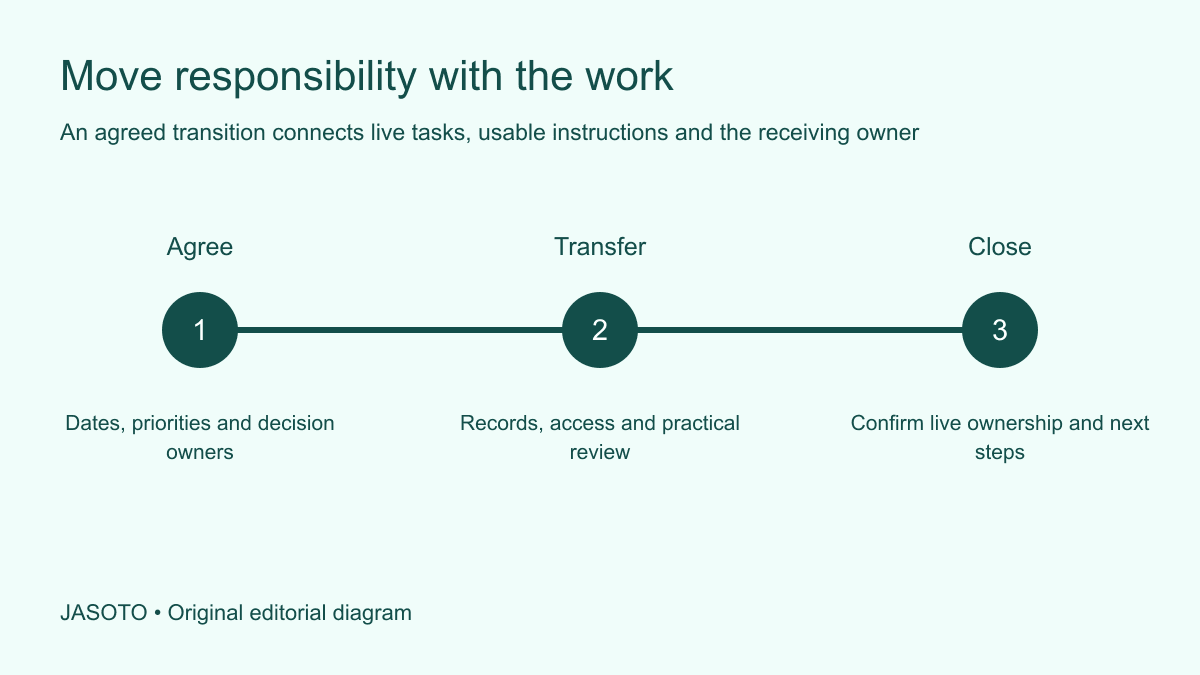
Original JASOTO editorial diagram. Its complete workflow is explained in the article; no actual customer outcome is depicted.
Plan the transition by agreeing which work you will finish, which work moves to a named receiving owner and which decisions need a manager before you leave the role. Build the handover around actual open tasks and a practical review. Keep the new team's joining arrangements in a separate current plan so the final days in one role do not silently consume the preparation needed for the next.
This original guide is for a UK employee moving between teams or employers. Acas provides guidance on notice periods; confirm the actual timing and obligations through your employment arrangements and appropriate advice where needed. The workflow below organizes responsibilities around an already agreed transition. It focuses on making the work usable for the next person and distinguishing a completed handover from a document that has merely been sent.
The practical answer
- Agree the transition boundary with managers.
- Inventory live work by the next action.
- Transfer ownership and individual access explicitly.
- Keep new-team joining arrangements visible.
Confirm the transition dates and decision owners
Establish the agreed final working point in the old role and the first working point in the new team. Record any confirmed overlap, absence or induction commitment that affects the plan. Do not assume a suggested start date is settled or that two managers have agreed how the same working day will be used. Ask the relevant people to resolve a conflict before building dependent appointments around it.
Name the manager who can prioritize outgoing work and the receiving contact for the new role. These may be different people with different authority. The departing employee can identify the workload, but should not privately decide that a critical task will be abandoned because the handover time looks short. Make constraints visible and ask the responsible manager to choose the priority. A realistic transition starts with an agreed boundary rather than a promise to complete everything regardless of the actual time available.
Inventory live work by its next action
List open tasks with the current state, next action, due point and relevant source. Avoid a narrative that says a project is “in progress” without telling the next person what needs to happen. Separate confirmed commitments from tentative discussions. The receiving owner should be able to identify the immediate decision without reading every historical message to discover which parts remain active.
For an invented service coordinator leaving a role, one booking is awaiting a customer reply, another needs a manager's approval and a third is confirmed for a later date. Those are three different next actions. Record the contact route and current record location through appropriate permissions, keeping unnecessary personal details out of a broad summary. The handover inventory is a navigation tool into the work, rather than a duplicate storage location for every document and conversation associated with it.
Agree finish, transfer and escalate categories
Ask the outgoing manager to decide which tasks you should complete before the transition, which move to a named person and which need a decision about their future. Use those categories consistently. A transfer requires a receiving owner, while an escalation needs the person authorized to resolve it. A task does not become transferred merely because someone is copied into an email about it.
Keep the plan proportionate to the available time. If there are too many finish tasks, show the conflict and ask for revised priorities. Avoid silently reducing quality or skipping necessary checks to satisfy an unrealistic list. A manager may decide to move a deadline, narrow an output or allocate another person. Record the approved change so the receiving team does not later interpret unfinished work as an unexplained omission by the departing employee.
Write instructions around the work people will do
For important recurring tasks, identify the current instruction and check whether it matches the actual process. Add the context a new owner needs, such as the source of incoming information, the output expected and the point where approval is required. Keep the instruction separate from a personal list of every habit you developed. The next person needs a reliable route through the task, with room for the organization's approved method to evolve.
Flag undocumented exceptions instead of presenting your own workaround as an established rule. Ask the process owner to confirm the acceptable approach. If the instruction is outdated, assign the correction and label the uncertainty. A handover can expose a process gap that existed long before the transition. Making that gap visible is useful; concealing it inside an apparently complete manual leaves the next person carrying the same ambiguity without knowing where it came from.
Demonstrate the risky handoff points
Choose a few representative tasks where a written note alone may leave uncertainty. Walk through the task using suitable sample or permitted live information, with the appropriate supervision and authorization. Explain why you make important checks and where the receiving person should stop for a decision. A demonstration should make the boundary understandable without giving another person unsupported authority.
Ask the receiver to explain or perform the next appropriate step. This checks whether the handover material is usable. It is different from watching you complete the task at speed while they try to take notes. Record questions that reveal missing instructions and assign them to the proper owner. If the work needs formal training, assessment or specialist competence, arrange that through the responsible process rather than treating one handover conversation as proof that the person is ready for independent work.
Transfer access through the proper account process
Identify which systems and records the receiver needs for the agreed tasks. Ask the authorized approver or administrator to arrange appropriate individual access and verify it with a harmless relevant check. Keep passwords and recovery secrets out of the handover document. The receiver needs their own supported route to the work, rather than dependence on your identity after you leave.
Record unresolved access dependencies with an owner and next action. An instruction pointing to a folder is unusable if the receiving person cannot open it. Do not solve that gap by exporting confidential material to an unapproved location or leaving your session available. Likewise, do not remove your own access unilaterally before required work is complete; follow the organization's authorized transition process. The manager and relevant technical owner should coordinate timing so the agreed responsibilities remain workable.
Brief contacts on the change appropriately
Agree who needs to know about the transition and what they should be told. A customer or supplier may need a new contact route and the status of an open commitment, while internal colleagues may need the decision boundary. Use approved wording and timing. Avoid sending a broad announcement that includes unnecessary details about the person's reasons for moving or the new employer.
Connect the message to the actual handover. If a supplier is told to contact a new owner, ensure that person knows the relevant reference and next action. A courteous introduction cannot compensate for an empty record. For the invented coordinator, the supplier update names the receiving contact and identifies the outstanding confirmation, while the full background remains in the approved business system. The message and the task record should point to the same current responsibility.
Protect the new team's joining plan
Confirm the new manager's arrival instructions, first-day contact and any equipment or account preparation. Keep those details in a separate maintained plan so they are easy to find. An outgoing task list can grow rapidly, and mixing joining instructions into it makes a missed dependency harder to notice. Ask who will resolve a conflict if the old role's final commitments overlap a new induction activity.
Avoid promising informal ongoing support that creates an undefined second job after the transition. If both teams agree a bounded follow-up arrangement, record its scope, contact route and end point. Otherwise route later questions through the current responsible owner. A well-intended “call me anytime” can leave the receiver relying on unavailable knowledge and the new team unsure why its colleague is repeatedly interrupted. Sustainable continuity comes from usable records and ownership, with any extra support explicitly agreed.
Review the handover against open work
Hold a final practical review with the manager or receiving owner. Check each live item: what has finished, what has moved and what remains unresolved. Confirm the receiving person's access and the location of the current instruction. Record actual acceptance or outstanding questions through the organization's process. Sending a document and receiving a polite acknowledgement should not automatically become evidence that every responsibility has been understood.
If additional coordination support is required, find suitable business services and give the provider a specific approved brief. When describing a replacement or expanded role through job opportunities, include the real responsibilities the handover exposed. Confirm any cross-site meeting before planning travel, including the host and material needed for the practical review. The transition should use the remaining time on the dependencies that most affect continuity, rather than on polishing an archive nobody needs for the next task.
Close with a reliable current record
Update the task inventory after the review and identify who owns it going forward. Follow the organization's arrangements for equipment, files and access at the end of the role. Keep personal records only where appropriate and avoid taking business material as a convenient reference for possible future questions. The new owner should have the authorized route to the current work without needing your private copies.
If a handover element fails, restore the last reliable status, identify the actual missing information and assign the correction to the current responsible person. Narrow any agreed follow-up to the specific gap. The practical result is a transition both teams can understand: outgoing tasks have owners and usable context, while joining arrangements have their own clear next step. A role change becomes easier to manage when responsibility moves visibly with the work instead of remaining attached to the person who used to do it.
Put the guide into practice
- Separate finish, transfer and escalation tasks.
- Demonstrate important handoff points.
- Confirm receiving access and instructions.
- Close with a reviewed current task record.
Frequently asked questions
Should I promise to help after I leave the role?
Only agree support that is appropriate, authorized and realistically bounded. Record the scope, route and end point where both teams approve an arrangement. Otherwise keep continuity in the current records and receiving owner so later work does not depend on informal unlimited availability.
What if nobody has been appointed to receive a task?
Raise the ownership gap with the responsible manager and record it as unresolved. Do not label the task transferred simply because a document exists. The manager should decide the next owner, a changed priority or another appropriate arrangement before the transition.
How do we check whether the handover worked?
Review live tasks and ask the receiver to identify or perform the next appropriate step using the current records and authorized access. Capture questions and dependencies with owners. A sent file or brief acknowledgement alone does not establish that every responsibility is usable.
Explore JASOTO tools
Discover providers and check support for your specific task.
Explore roles and responsibilities →Consider the practical responsibilities involved when recruiting or joining a team.
Plan work-related travel →Research a journey when joining, training or meeting colleagues in person.
Continue with JASOTO
Compare your next step
Discover UK businesses, compare services and request written quotes before making a decision.