
Jobs & Careers · UK Guide 2026
Design a Candidate Question Log for a Hiring Team
JASOTO · Updated November 5, 2026 · 1,623 words
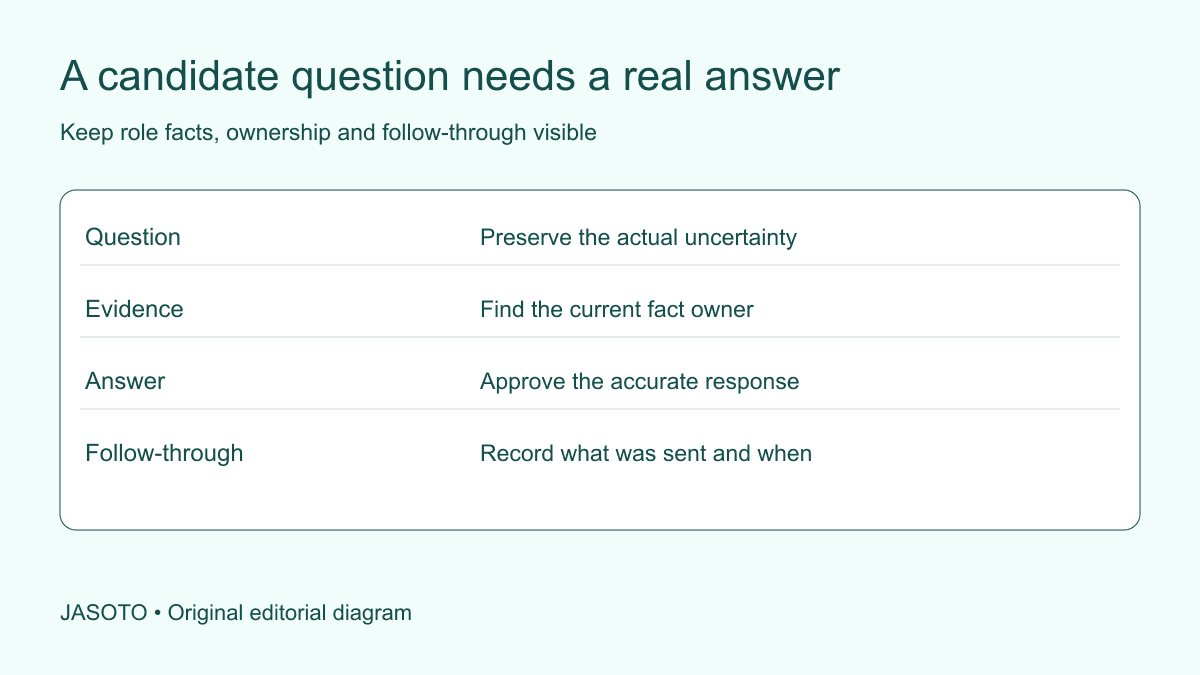
Original JASOTO editorial diagram. Its complete workflow is explained in the article; no actual customer outcome is depicted.
Design a candidate question log by recording the actual question, the person who can verify the answer and the next response action. Focus on questions candidates ask about the role and hiring process. Keep confirmed job facts separate from assumptions and private individual matters. The log should help the employer follow through accurately, without becoming an informal hidden score of who asked the most convenient questions.
This guide is an original administrative method for hiring teams in the United States. The worked example concerns an invented operations vacancy where candidates ask how often work at another site is expected. Use appropriate current HR and legal advice for recruitment, accommodations, privacy and employment commitments. The log supports coordination; it does not establish the legal effect of a particular answer or hiring decision.
The practical answer
- Capture the role question the candidate actually asked.
- Assign the answer to someone with current evidence and authority.
- Keep unresolved facts distinct from interviewers' assumptions.
- Record the response without turning reasonable questions into unsupported candidate judgments.
Define the log's purpose before collecting entries
State that the record tracks candidate questions, verified answers and promised follow-up. Keep assessment questions and scoring in the actual assessment process. A hiring team may need both kinds of record, but they serve different tasks. Mixing them can make a candidate's reasonable request for information look like evidence against their suitability without any role-related basis.
Identify who may view and update the log and which matters belong elsewhere. Use access appropriate to candidate information and the recruitment process. Do not make a widely shared spreadsheet the default location for every personal detail mentioned during an interview. The log should support a defined operational purpose rather than become an uncontrolled archive of everything the panel heard.
Preserve what the candidate actually asked
Write the question accurately with enough context to distinguish its meaning. Asking how travel is scheduled differs from saying travel is impossible. Asking when hours are confirmed differs from refusing the advertised hours. Avoid paraphrases that introduce a negative interpretation. Keep the original relevant note or appropriate source available where the actual process requires it.
If the question is ambiguous, clarify it respectfully through the appropriate contact route. Do not answer an easier question and mark the entry resolved. The candidate may need a specific fact to make an informed decision about continuing. Record that uncertainty plainly so the answer owner does not infer a request that the person never made.
Identify the source of the answer
Assign the question to someone with current evidence and appropriate authority. A panel member may know an older working arrangement while the role has changed. A manager may describe typical practice without controlling the employment terms. Check the actual source rather than letting the first confident answer become the shared official position.
Keep a reference to the relevant role document, approved policy or responsible owner. Do not copy confidential material into the log simply to make the row self-contained. A concise explanation and appropriate controlled reference can be enough. The team should understand what supports the answer and which part, if any, still needs confirmation before communicating it to the candidate.
Separate confirmed facts from estimates and preferences
Label the basis of the response. A confirmed contractual requirement, a current typical pattern and a manager's preference are different statements. Preserve those differences so the candidate does not receive an estimate as a guarantee. Use suitable advice for employment terms and consequential representations rather than relying on a generic note that all answers are informal.
If the fact is not yet decided, say so and identify the next decision. Do not fill the gap with a reassuring guess to make the employer look organised. An honest pending answer is useful when it has an owner and update point. It allows the hiring team to resolve a role ambiguity instead of passing it to the eventual employee as an unpleasant surprise.
Give the answer owner a concrete task
State what needs verification and when the response is useful. Confirm the current expected site-visit pattern for this vacancy is more actionable than clarify travel. Keep an internally chosen target separate from a commitment already given to the candidate. If an update was promised, preserve the actual words and appropriate reference so the team can follow through accurately.
Assign one person to send or coordinate the candidate reply. Several experts may contribute, but a shared answer can still go unsent if nobody owns communication. Do not assume a status change to verified means the candidate has received it. The log should distinguish the internal fact being established from the external response being completed.
Keep individual matters in the appropriate route
Some questions involve personal circumstances or an accommodation request rather than a general role fact. Use the proper confidential process and share only relevant information with authorised people. The [EEOC's disability-inquiry guidance](https://www.eeoc.gov/pre-employment-inquiries-and-disability) explains restrictions and specific considerations around pre-employment questions. Obtain suitable advice for the actual case rather than using this general log as a substitute for the proper hiring process.
Do not solicit medical detail just because a candidate asks about an arrangement. Record the operational routing action where appropriate and keep sensitive content in its proper controlled record. The general log can show that a private matter has been referred without exposing its substance to the whole panel or turning it into a broad judgment about the person.
Review whether the role information needs correction
If several candidates ask the same factual question, check whether the vacancy or role description is unclear. One question can also reveal a material contradiction worth resolving. Do not wait for a large count if the published information is known to be wrong. Assign the correction through the appropriate hiring authority and preserve what changed.
Distinguish a general role clarification from an individual arrangement. Relevant shared job facts may need consistent communication to affected candidates, while private matters should not be broadcast. Use suitable hiring advice where a change affects the process or expectations. The log should help the team identify the decision, not mechanically send every answer to everyone.
Use answer wording that matches its evidence
Write a direct answer to the actual question, with relevant qualifications and the appropriate next step. Avoid an unexplained policy link when the candidate needs to know which part applies. Conversely, do not rewrite approved terms casually in a way that changes their meaning. Ask the responsible owner to review consequential wording before it is used as the employer's response.
Keep the tone factual and respectful. A question about scheduling is not automatically a lack of commitment, and a question about progression does not prove the candidate intends to leave. The log should not contain speculative labels about character. Use the actual role-related assessment process for suitability decisions, with evidence and appropriate guidance rather than hidden inferences in administrative notes.
Worked example: expected work at another site
Imagine candidates for an operations role asking how often attendance at another site is expected. Interviewers initially give different descriptions based on past arrangements. The coordinator logs the actual question and asks the authorised role owner to confirm the current position for this vacancy. The answer distinguishes confirmed requirements from any estimate of the usual pattern and follows the appropriate employment-information process.
The hiring team reviews whether the advertised information needs a relevant correction and assigns the candidate replies. This invented example claims no legal conclusion or hiring result. It shows how a question log can expose inconsistent employer information without recasting the candidates' request as a problem with their attitude or treating an old practice as a guaranteed future arrangement.
Record the response and remaining questions
When the reply is sent, record the relevant date, version or message reference through the actual system. Preserve any new question that arises rather than marking the entire topic complete automatically. A candidate may understand the general answer but need clarification about a specific condition. Keep the next action with an owner and appropriate handling.
Do not use the log to claim agreement the candidate has not given. Receiving an answer, acknowledging it and accepting employment terms can be different events. Use the proper recruitment and contractual processes for those decisions. The administrative record should make follow-through visible without inventing acceptance or a stronger commitment than the evidence supports.
Test the record with a substitute coordinator
Ask an authorised colleague unfamiliar with one entry to identify the question, evidence owner, response status and next action. If they cannot, clarify the field or wording. Use fictional or suitably controlled examples when testing. The exercise should reveal practical ambiguity without exposing candidate information unnecessarily or creating new informal assessment commentary.
Review repeated gaps such as answers left verified but unsent or source references that only one manager can access. Change the relevant step and retain the previous template. Avoid claiming improved candidate experience without appropriate evidence. A useful first outcome is simply that the team can identify and complete the actual promise it made to a candidate.
Maintain and retire the log appropriately
Apply the business's appropriate retention, privacy and access arrangements after recruitment. Keep relevant job-information corrections connected to the current role record, while candidate-specific material remains subject to its own requirements. Do not retain every personal detail indefinitely because it once appeared in an interview conversation. Obtain suitable advice where obligations or disputes require particular preservation.
Use JASOTO businesses to discover suitable recruitment operations support and verify capability directly. Keep the facts presented through JASOTO jobs aligned with the actual role and approved answers. For an agreed workplace visit, research travel after the appointment is confirmed. A useful question log helps the employer provide clear, evidenced answers and makes the next response someone actually owns.
Put the guide into practice
- Define the log's role-information purpose.
- Record the question, source and answer owner.
- Review whether a fact needs wider role-information correction.
- Confirm the reply and handle private matters appropriately.
Frequently asked questions
Is this a log of interview questions asked by the employer?
This guide concerns questions candidates ask about the job or process and the employer's follow-up answers. Keep that administrative purpose distinct from the assessment questions, scoring and formal hiring decision records, while linking appropriate references where necessary.
Should asking a question affect the candidate's score?
Do not turn a reasonable clarification into an unsupported judgment about motivation or character. Use the actual role-related assessment criteria and appropriate hiring guidance. The log's purpose is to provide accurate answers and follow-through, not create an informal hidden scoring system.
What if a candidate raises a private individual need?
Use the appropriate confidential hiring or accommodation route and suitable HR or legal advice. Do not place unnecessary sensitive details in a shared general question log or treat the request as a general role fact to distribute to everyone.
Explore JASOTO tools
Discuss role-information and candidate follow-up needs with suitable providers.
Keep advertised job facts clear →Connect verified answers with the current role description and vacancy information.
Research a confirmed workplace visit →Plan travel after the hiring team confirms the relevant appointment and location.
Continue with JASOTO
Compare your next step
Discover UK businesses, compare services and request written quotes before making a decision.