
Websites & Visibility · UK Guide 2026
Write an Honest Team Biography for a Small Business
JASOTO · Updated 5 November 2026 · 1,563 words
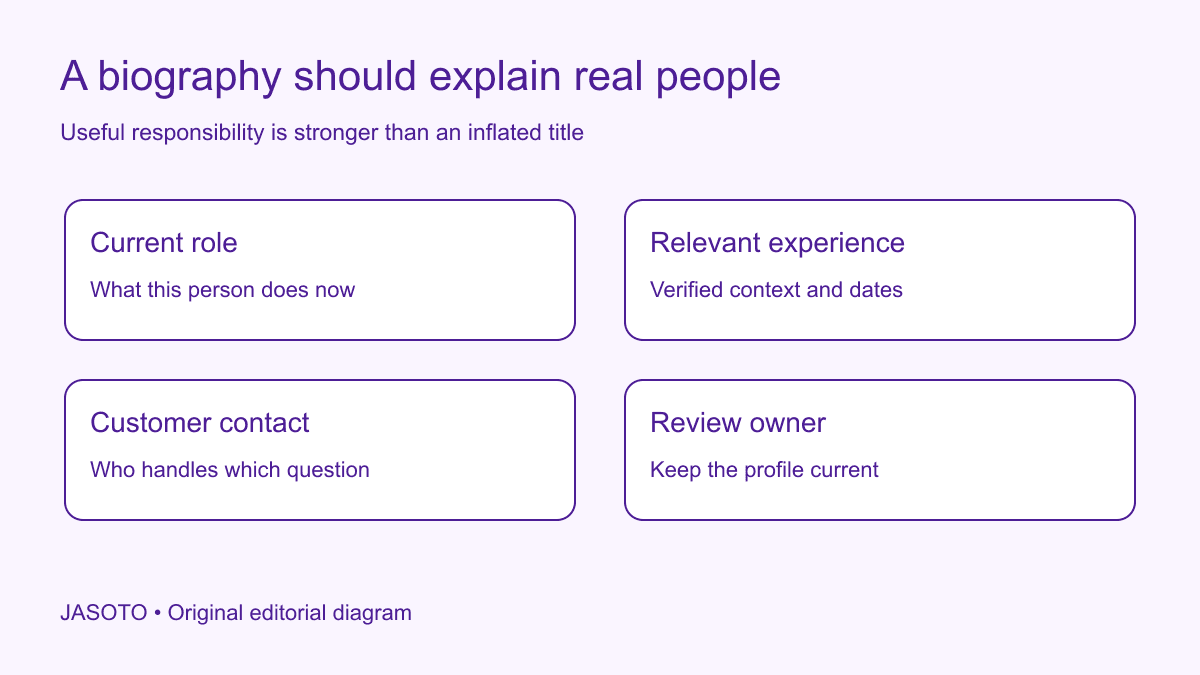
Original JASOTO editorial diagram. Its complete workflow is explained in the article; no actual customer outcome is depicted.
Write an honest team biography by explaining what the person does now, which relevant experience they can support and how their role affects customers. Verify credentials and avoid titles or collective claims that imply expertise, staffing or availability the business does not have. A useful biography helps a customer understand responsibility, rather than making every team member sound like the founder of a large specialist department.
This guide offers an editorial workflow for a small UK business. It is not advice on professional registration, protected titles or employment status. Those matters need the appropriate checks for the actual role. The example profiles are fictional and should not be presented as real people, customer endorsements or proof of experience.
The practical answer
- Describe the person's current role and useful customer responsibilities.
- Distinguish experience from credentials and current authorisation.
- Keep employees, founders and external specialists accurately represented.
- Give each biography an approval owner and review point.
Decide what a customer needs from the biography
Identify the practical question the profile should answer. A customer may want to know who coordinates a project, who performs technical work or who handles an existing booking. A general account of enthusiasm does not answer those questions. Choose details that explain the person's relevance to the service and the responsibilities they actually hold.
Separate the biography's purpose from recruitment or internal performance review. A public profile does not need every achievement, responsibility or career detail. It should support an informed customer decision while respecting the person's preferences and the business's publication process. Avoid forcing all profiles into the same length if some roles require less explanation. Consistency of meaning matters more than symmetrical blocks of text.
Start with the current role in ordinary language
Confirm the title and explain it through actions. “Operations coordinator” may mean little to a new customer until the profile states that the person arranges bookings and keeps project information moving between the customer and delivery team. Use that description only when it is true. A fashionable title should not substitute for an accurate account of responsibility.
Check whether the title implies authority or specialist status that the person does not hold. If a role includes several functions in a small business, explain the relevant combination plainly. Do not invent separate departments to make the organization appear larger. Customers benefit from knowing who does what and where decisions are referred, especially when one person covers more than one activity.
Gather a factual profile brief
Ask for the preferred published name, current role, relevant responsibilities and a few supported examples of experience. Identify which information is current, historical or provisional. Give the person a chance to flag private details and explain the intended publication context. Do not collect a complete personal history simply because a generic biography questionnaire asks for one.
Create a working fact sheet with evidence references and open questions. A certificate, employment record or approved project description may support different claims, so note what each establishes. Keep confidential records in the appropriate place rather than attaching them to the public profile. The writer needs verified facts and limits, not unrestricted access to every personnel document.
Distinguish experience, qualifications and authorisation
Experience describes work or learning in a context. A qualification describes a particular award or course. Current authorisation or registration may be a separate matter where relevant. Do not merge these into a vague phrase such as “fully certified expert” unless the exact claim has been properly checked. State the useful fact with enough context to avoid exaggeration.
[CAP's substantiation advice](https://www.asa.org.uk/advice-online/substantiation.html) addresses documentary support for objective marketing claims. Apply appropriate review to biography claims as well as headline advertising. A person's approval of flattering wording does not replace evidence for a factual credential or performance statement. Keep the public wording within what the relevant record supports and seek specialist advice where a regulated title is involved.
Describe past work without claiming ownership of every result
Explain the person's contribution to a previous project rather than presenting the entire outcome as their individual achievement. Distinguish work performed through an earlier employer from work delivered by the current business. A founder's relevant background can be useful, but should not imply that the new company has existed for the same length of time.
Avoid naming former customers or sharing project details without the appropriate permission and checks. If information cannot be verified or cleared, use a narrower supported description. “Experience coordinating multi-site schedules” can be informative where true, without claiming a named organization's endorsement or a measured result the person cannot substantiate. Do not replace confidential evidence with invented examples presented as real work.
Keep team size and business history clear
Use accurate singular and plural language. A sole operator can describe their role and any genuine support arrangement without pretending to be several people. A small team can explain how responsibilities are shared. Do not use a stock group photograph or fictional staff names to imply capacity that does not exist. If an image is illustrative, label it appropriately and consider whether it belongs on a team page at all.
Check aggregate experience claims carefully. Adding overlapping years from unrelated roles may produce an impressive number without explaining relevant capability. Prefer specific context where it helps a customer assess the service. If the business publishes a collective total, verify its calculation and interpretation. Avoid allowing a combined figure to imply decades of trading history or specialist practice that the organization cannot support.
Represent external specialists accurately
If contractors or advisers appear on the page, describe the actual relationship and responsibilities through the business's approved wording. Do not automatically present every occasional external contact as an employee or permanent team member. Conversely, do not obscure a genuine role merely because the person is external. The useful question is what the customer can reasonably expect from the service arrangement.
Agree publication with the person and relevant business owner. Check whether the profile implies they work on every project or are always available. A specialist who supports selected work should not be presented as a universal guarantee. Keep contractual or employment-status decisions with the appropriate professionals; the biography should reflect the settled arrangement rather than attempt to decide it through a label.
Work through a fictional profile revision
Imagine a new workshop whose draft says: “Our technical director brings twenty years of company expertise and personally guarantees every repair.” The fact brief shows that the person founded the business recently, has relevant prior roles and coordinates assessments, while some repairs are performed by other staff. The original wording combines business history, personal involvement and a guarantee without a clear basis.
A useful revision explains the current role and verified prior experience, then identifies the actual repair process elsewhere. It omits the unsupported guarantee and does not imply that all earlier work belongs to the new company. This fictional example is not a model credential statement. It demonstrates how a biography can remain informative after exaggerated claims are removed rather than replaced with equally vague praise.
Check the photograph and contact implications
Use a current, appropriately approved image and verify the right to publish it through the business's process. Explain who is depicted and avoid captions that imply additional qualifications or responsibilities. A portrait's professional appearance is not evidence of capability. Keep personal contact details out unless their publication is authorized and operationally appropriate.
If the biography invites customer contact, link to the maintained business route. A person away on a project or business journey should not leave customers with a dead end. Explain role responsibility without promising immediate individual access. The internal team should know how inquiries are covered when the profiled person is absent or no longer handles that type of question.
Review the page as a customer unfamiliar with the team
Ask a reviewer who they believe will perform the work, make decisions and answer questions after reading the profiles. Compare their interpretation with the operating arrangement. The issue may come from the page order, image or heading as much as a particular sentence. Check whether collective language makes a narrow individual credential appear to apply to everyone.
Use the same scrutiny when comparing business providers: relevant responsibilities and supported claims provide more useful information than generic superlatives. If the business is recruiting, keep open roles distinct from existing capacity. A planned hire is not a current team member, and an aspirational department name should not imply that a function is already staffed.
Approve the final version and maintain it
Have the person check factual accuracy and publication preferences, and have the responsible business reviewer check claims and customer implications. Review the final layout and excerpts, not just an isolated document. Keep the approved version, evidence references and review date in the content record so later editors can understand the basis for the profile.
Revisit biographies when roles, credentials, relationships or contact responsibilities change. Remove or update outdated claims promptly and retain a rollback path for publishing errors. Do not leave someone presented as a current employee because an old profile continues attracting visits. The practical goal is a page that describes the real team customers can deal with today, with useful experience explained honestly and its limits respected.
Put the guide into practice
- Confirm role, name and preferred published details.
- Verify experience and qualification claims.
- Check what the reader might infer about service delivery.
- Approve images and publication context.
- Review profiles when responsibilities change.
Frequently asked questions
Does a new business need to hide that the team is small?
No. Explain how the actual team handles work and where customers obtain help. Do not invent departments or imply more staff than exist. A clear account of responsibilities and external support can be useful without making unsupported claims about scale, coverage or continuous availability.
Can we combine everyone's experience into one large number?
Be careful about what the total implies and whether the calculation helps the reader. Overlapping years across unrelated roles can create a misleading impression of business history or specialist experience. Individual, relevant descriptions are often clearer. Verify any objective aggregate claim and explain its basis if you use it.
Should we publish personal hobbies?
Only where the person is comfortable and the detail suits the page. Personal interests are optional and should not displace the useful explanation of role and responsibility. Avoid gathering private information simply to make every profile the same length or create an artificial sense of intimacy.
Explore JASOTO tools
Continue with JASOTO
Compare your next step
Discover UK businesses, compare services and request written quotes before making a decision.