
Business Growth · UK Guide 2026
Review Inquiry Quality After a Service Description Update
JASOTO · Updated 5 November 2026 · 1,612 words
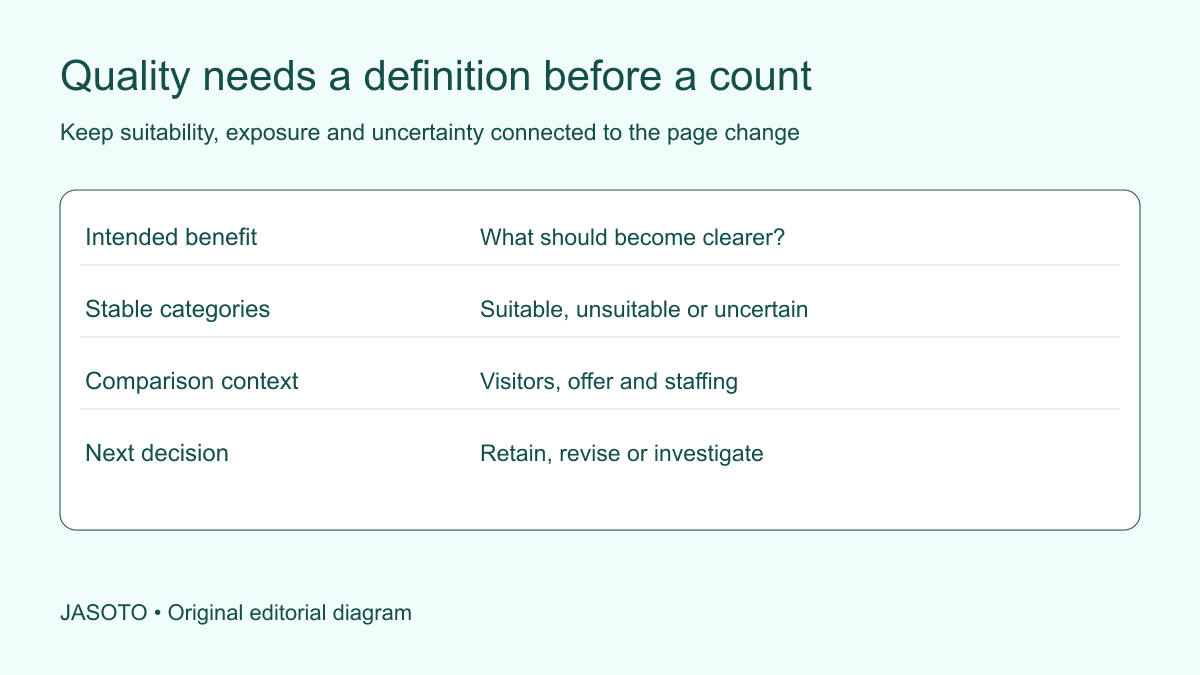
Original JASOTO editorial diagram. Its complete workflow is explained in the article; no actual customer outcome is depicted.
Review inquiry quality after updating a service description by defining what a useful request looks like, applying the same categories before and after the change and inspecting the customer examples behind the counts. Include relevant traffic and operational context. More inquiries alone do not show that the description helped customers understand the service, and fewer questions can mean several different things.
Start with a particular page revision and the decision it should improve. The workflow below is for a small UK business and uses fictional cases. It supports practical investigation without presenting an uncontrolled comparison as proof of causation. Handle customer records appropriately and keep objective claims about results within what the actual evidence supports.
The practical answer
- Define useful inquiry quality before inspecting the results.
- Preserve genuine unsuitable demand and uncertainty in the record.
- Compare like periods while noting traffic and service changes.
- Use specific customer evidence to revise or retain the wording.
State what the description was intended to improve
Record the old wording, new wording, publication point and reason for the change. Name the customer decision affected, such as recognizing service scope, checking coverage or understanding what happens after a request. A vague objective to improve leads makes it difficult to decide which evidence matters or whether the revision has helped.
Write a testable expectation in ordinary language. For example, a clearer scope boundary should help customers identify whether their task fits before submitting detailed information. This is an expectation to investigate, not an outcome already established. Keep it separate from the report of what happened after publication so the analysis does not quietly rewrite the original purpose to match a favorable result.
Define useful inquiry quality operationally
Agree what makes a request suitable for a relevant next action. Consider service fit, coverage, needed information and realistic intent without demanding that every customer submit a complete technical brief. Missing detail may be reasonably clarified. Do not define quality simply as whether the business eventually wins the work.
Use [GOV.UK's performance-metric guidance](https://www.gov.uk/service-manual/measuring-success/how-to-set-performance-metrics-for-your-service) for the principle of linking measures to service purpose and hypotheses. Its government reporting requirements do not automatically apply to this business. Define local categories that help assess the particular page's intended benefit and can be applied consistently by the people reviewing inquiries.
Keep distinct categories visible
Separate suitable requests, genuine unsuitable requests, duplicates, unwanted contact and uncertain cases. An outside-area customer is evidence of a real need even if the business cannot serve it. A duplicate affects workload differently from a new request. Preserve those distinctions rather than grouping every unsuccessful contact as poor quality.
Write examples and boundary rules using appropriately fictional or generalized material. Give uncertain cases a reviewer and next action. Keep the original classification distinct from later commercial outcomes. A suitable inquiry that does not become a sale should not retrospectively be relabelled spam merely to improve a reported conversion figure.
Choose a comparison period suited to the question
Use periods with relevant service availability and working patterns, noting their limitations. Record closures, campaigns, staffing changes or unusual demand. Avoid choosing dates after seeing which window creates the most favorable result. If the available baseline is weak, state that and use the review mainly to investigate specific customer understanding.
Keep the page version and other journey changes visible. A form redesign or new advertising channel introduced at the same time can affect inquiries independently of the description. The evidence may support a combined observation without isolating the wording's effect. Do not make that distinction disappear because the team wants one simple success statement.
Record exposure and channel context
Where available through an appropriate measurement setup, note relevant page visits, traffic sources and contact channels. A higher inquiry count may simply accompany more visitors. A changed audience may produce different needs. Define the scope of the evidence and ask the technical owner about tracking limitations rather than treating every reported visit as a perfectly known reader.
Include inquiries arriving through other routes only when the comparison explains their role. A customer may read the page and call, while another may never see it. Keep known, inferred and unknown exposure distinguishable. The analysis should not assign every incoming message to the revised description solely because it arrived after publication.
Review the information customers actually provide
Check whether the new requests include the details the page genuinely asked for and the service team needs at that stage. Record recurring omissions and whether they prevent a useful next action. Avoid blaming a customer for failing to supply information hidden in another page or requested only after submission.
Separate better preparation from extra burden. A form can collect more fields while discouraging relevant customers or producing guessed answers. Inspect examples and ask the team whether the information helps. The useful objective is a truthful usable request, not an apparently complete record created by mandatory questions that customers do not understand.
Inspect the scope misunderstandings behind the counts
Read an appropriate sample of genuine unsuitable requests through controlled access. Identify whether the issue concerns scope, area, price basis, timing or another decision. Look for the exact page wording and route involved. A category count tells the team where to investigate, while the case context helps choose the actual correction.
For visit-related questions, compare the service page, directions and confirmation process before customers plan travel. A location image or call-to-action may imply attendance that the body text does not promise. Review the whole presentation and next step. Do not assume the problem is solved by repeating the same sentence in an FAQ without checking where the misunderstanding arose.
Calibrate classifications between reviewers
Have appropriate colleagues independently categorize a small relevant set under the agreed definitions, then discuss disagreements. Record whether the rule or the individual decision needs correction. This helps prevent a change in reviewer judgment from masquerading as a change in inquiry quality. Keep private material controlled during the exercise.
Do not turn calibration into pressure to classify more requests as suitable. The aim is consistent interpretation and useful next actions. If the service itself has changed, update definitions with an effective point and preserve the earlier context. Comparisons across different offers should explain that difference rather than pretend every request faced identical conditions.
Work through a fictional boundary clarification
Imagine a business revises a description to explain that installation requires separate assessment. The review records suitable supply requests, installation-assessment requests and genuine inquiries expecting an automatic installation booking. The team compares the relevant cases with the page and form journey instead of judging the update only by total submissions.
One repeated misunderstanding points to an old button label, so the team assigns a focused correction and preserves the earlier version. This fictional scenario shows how quality evidence can produce a specific action. It supplies no fabricated improvement percentage and does not establish that the description caused every observed change in demand.
Decide what the evidence supports now
Summarize the observations, plausible explanations and unresolved questions separately. The review may support retaining the clearer scope, correcting a contradictory action or gathering more evidence. A small sample can reveal a definite factual error while remaining inadequate for a broad claim about commercial performance. State both parts accurately.
Assign the next action and its owner. Research content providers with the observed task and verified service facts if support is needed. Avoid commissioning an undefined rewrite merely because the overall inquiry count moved. A focused supported change is easier to review, test and reverse than several simultaneous edits unrelated to the evidence.
Verify revisions and preserve rollback information
Keep old and new wording, the reason for revision and the intended customer answer. Test the changed task with an appropriate reader and inspect the next step. If the fix alters commercial or specialist information, obtain the relevant review. Do not declare success from a smooth internal explanation alone.
Set a review trigger for a new misleading interpretation, operational mismatch or other material regression. Preserve the route for a prompt correction. A rollback should restore an accurate state, not automatically reinstate an older defect. The owner should understand what evidence would justify revising, reverting or investigating further.
Check whether clearer boundaries exclude the right requests
A more explicit description can reduce unsuitable submissions while still leaving affected customers with a useful answer. Review whether the page explains the boundary before people invest effort, and whether it provides an honest route for genuine edge cases. A lower unsuitable count is less meaningful if customers simply cannot find any maintained contact when their situation needs review.
Inspect the cases that remain uncertain and the service team's handling of them. If staff can reasonably assess an unusual request, the page should not impose a broader exclusion accidentally. Conversely, do not weaken an accurate boundary to increase apparent lead volume. Keep the content decision tied to actual service capability and customer understanding. This check helps the business evaluate the quality of the decision supported by the page, rather than equating every decrease in contact with improvement.
Maintain a proportionate learning record
Keep the definitions, period, relevant counts, case findings and decision in a concise record. Consider customer insight roles when recurring review needs capacity. Remove unnecessary recording effort through the responsible process and follow appropriate access and retention arrangements. A useful record supports a decision without becoming a duplicate customer database.
Review again when the offer, audience or page materially changes. Avoid treating one observation period as a permanent verdict. The practical result is an evidence-based account of inquiry suitability after a specific revision, with the context and uncertainty needed to choose the next improvement honestly.
Put the guide into practice
- Record the page change and expected benefit.
- Approve suitability definitions and review rules.
- Collect comparable inquiry and exposure evidence.
- Inspect examples behind the summary counts.
- Choose a proportionate action and rollback condition.
Frequently asked questions
Does a higher number of inquiries prove the new description is better?
It may reflect more visitors, a promotion or a changed service offer. Review suitability, task understanding and relevant exposure alongside volume. Keep the change's intended benefit explicit and avoid claiming a causal improvement from a simple before-and-after count without appropriate evidence.
Should unsuitable inquiries be deleted from the analysis?
Keep genuine unsuitable demand in an appropriate category. It can show that coverage, scope or the next step remains unclear. Separate it from spam and duplicates under stable rules, and preserve uncertain cases for review rather than making the summary appear cleaner through selective exclusion.
What if there are only a few inquiries?
Use them to investigate specific misunderstandings and report the small sample clearly. A consequential inaccurate promise can be corrected without waiting for a large dataset. Broader claims about conversion or demand need more suitable evidence, with uncertainty and other changes kept visible.
Explore JASOTO tools
Continue with JASOTO
Compare your next step
Discover UK businesses, compare services and request written quotes before making a decision.