
Jobs & Careers · UK Guide 2026
Write an Internal Vacancy Announcement People Can Use
JASOTO · Updated 5 November 2026 · 1,631 words
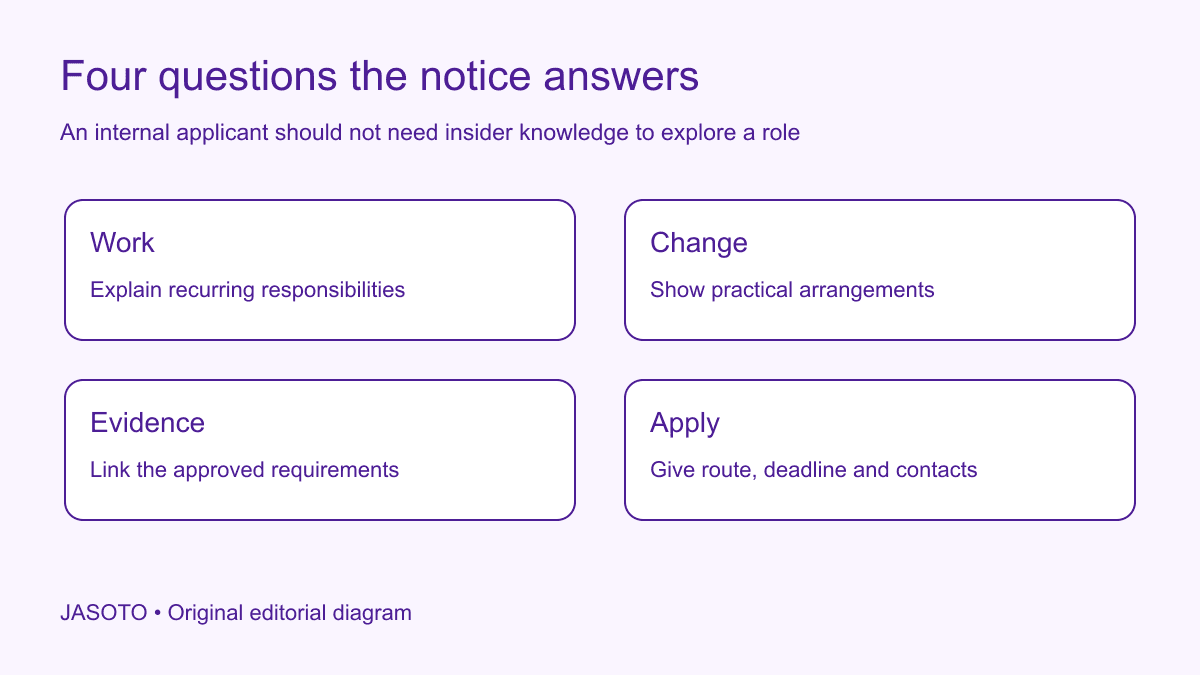
Original JASOTO editorial diagram. Its complete workflow is explained in the article; no actual customer outcome is depicted.
An internal vacancy announcement should let a colleague decide whether to explore the role and understand exactly how to apply. Explain the work, the practical arrangements, the selection process and the application deadline. Do not rely on people already knowing the manager, team or informal history behind the opening. Internal applicants still need a clear description of what would change if they moved.
This guide provides an original drafting and review process for a small UK employer. Acas's recruitment guidance says to follow the organisation's recruitment policy and use inclusive language describing the job. Check the current guidance and obtain appropriate advice for specific recruitment decisions. The examples below focus on making an authorised vacancy understandable, rather than deciding who is eligible or whether a business should recruit internally.
The practical answer
- Describe real responsibilities and decisions.
- Make practical changes explicit.
- Provide one clear application route.
- Keep clarifications consistent.
Confirm the opening is ready to announce
Before writing, obtain the approved role description, practical arrangements and agreed recruitment process. Confirm who owns each detail. A manager may understand the work while another person controls the salary information or application process. Record unresolved points and settle them before they become promises in the announcement. “We will work it out with the successful person” should not conceal something applicants need to assess the opportunity.
Identify whether the opening is a permanent move, temporary assignment or another authorised arrangement, using the organisation's actual terminology. Confirm the expected start discussion and what can honestly be said about duration. Do not invent certainty for a cleaner advert. An internal announcement often travels quickly through informal conversations, so a vague opening can produce several competing explanations before the formal process even begins.
Explain the work through concrete responsibilities
Describe a small number of recurring activities and the decisions the role owns. “Coordinate supplier appointments and maintain the current service calendar” tells a colleague more than “drive operational excellence”. Add an example that distinguishes the role from adjacent jobs. A coordinator who gathers information for approval has a different responsibility from a manager who authorises the commitment, even if both attend the same meetings.
Keep the description focused on the advertised work rather than the current postholder's personal style. A colleague should not need to imitate someone's personality to understand whether their experience is relevant. Review broad phrases such as “must thrive under pressure” and identify the actual work pattern behind them. If there are deadlines or irregular events, describe them factually. Avoid treating a vague cultural preference as evidence of what the job requires.
Make the practical change visible
State the confirmed working location, hours or pattern, reporting line and any travel expectation relevant to the opening. Use approved wording for pay and other terms. Internal applicants may assume that arrangements from their current role will continue unless the announcement explains otherwise. Do not leave material practical details to a private conversation available only to people who already know the hiring manager.
Where several sites are involved, explain the work connection between them. “Based at the town office with planned visits to the distribution site” is clearer than listing two addresses without context. Mark any unresolved point honestly and identify who can answer it. If the practical arrangements are not settled enough for a fair comparison, the recruitment owner should decide whether the announcement is ready, rather than letting the writer fill the gap with optimistic language.
Distinguish requirements from things someone can learn
Check the approved person specification and identify what an applicant needs to demonstrate at selection. Use evidence tied to the work. For example, “can maintain an accurate handover record” is more assessable than “naturally organised”. Where the organisation will provide training, say what the confirmed arrangement is without implying that every skill can be learned after appointment.
Avoid copying a long list from an older vacancy simply because the title is similar. Ask whether each requirement is actually needed and where applicants can find the complete specification. Internal colleagues may have relevant evidence from ordinary work that is not obvious from their current job titles. The announcement can invite them to describe that evidence while retaining the published criteria. It should neither discourage exploration through unnecessary jargon nor promise that selection standards will be waived.
Describe the application route as a sequence
Tell applicants what to submit, where to send it and how to identify the vacancy. Specify the deadline with a date and time, and clarify the relevant time zone if colleagues work across locations. Link directly to the approved form or instructions. Test the link using an account with ordinary employee access, because a document that opens for the recruitment owner may be inaccessible to the intended audience.
State what happens after submission using the confirmed process. A useful sequence might be acknowledgement, review against the role criteria and invitations to a stated assessment stage. Do not promise dates the hiring team has not agreed. If the process requires a particular conversation or approval, describe that requirement through the organisation's policy. Avoid inventing an informal manager-permission step merely because it has happened by custom in one department.
Give applicants a question route they can trust
Name a person who can answer questions about the role and a contact for the recruitment process where these are different. Explain how colleagues can arrange a conversation and whether there is an information session. A general “ask your manager” can be unhelpful when the manager does not know the vacancy or when someone wants to explore it before discussing a possible move.
Agree how questions and answers will be shared consistently. If one person asks about a responsibility missing from the advert, the owner may need to update the public information rather than answer only through a private message. Do not publish an applicant's identifiable question or personal circumstances. Separate general clarification from individual support. An accessible question route helps colleagues make informed decisions without requiring them to rely on friendships inside the hiring team.
Reach colleagues outside the obvious channels
Map where the intended internal audience actually receives information. Office email alone may not reach colleagues who work shifts, spend little time at a computer or are away from their usual site. Use the organisation's approved channels and confirm that each carries the same current application information. A notice on a staff board should include a practical way to obtain the full details, rather than merely referring to an intranet nobody on that shift can readily open.
Keep distribution consistent with the approved recruitment scope. If the announcement is for a defined audience, do not quietly broaden or narrow it through forwarding habits. The recruitment owner should decide the appropriate reach. The writer's job is to make the authorised information usable through each channel. Avoid assuming that a high message-open rate establishes that all relevant colleagues had a reasonable chance to see or act on the opening.
Review an example from the applicant's perspective
Consider an invented operations assistant vacancy. The first draft says, “Exciting development opportunity in operations; speak to Jamie.” It does not explain the tasks, location, duration or application process. A revised announcement names the recurring scheduling work, explains the reporting line, links the approved role description and provides the application deadline. Jamie remains the role contact, while a separate address handles submissions.
Ask a colleague outside the hiring team to read the revised version and explain how they would apply. Check which details they still have to guess. This review tests the document's usefulness rather than the colleague's knowledge. If they assume a conversation is mandatory when it is only optional, adjust the wording. If they cannot tell whether the opening changes their work location, make the approved arrangement more visible before distributing it.
Keep one current version and control corrections
Store the full announcement in one maintained location and link to it from shorter messages where appropriate. Show the publication or update date. If a material detail changes, ask the recruitment owner how the process should respond and notify the intended audience through the agreed channels. Correcting one page quietly can leave applicants relying on earlier emails or printed notices.
Keep an editorial record of the approved correction and the version it replaces. Do not rewrite the advert to match an informal preference that appears during applications. If the role or process genuinely changes, use the proper decision route. For external drafting or recruitment support, discover business service providers and ask how they will preserve approved details across versions. A clear approval trail makes it easier to restore the previous wording if an unapproved edit appears.
Close the announcement and preserve useful learning
When the application window ends, update the current notice according to the agreed process and stop circulating it as an open opportunity. Direct individual outcome questions to the recruitment owner. Review whether the advert generated repeated clarification questions and improve the next template. Do not interpret the number of applications as proof that the announcement was fair or that it reached every appropriate colleague.
If the role is later advertised more broadly, review job opportunities using the approved description and current process rather than republishing an obsolete internal message. Where a site visit forms part of exploration, confirm the host and purpose before planning travel. The practical result of a good internal announcement is an informed next step: colleagues understand the work, know how to ask and can apply through a consistent route. Familiarity with the employer should make exploration easier, without requiring familiarity with the hiring team's private conversations.
Put the guide into practice
- Confirm the approved role and process.
- Test links with ordinary employee access.
- Review the notice outside the hiring team.
- Maintain and close the current version.
Frequently asked questions
Can the announcement be shorter than the full job description?
Yes. Use the announcement to explain the opportunity and application route, then link to the approved full description and person specification. Keep the important practical arrangements visible, and make sure the linked documents are available to the intended internal audience.
Should questions be answered privately or publicly?
Handle individual circumstances through an appropriate private route. When a question reveals missing information about the role or process, consider publishing a general clarification through the recruitment owner. Share the answer consistently without identifying the person who raised it.
What if a detail changes after publication?
Ask the responsible recruitment owner how the change affects the process, update the maintained version and notify the audience through the agreed channels. Keep the correction traceable. Do not assume a silent edit to one intranet page reaches everyone who saw an earlier message.
Explore JASOTO tools
Discover providers and check support for your specific task.
Explore roles and responsibilities →Consider the practical responsibilities involved when recruiting or joining a team.
Plan work-related travel →Research a journey when joining, training or meeting colleagues in person.
Continue with JASOTO
Compare your next step
Discover UK businesses, compare services and request written quotes before making a decision.