
Global Business · UK Guide 2026
Check Currency Labels in an International Quotation
JASOTO · Updated 5 November 2026 · 1,559 words
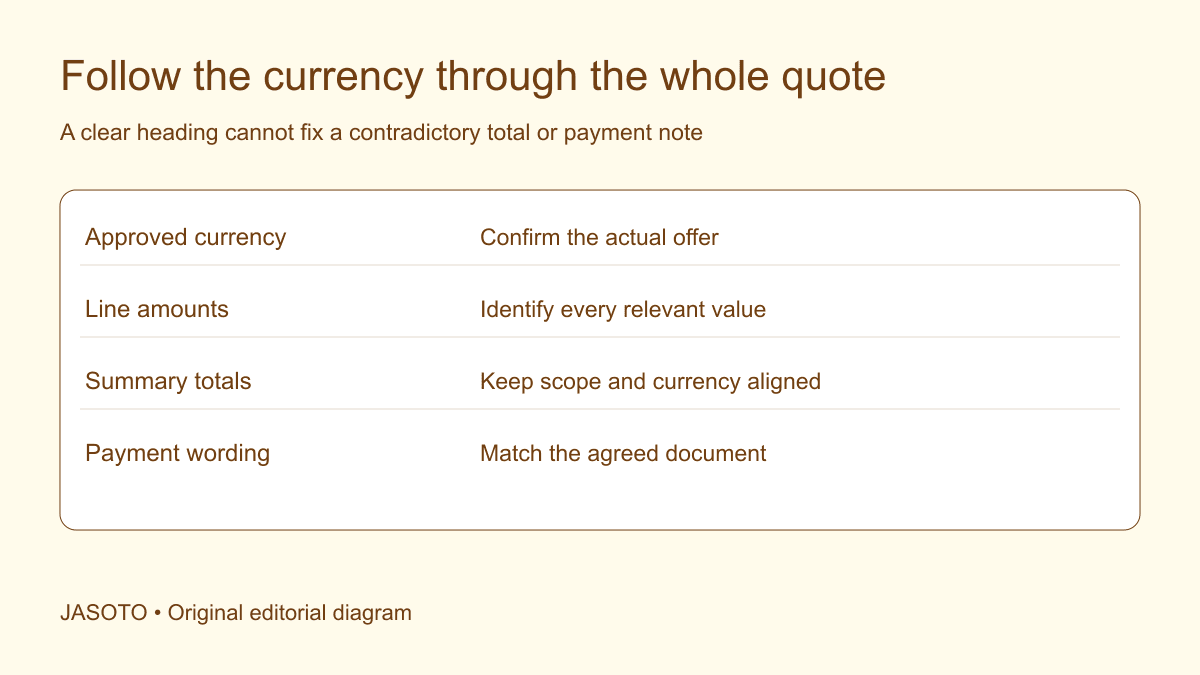
Original JASOTO editorial diagram. Its complete workflow is explained in the article; no actual customer outcome is depicted.
Check currency labels in an international quotation by confirming the approved currency, reviewing every amount's role and tracing the same meaning through totals, deposits and payment instructions. Use a clear identifier suited to the recipient and verify standard codes through an authoritative source where used. A correct heading does not resolve a contradictory footer, converted estimate or payment note elsewhere in the document.
This is a document-consistency workflow for a UK business, using fictional quotation references without invented prices or exchange rates. It does not decide tax treatment, payment rights or currency-conversion policy. Give those matters to the appropriate commercial or finance owner and professional adviser, then check that the final document represents the approved decision accurately.
The practical answer
- Confirm the quotation's approved currency before reviewing symbols.
- Check line items, totals and payment wording as one connected offer.
- Keep conversions and indicative values clearly distinguished.
- Reconcile template, export and translated versions before release.
Confirm the quotation's commercial source
Identify the approved quote reference, version and issuing party. Ask which currency governs the offer and where that decision is recorded. Do not infer it solely from the supplier's address or an old template. A business can quote internationally in different currencies, and a copied document may retain labels from another transaction.
Record who authorizes changes and what remains provisional. If the business has not settled the currency or is discussing alternatives, keep the draft status clear. The reviewer should not make a commercial choice while tidying the presentation. Establishing the source decision first makes the remaining checks specific and prevents a plausible label from becoming an accidental commitment.
Choose a clear currency identifier
Review whether the current symbol or label is sufficiently clear for the audience and task. Where a standard code is used, verify it rather than constructing an abbreviation from a country name. [SIX maintains ISO 4217 currency-code information](https://www.six-group.com/en/products-services/financial-information/market-reference-data/data-standards.html), providing an authoritative reference for the code designation. Use current information relevant to the actual currency.
Keep identifier accuracy separate from the amount itself. A valid code does not prove a price, conversion or commercial term is correct. The review should record both the reference checked and the approved offer. Avoid adding unnecessary technical notation if a clear conventional presentation already suits the context; the aim is understandable accurate identification throughout the quotation.
Inventory every place money appears
List line prices, unit rates, subtotals, discounts, deposits, balances, optional items and payment notes. Include values inside text, tables, images and attachments. A search for the main symbol can help locate references but may miss amounts displayed differently. Use the actual document structure and relevant system fields.
Give each important value a role and source. An optional item, indicative conversion and payable total should not appear interchangeable. The worksheet can record amount reference, currency, basis, status and approving owner without duplicating private financial details unnecessarily. This inventory provides a practical map for checking the complete offer rather than inspecting only the most prominent total.
Check line amounts with their units
Compare the currency, charging unit and service description together. A correct currency attached to an incorrect quantity or period still misrepresents the offer. Refer calculation and commercial questions to the responsible owner. Do not insert assumed units or exclusions to make the table appear complete.
Check headings and repeated rows after editing or translation. A currency label may govern an entire column only if the layout makes that relationship clear. If the table splits across pages, ensure the meaning remains understandable in the exported result. A reader should not need to return to an unrelated cover note to identify the currency of a detached optional-item section.
Reconcile subtotals and the stated total
Have the appropriate reviewer check the arithmetic and scope through the business's process. At the same time, verify that each summarized value uses the intended currency and inclusion basis. Matching digits do not establish that the total is described correctly. A label left from another template can change the apparent meaning without changing any calculation.
Keep unresolved differences explicit. Do not force a reconciliation by changing a code or adding a vague adjustment. Record the specific document reference and ask the responsible person to settle it. Once corrected, identify the version that should be issued and ensure the obsolete export cannot be selected casually for customer use.
Review deposits, balances and staged payments
Trace any deposit or staged-payment wording back to the approved arrangement. Check currency and the relationship between stages and the full offer. A deposit note copied from a previous quotation may use a different currency or describe a different calculation basis. Identify the discrepancy rather than assuming the main total overrides every other statement.
Review what the customer is asked to do next. A request to accept a quotation, pay a deposit or discuss options creates different expectations. Keep the practical action aligned with the approved terms. This editorial check should not invent payment conditions or decide whether a disputed amount is due; it ensures the customer-facing document consistently states the decision the business has actually authorized.
Separate converted and indicative values
If another-currency value appears for information, ask the owner to define its purpose, basis and status. Make the distinction from the actual offer clear. A side-by-side display can otherwise look like a choice between two payable totals. Do not add a conversion merely to make an international quotation seem more helpful when nobody has approved or will maintain it.
Where conversion is part of the actual arrangement, obtain the approved inputs and relevant explanation through the appropriate process. Verify the relationship in the final document without giving independent exchange-rate advice. Keep uncertainty visible and refer questions to the finance or commercial owner. A polished table is not a substitute for a settled conversion policy.
Check payment information through the authorized process
Compare the payment wording with the approved quote and the business's established verification controls. A currency consistency review should not become an unverified change to banking instructions. If a message requests a new payment route or altered details, follow the organization's appropriate checking process with the responsible team.
Record the document discrepancy without reproducing secrets or unnecessary account information in a general editorial worksheet. The useful finding may be that the attachment and quotation describe different currencies or entities. Escalate that precisely. Avoid resolving it by selecting whichever version arrived most recently or looks more professionally formatted.
Review translated versions as the same commercial record
Give language reviewers the approved currency, amount roles and relevant conditions. Ask them to preserve the actual commercial meaning while making the text understandable. A translation may correctly repeat a code but turn an indicative value into a definite price. Review the relationship, not only the digits or familiar symbols.
Explore language support for appropriate expertise and use stable quote references across versions. Keep approved localized formatting distinct from a changed amount. If a decimal or grouping convention changes, have the responsible reviewers verify the intended numeric value in the actual output. Do not assume identical punctuation is required or that any localized punctuation is automatically correct.
Test templates and final exports
Inspect the generated PDF, email attachment or customer portal view that will actually be used. Check column headings, page breaks, footer notes and attachment labels. Template data can be correct while a static note remains outdated. Have the technical owner investigate the source of repeated inconsistencies instead of asking staff to repair every export manually forever.
Use an appropriate non-sensitive test when reviewing system behavior. Keep the approved quotation distinct from a test document. Research bookkeeping or document support with the actual consistency issue, and consider finance administration roles when recurring review needs capacity. The responsible owner should know what evidence establishes that the issued version is the intended one.
Work through a fictional copied-template problem
Imagine quote Q18 is approved in one currency, while an optional-service attachment retains another currency label from an older template. The figures alone do not reveal the intended offer. The reviewer records the two references and asks the commercial owner to confirm the attachment's status and correct value source.
The owner issues a revised attachment, and the reviewer checks the final package and acceptance wording together. For a business travel quotation, the same principle applies to separately supplied components: each amount's currency and role must be clear. This fictional example supplies no price or conversion and illustrates a controlled correction rather than a financial recommendation.
Retain the approval trail and review repeated causes
Keep the approved source, issued version, review record and any superseded documents according to the business's process. If a quotation changes, identify the effective version and affected recipients through the authorized communication route. Preserve a rollback or correction path for a publishing error rather than overwriting history without explanation.
Review recurring failures such as stale footers, mismatched attachments or unclear indicative values. Fix the template or ownership gap supported by the evidence. Do not claim that a clearer currency label reduces financial losses without measurement. The immediate outcome is a quotation whose currency identity and amount relationships remain consistent from the approved offer to the document the customer is asked to act on.
Put the guide into practice
- Identify the approved quotation and currency source.
- Verify relevant codes against an authoritative reference.
- Check every amount's currency and role.
- Review converted or indicative values with their owner.
- Test the final export and acceptance route.
Frequently asked questions
Is a dollar sign enough for an international quotation?
A symbol can be ambiguous across an international audience. Confirm the intended currency and use an appropriate clear label, checking the relevant standard code where used. Apply it consistently across the actual quotation and payment information rather than assuming the recipient will infer the currency from the supplier's location.
Should we convert the customer's quotation ourselves?
Currency conversion is a separate commercial decision requiring approved values, assumptions and terms. This checklist verifies how the decided currency is identified. Do not let a formatting review silently select an exchange rate, change the offer or create a second payable amount without the responsible owner's approval.
What if the invoice currency differs from the quotation?
Refer the difference to the responsible commercial or finance owner and the actual agreement. Preserve the documents and explain the discrepancy precisely. Do not correct one label by guessing, or treat a matching numeric total as proof that the two documents represent the same payment obligation.
Explore JASOTO tools
Find appropriate help with quote and invoice document controls.
Explore finance administration roles →Define responsibility for checking commercial documents.
Review travel quotations →Apply clear currency identification when comparing business-trip offers.
Explore language support →Keep currency and commercial meaning aligned across translated versions.
Continue with JASOTO
Compare your next step
Discover UK businesses, compare services and request written quotes before making a decision.