
Jobs & Careers · UK Guide 2026
Write an Interview Follow-Up That Resolves a Question
JASOTO · Updated 5 November 2026 · 1,613 words
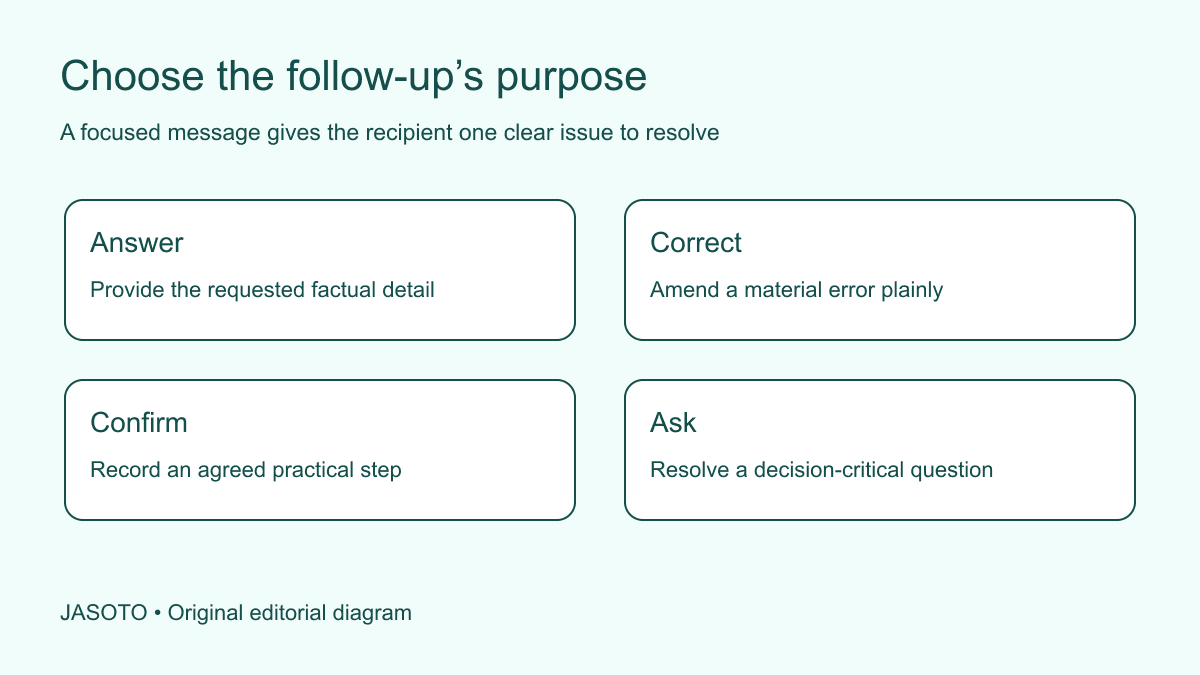
Original JASOTO editorial diagram. Its complete workflow is explained in the article; no actual customer outcome is depicted.
An interview follow-up is most useful when it resolves something specific: an unanswered question, an agreed document request, a factual correction or the next action. Identify that purpose before writing. Give enough context for the recipient to connect the message to the conversation, then provide the relevant answer or a clear request. A short practical message can be easier to act on than a second application hidden inside a thank-you email.
This original guide supports UK applicants following up through an employer's recruitment process. National Careers Service interview guidance discusses follow-up and asking when to expect a response. The decision method and sample messages below help you choose a useful reason to write and keep the content factual. Follow any instructions the employer has given about contact, documents and timing.
The practical answer
- Choose one clear purpose before writing.
- Use the agreed contact and timeline.
- Keep facts and contribution descriptions consistent.
- Send only relevant permitted material.
Identify the unresolved point
Review your notes soon enough to distinguish what was actually agreed from what you wish you had said. Write the outstanding question in one sentence. Perhaps the interviewer requested a permitted example, you promised to confirm availability or a practical location point remains unclear. If the only purpose is expressing thanks, keep the message proportionate and avoid inventing an unresolved issue to justify more contact.
Separate a genuine gap from ordinary post-interview uncertainty. You may feel an answer could have been stronger without needing to replace it by email. Ask whether the new information changes an important fact or fulfills an explicit request. This helps avoid sending a long reconstruction of every answer. The useful follow-up gives the recipient something clear to understand or do, rather than making them determine which part of a lengthy message is supposed to affect the process.
Check the agreed contact and timeline
Use the route given during the interview or the established recruitment conversation. If the employer named a coordinator for documents or questions, send the message there. Do not guess a panel member's private address simply because their name is public. Keep the role reference and appointment date available so the recipient can locate the relevant application.
Review what the employer said about the next update. If a response is expected after a stated point, an earlier status enquiry may add little. If an agreed point has passed, state that context neutrally. The message should ask for the current position without implying that a delay reveals a particular outcome. Recruitment timing can change, and you should record what is known rather than interpret silence as either rejection or a promise that an offer is imminent.
Choose one main purpose for the message
Decide whether you are answering, correcting, confirming or asking. Put that purpose near the beginning. If several items were explicitly requested, present them as a short organized response. Avoid mixing a document delivery, a salary discussion and a request to change interview feedback into one unclear paragraph. Separate issues when they belong to different responsible contacts or processes.
For an invented coordinator applicant, the interviewer asks whether the person can provide an independent writing sample. The follow-up states that the requested sample is available through the agreed route, identifies it clearly and explains that it uses fictional inputs. It does not repeat the whole project story from the interview or claim that the sample produced real customer results. The recipient can find the requested evidence and understand its status without decoding a new narrative.
Answer with the minimum useful context
Quote or summarize the question briefly, then provide the factual answer. Include a date, reference or file label where it helps. If the answer remains incomplete, say what is known and when you can confirm the rest. Do not replace an unknown with an optimistic guess merely because you promised to respond quickly. A clear partial answer can be useful when its limit is explicit.
An illustrative message might say, “Following our discussion about the site visits, I can confirm my availability for the two dates you proposed. The later date remains unconfirmed because I am waiting for an existing commitment to be settled. I can update you by the agreed point.” Use only your actual facts and commitments. Avoid making the follow-up sound more definite than the arrangement you can keep, and update the recruiter if the promised confirmation time changes.
Correct a material fact plainly
If you gave an incorrect date, qualification detail or responsibility description, identify the error and supply the accurate information through the appropriate route. Keep the correction direct. Explain enough to prevent confusion, without turning a simple factual amendment into an elaborate defence. Do not conceal a material discrepancy by quietly changing an online profile and assuming the interviewer will see the update.
Distinguish factual correction from expanding a claim. A candidate may remember an additional task they performed, but that does not necessarily make the original answer false. Consider whether it is useful to the requested assessment and permitted within the process. The goal is an accurate record, not an unlimited opportunity to improve every response after hearing the questions. If a correction affects a submitted document, ask whether the employer needs an updated version and label it clearly.
Handle documents and links carefully
Send only the material requested or appropriately agreed. Use the specified delivery method and a clear filename. Check the recipient's access, the document version and any confidentiality boundary before sending. A portfolio example should not become broadly public simply because a private link failed. If you cannot provide the requested material legitimately, explain that and ask what alternative would be useful.
Keep the covering explanation brief and relevant to the question. Identify your contribution and the status of an independent sample where necessary. Avoid attaching a large folder of unrelated work in the hope that one item will strengthen the application. A specific requested file is easier to review and less likely to obscure the answer. Test the exact attachment or link, rather than relying on a similarly named local version that was checked several days earlier.
Ask an outstanding practical question neutrally
Frame the question around the decision you need. “Could you confirm which site the initial training takes place at?” is actionable. “I am confused about everything you said about locations” leaves the recipient to rebuild the whole conversation. Include the conflicting detail if there is one, and ask which current information should guide your planning.
Avoid loading the question with an unsupported conclusion. A different location mentioned during the interview may be a training venue or a possible future site, rather than evidence that the employer changed the role without explanation. Ask for the specific distinction. If the answer matters before an offer or another appointment, say why it is needed at that point. Keep personal detail proportionate and use the appropriate private route for individual arrangements.
Read the message from the recipient's position
Check whether the role, interview and requested action are obvious. Remove background already available in the thread unless it is needed to identify the issue. Use a subject line that helps the established contact connect the message with the process. A greeting and brief thanks can fit naturally, while the practical purpose should remain easy to find.
Read for factual consistency with your CV, application and interview account. The follow-up should not enlarge your contribution or introduce an unsupported result. Check names, dates, attachments and recipient addresses before sending. If someone helps edit the wording, verify that they have preserved your meaning. A polished phrase can accidentally turn “prepared information for approval” into “approved the plan”, changing the evidence instead of clarifying it.
Record the next step without repeated chasing
After sending, note the date, purpose and any response you requested or promised. If the employer provides an update point, use it to guide any further enquiry. Repeated messages through different channels can make the record less clear and rarely create useful new information. When a deadline passes, follow up through the established route with the specific unresolved item rather than forwarding the same long account again.
Use job opportunities to continue a broader search while waiting for a decision, without interpreting one pending application as a confirmed outcome. If you seek help from business service providers, share only appropriate material and retain responsibility for factual accuracy. Confirm any new interview or site appointment before planning travel. The follow-up record should identify actual commitments so a proposed conversation or suggested date does not quietly become a booking in your calendar.
Close the exchange when the question is resolved
When a useful answer arrives, update your notes and acknowledge it briefly where appropriate. Mark the outstanding item resolved and use the current information for the next step. If the response introduces a new material uncertainty, ask the smallest focused question needed to clarify it. Avoid treating every reply as an opportunity to reopen the whole interview discussion.
If your draft has grown into a second application, return to the original purpose and remove material that does not serve it. If an attachment is unsuitable, replace it with a permitted alternative before sending and update the covering note. This is the practical rollback: one accurate issue, one useful response and one clear next step. A well-chosen follow-up supports the recruitment process by resolving uncertainty, while leaving the employer to assess the application through its established procedure.
Put the guide into practice
- Identify the exact unresolved point.
- Check names, dates and delivery route.
- Review attachments from the recipient view.
- Record the agreed next action.
Frequently asked questions
Should every interview follow-up contain a new work example?
Include new material when it was requested or appropriately agreed and relevant to the process. A follow-up can simply express thanks, confirm availability or resolve a practical question. Do not send a large unsolicited portfolio because you feel every answer needs further evidence after the interview.
What if I realize I gave a wrong fact?
Correct a material error plainly through the established recruitment route. State the accurate information and identify any submitted document that also needs correction. Keep the explanation proportionate and distinguish an actual factual amendment from an attempt to rewrite every answer.
When should I ask about the outcome?
Use the timeline and contact instructions the employer gave. If the stated update point has passed, ask neutrally for the current position through the established route. Avoid interpreting silence as a confirmed outcome or sending the same enquiry to several panel members independently.
Explore JASOTO tools
Discover providers and check support for your specific task.
Explore roles and responsibilities →Consider the practical responsibilities involved when recruiting or joining a team.
Plan work-related travel →Research a journey when joining, training or meeting colleagues in person.
Continue with JASOTO
Compare your next step
Discover UK businesses, compare services and request written quotes before making a decision.