
Jobs & Careers · UK Guide 2026
Interview Invitation Checklist: Arrival Details That Help
JASOTO · Updated 5 November 2026 · 1,518 words
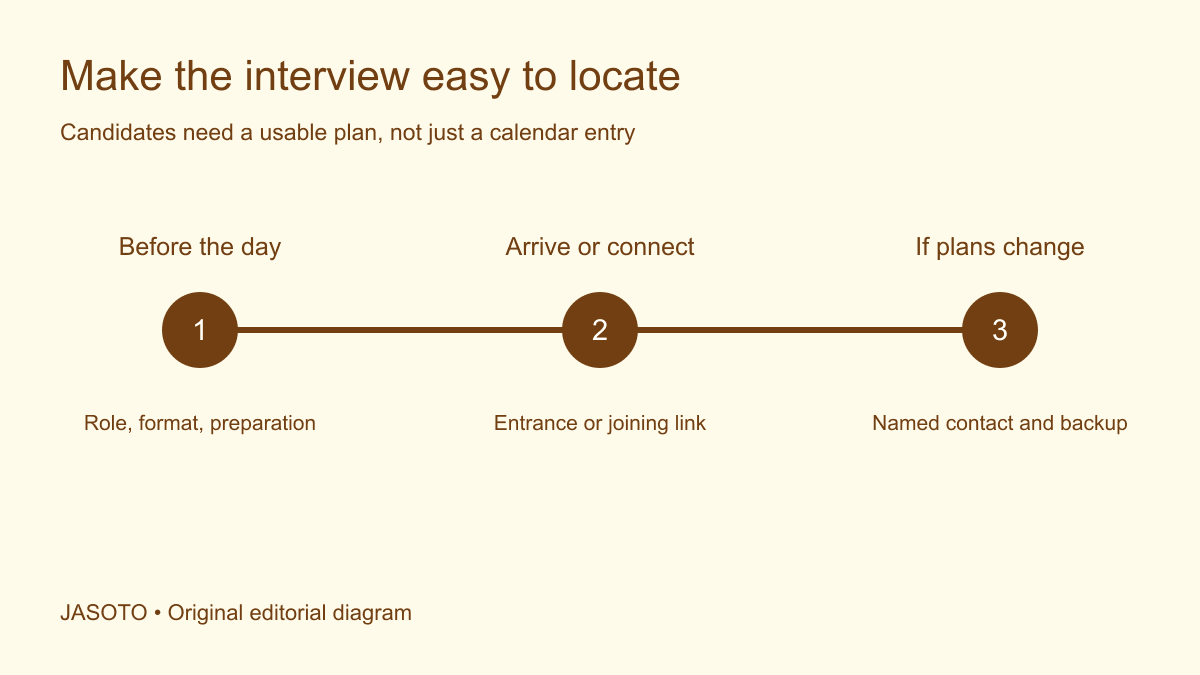
Original JASOTO editorial diagram. Its complete workflow is explained in the article; no actual customer outcome is depicted.
A useful interview invitation tells the candidate which role and stage the meeting concerns, when it happens, what to expect, how to arrive or connect and whom to contact about arrangements. It also gives a clear way to discuss adjustments. Check those details with the people running the interview before sending the message; a polished template cannot compensate for an incorrect location or an unmonitored contact address.
This guide is for UK small employers preparing ordinary interview invitations. The practical message structure is an editorial recommendation. Acas provides the employment guidance referenced below. International teams can reuse the planning method, but should verify the rules and arrangements relevant to their location rather than treating a UK example as universal.
The practical answer
- State the role, interview format, date, time and time zone clearly.
- Describe the actual entrance and contact route, not only the postcode.
- Invite adjustment requests and explain how to discuss them.
- Check the invitation from a candidate's point of view before sending.
Confirm the interview internally first
Check the role title, candidate name, interview stage and names or roles of the interviewers. Confirm the room or remote platform is available for the expected duration, including any setup time. Ask who can respond if the candidate cannot find the entrance or join the call. A contact who is already interviewing another candidate may need a colleague to cover practical questions.
Separate confirmed details from decisions still pending. If a presentation task has not been agreed, do not imply that instructions will arrive later unless someone owns that action. If the venue may change, either resolve it first or tell the candidate clearly what remains provisional. An employer can create avoidable travel costs by presenting a tentative booking as final. The invitation should reflect the real state of the arrangements, not the organiser's hope that the missing pieces will fit.
Put the essential appointment information first
Lead with the role and the purpose of the meeting. Give the date in a readable form, the start time, expected duration and time zone where there could be ambiguity. W3C's date-format guidance explains why numeric dates can confuse international readers. Writing the month in words is a practical way to make a human-readable invitation clearer; do not assume every candidate interprets the same sequence of numbers in the same way.
Keep the subject line informative without including unnecessary personal information. The body and calendar entry should agree. If you update the time, change both and make the revision explicit rather than adding a new date deep in a reply thread. Ask the candidate to confirm through a monitored route and identify what to do if the proposed appointment is unsuitable. A request to confirm should not become a guessing exercise about whether to reply to an automated calendar sender.
Describe the format without making candidates guess
Explain whether the meeting is in person, remote or a combination, and whether it includes a discussion, presentation or practical assessment. State any preparation that has actually been agreed. If there is no presentation requirement, avoid a vague instruction such as “come prepared to showcase your skills” that might lead candidates to spend unnecessary time producing work nobody intends to review.
Where a task is involved, provide the same relevant instructions through the employer's agreed process. This article does not define what makes a lawful work trial; consult current guidance for that question. An invitation should explain what the candidate will encounter, what materials are needed and how they can ask for clarification. If a supporting document changes, label the updated version and explain which instruction it replaces. Do not let different candidates prepare against accidentally different briefs.
Give an arrival route that works on the ground
For an in-person interview, include the full address, the appropriate entrance and whom to ask for. A business park may contain several units with similar names. A building may have separate public and staff entrances. Ask someone familiar with the site to check the route from the point where a visitor actually arrives, rather than relying solely on a map pin.
State any relevant reception process and confirm arrangements for early arrival. Avoid requesting that candidates wait in a space the business has not authorised them to use. If parking, transport or step-free routes matter, give confirmed information or direct candidates to the appropriate contact; do not guess. JASOTO travel can help people research a journey, but the employer remains responsible for communicating the correct interview destination. Travel-provider availability and fares need checking separately from the invitation.
Make the remote joining route understandable
For an online interview, provide the joining method and explain any account, software or browser requirement that the employer has verified. A link without context may leave a candidate unsure whether they need to install something or whether an unfamiliar waiting screen is expected. Use the organisation's approved platform and avoid exposing links to other candidates through a shared message.
Acas advises employers to consider reliable communication and a backup for connectivity problems. State how the candidate can contact the organiser if joining fails and who will monitor that channel at the interview time. Agree internally what happens next: a delayed start, another supported method or a rearrangement. The fallback should be something the team can actually provide. Do not promise a telephone alternative if no interviewer will have a suitable contact route or the assessment cannot sensibly use it.
Invite a practical conversation about adjustments
Acas says employers must ask interviewees whether they need reasonable adjustments to attend. Give a clear contact for that conversation and allow it to happen before the appointment. An invitation should help a candidate raise a need without having to guess whether the request will reach someone able to act. Use the employer's appropriate confidential process rather than asking them to reply to a broad group.
Record the agreed arrangement with the people who need to implement it. Confirm practical details with the candidate when appropriate instead of assuming that forwarding their message completes the task. Avoid requesting unnecessary personal or medical information in the invitation. The objective is participation in the interview, not creating a general record about the person. If the organisation is unsure how to handle a request, seek suitable advice promptly and keep the candidate informed through the named contact.
Keep the invitation separate from internal assessment notes
Check recipients, attachments and calendar visibility before sending. A copied invitation should not expose other candidates' names or internal comments about assessment. Use an approved template without carrying over the previous person's details. If colleagues collaborate on the draft, move internal discussion out of the final message and inspect the actual attachments, not only their filenames.
Keep a version or record of what was sent so the interview team can answer questions consistently. When arrangements change, notify the candidate through the agreed route and update the relevant internal record. Acas also addresses confidentiality and data protection for interview notes; an invitation is only one part of the wider recruitment information process. This guide does not specify retention periods because those need to follow the organisation's applicable policy and obligations, rather than a generic number copied from a blog.
Worked example: the entrance that a postcode misses
Imagine a small employer interviewing for an office coordinator. The site has a warehouse entrance on one road and visitor reception on another. The first draft contains only the postcode, which points towards the warehouse. The organiser walks through the visitor route with reception and adds the correct entrance description, the name to ask for and a monitored contact for arrival difficulties. This is an invented example, not a reported hiring outcome.
The organiser also confirms the room, duration and practical format with the panel. The invitation asks the candidate to reply about availability and explains how to discuss adjustments. If the employer uses external interview space, JASOTO businesses can help identify potential venues or support providers, but the booking must be checked directly. The useful improvement is specific: a candidate can locate and prepare for the intended interview without reconstructing the employer's internal arrangements.
Read the message as a candidate before sending
Ask a colleague unfamiliar with the arrangements to answer five questions from the invitation: where and when is it, what happens, what preparation is needed, how do I confirm, and whom do I contact? If they need additional knowledge to answer, revise the message. Test the joining link and confirm that any attachment opens using the intended method. These checks target the candidate's actual task rather than the appearance of the template.
Give the reception or hosting colleague the final appointment details too. A candidate should not arrive with accurate instructions that nobody on site recognises.
Save a clean reusable structure while reviewing all appointment details each time. JASOTO jobs can support role discovery and candidate research, but a specific invitation must remain accurate to the employer's own interview. Track recurring questions after sending: repeated confusion about an entrance or task is evidence that the template needs improvement. The aim is a fair opportunity to arrive and participate, with fewer avoidable administrative obstacles before the conversation begins.
Put the guide into practice
- Confirm the role, stage, date and expected duration.
- Explain the venue entrance or remote joining method.
- Name a contact for arrangements and last-minute problems.
- Keep candidate information out of group invitations.
Frequently asked questions
Should the invitation include a full street address?
For an in-person interview, give the correct address and useful entrance instructions. A postcode alone may point to a site with several buildings. Confirm the specific room or reception arrangement internally before sending.
What if a candidate needs an adjustment?
Provide a clear contact and invite the candidate to discuss what they need to participate. Follow current Acas guidance and your organisation's arrangements. Do not assume a generic statement that the building is accessible resolves every request.
Can the same template be used internationally?
The information structure is reusable. Adapt local employment guidance, date formats, time zones, travel information and terminology. Do not copy UK legal wording into another jurisdiction without checking it.
Explore JASOTO tools
Continue with JASOTO
Compare your next step
Discover UK businesses, compare services and request written quotes before making a decision.