
Jobs & Careers · UK Guide 2026
Prepare for an Interview With a Practical Demonstration
JASOTO · Updated 5 November 2026 · 1,641 words
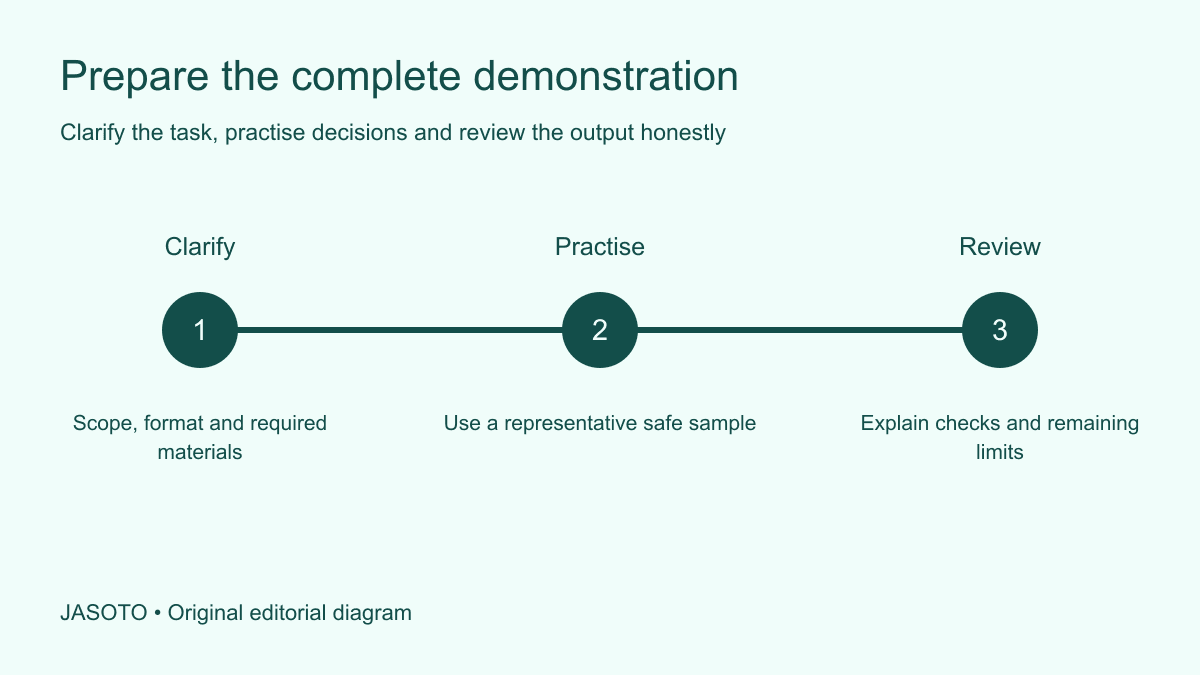
Original JASOTO editorial diagram. Its complete workflow is explained in the article; no actual customer outcome is depicted.
Prepare for a practical interview demonstration by confirming what you must do, what materials will be supplied and how the employer will observe the work. Practise a representative task while explaining your decisions, and prepare questions for missing information. Do not assume the demonstration is a performance of a memorized routine or that speed is the only quality being assessed.
This original guide is for UK applicants asked to demonstrate a relevant skill. Acas recruitment guidance discusses interviews and work trials; the actual arrangements depend on the task and employer. Follow the provided instructions and seek appropriate clarification about safety, access, assessment conditions or an extended work request. The preparation method below helps you approach a bounded demonstration without giving legal advice about a particular trial or instructing you to operate unfamiliar equipment unsafely.
The practical answer
- Confirm the actual demonstration instructions.
- Practise a complete representative task.
- Explain decisions without hiding uncertainty.
- Know when permission or support is needed.
Confirm the demonstration's scope
Read the invitation for the task, expected duration, location and required output. Ask whether the demonstration is live, prepared in advance or a combination. Confirm which tools, materials and reference information are available. “Show how you would organize an order” could involve talking through a scenario, using a sample system or completing a physical task. Those formats need different preparation.
Write down what remains unclear and send a concise clarification through the recruitment contact. Ask questions that materially affect readiness, rather than requesting the answer to the exercise. You might confirm file format or whether internet access is allowed. Do not assume that a tool you regularly use will be available. If the employer has given specific conditions, treat them as the starting point and avoid preparing an alternative format that bypasses the requested skill.
Identify the capability behind the task
Link the demonstration to the role description. The employer may be observing accuracy, prioritization, communication, technique or decision-making. You may not know its full assessment method, so avoid inventing a hidden scoring system. Focus on performing the relevant work thoughtfully and following the instructions. A candidate can prepare useful habits without trying to guess every preference of an unfamiliar assessor.
For an invented administration exercise, the task is to prepare a handover from several messages. The visible output is a short note, but relevant capabilities may include separating confirmed facts from outstanding questions and identifying who needs to act. Practise those decisions rather than merely learning a decorative document layout. If the task description genuinely does not explain the intended output, ask for clarification before building your preparation around an unsupported interpretation.
Rehearse a comparable task with sample material
Create or use appropriate practice inputs that exercise the relevant skill without reproducing confidential work. Keep the example distinct from the employer's actual task. An administrator could practise summarizing fictional requests; a designer could explain choices in an independent layout; a technician should use only suitable equipment and activities within their competence. Practice should not create a hazard in the name of being realistic.
Run the task from instruction to final check, rather than practising only the part you enjoy. Notice where you need information, what you check before acting and how you recognize completion. Do not invent an idealized task where every input is complete if the role commonly involves uncertainty. Include a clearly labelled missing fact and rehearse asking for it or recording the limitation. This prepares judgement without teaching a script for pretending uncertainty does not exist.
Explain decisions at useful moments
Prepare to state your plan briefly before starting: what you understand the task to require and which step comes first. During the demonstration, explain important decisions where appropriate, without narrating every movement. Ask the interviewer how they prefer questions or commentary to be handled if the format does not make that clear. Some activities need concentration, and constant narration may be unsuitable.
Use plain reasoning tied to the task. “I am checking the address against the supplied record before copying it” is more useful than announcing a general commitment to excellence. If you change approach, explain the information that prompted the change. Avoid performing certainty when the sample contains an ambiguity. A responsible question or clearly recorded assumption can be more appropriate than a quick action based on a guess, depending on the task and the employer's instructions.
Prepare equipment and files without relying on them
If you must bring a device, presentation or other material, test the exact item and required format beforehand. Check that the file opens through the intended route and that any permitted offline version is available. Confirm what the venue supplies before buying or carrying additional equipment. A successful home test does not establish that an unfamiliar site has the same connections, access or software.
Keep the materials focused and appropriate to share. Close unrelated applications and inspect sample files for private content, comments and hidden information. Do not use a live employer or customer account as a convenient demonstration environment without explicit authorization. If something fails on the day, explain the issue and ask for the approved fallback. Avoid changing security settings, downloading unfamiliar software or improvising repairs merely to preserve the appearance that the task is proceeding smoothly.
Know when to stop and ask
Identify the points where you would need permission, specialist knowledge or a safety instruction. Practise saying that clearly. A demonstration invitation does not give blanket authority to alter live records, handle unsuitable materials or use equipment you do not understand. If the instructions conflict with what you know about the task, raise the concern respectfully and ask the responsible person to clarify the arrangement.
For a fictional stock-handling scenario, the candidate may be asked how they would move an awkward item. They can explain the information and assistance needed rather than attempting an unsafe lift to seem willing. This is an illustration of a decision boundary, not a manual-handling technique. The actual work should follow the employer's appropriate arrangements and competent advice. A useful demonstration shows your approach to the role within the limits of what you are authorized and prepared to do.
Use time to make the output inspectable
Practise allocating time to understanding, execution and review. The proportions will depend on the task, so do not assume a universal formula. Make the result easy for the interviewer to inspect: label a draft, identify an outstanding question and explain what remains unfinished. If time ends before completion, a truthful status helps the assessor understand what you did and what would come next.
Avoid sacrificing essential checks to create a polished-looking finish. In the handover example, an attractive note with a guessed delivery date is less reliable than a clear note that distinguishes an unconfirmed date. Do not infer that the employer wants perfection at any cost. Follow the task and show the process you can support. If a choice involves a tradeoff, explain it in the context of the available information rather than offering an elaborate justification after the fact.
Prepare for feedback and follow-up questions
Expect questions about your approach, an alternative or a limitation. Answer from what you actually did. If you notice an error, identify it and explain the correction rather than hoping the assessor missed it. A practical exercise can provide useful discussion even when the result is incomplete. Avoid converting every mistake into a claim that you deliberately designed a test; that changes the evidence instead of reflecting on it.
Practise a short review: what worked, what needs correction and what you would check before using the output in real work. Keep the reflection specific. “I would verify the missing approval before sending this” is actionable. A generic promise to communicate more clearly adds little when the actual issue was an uncertain source. If the interviewer offers feedback, listen and clarify the relevant point without assuming the discussion reveals the final recruitment decision.
Check practical arrangements around the demonstration
Confirm the arrival instructions, contact and any legitimate preparation requirement. If you need an adjustment or another arrangement to participate, use the appropriate recruitment route early enough for discussion. Do not assume that a venue change or new task format carries forward everything previously agreed. Keep the confirmed information together so you can identify what changed and what needs clarification.
Research travel options only after the actual location and arrival time are established. If you need printing, equipment support or another service found through business listings, confirm suitability and timing directly. Use job opportunities to understand comparable responsibilities, while treating this employer's instructions as the source for this exercise. Preparation should reduce practical uncertainty without turning a short demonstration into an expensive speculative project that the employer did not request.
Review the exercise before preparing the next one
Afterwards, note the task format, questions asked and the preparation that proved useful. Keep the employer's materials only where permitted, and do not publish confidential assessment content as a portfolio piece. Separate your own learning notes from information you are not authorized to retain or share. One interview exercise should not become a source of undisclosed material circulated to future applicants.
If the preparation was too narrow, return to representative tasks rather than memorizing a supposedly perfect answer. If the equipment plan was fragile, restore a simpler tested format for the next permitted demonstration. The rollback is to remove unsupported assumptions, clarify the task and practise the complete process again. A practical interview is easier to approach when you know the intended output, can explain your decisions and have a clear boundary around what requires help or permission.
Put the guide into practice
- Check supplied and required materials.
- Test appropriate files and equipment.
- Practise a clear stopping and help route.
- Prepare an honest output review.
Frequently asked questions
Should I ask questions during a practical task?
Clarify how the interviewer wants questions handled, then ask when missing information affects the task. Distinguish a request for an essential fact from asking the assessor to make every decision for you. If you must proceed with an assumption, label it and explain its limit.
What if I cannot finish in the allotted time?
Follow the instructions, show what you completed and give an accurate account of what remains. Identify necessary checks or decisions before the output could be used. Do not hide missing work or fabricate a completed result simply to make the demonstration appear finished.
Should I attempt equipment I have not used before?
Explain your actual experience and ask about the instructions, supervision and authorization required. Do not improvise unsafe operation to look confident. The appropriate response depends on the equipment and workplace arrangements; preparation should include knowing when a task needs competent support.
Explore JASOTO tools
Discover providers and check support for your specific task.
Explore roles and responsibilities →Consider the practical responsibilities involved when recruiting or joining a team.
Plan work-related travel →Research a journey when joining, training or meeting colleagues in person.
Continue with JASOTO
Compare your next step
Discover UK businesses, compare services and request written quotes before making a decision.