
Jobs & Careers · UK Guide 2026
Interview Venue Changed? Rebuild Your Travel Plan
JASOTO · Updated 5 November 2026 · 1,663 words
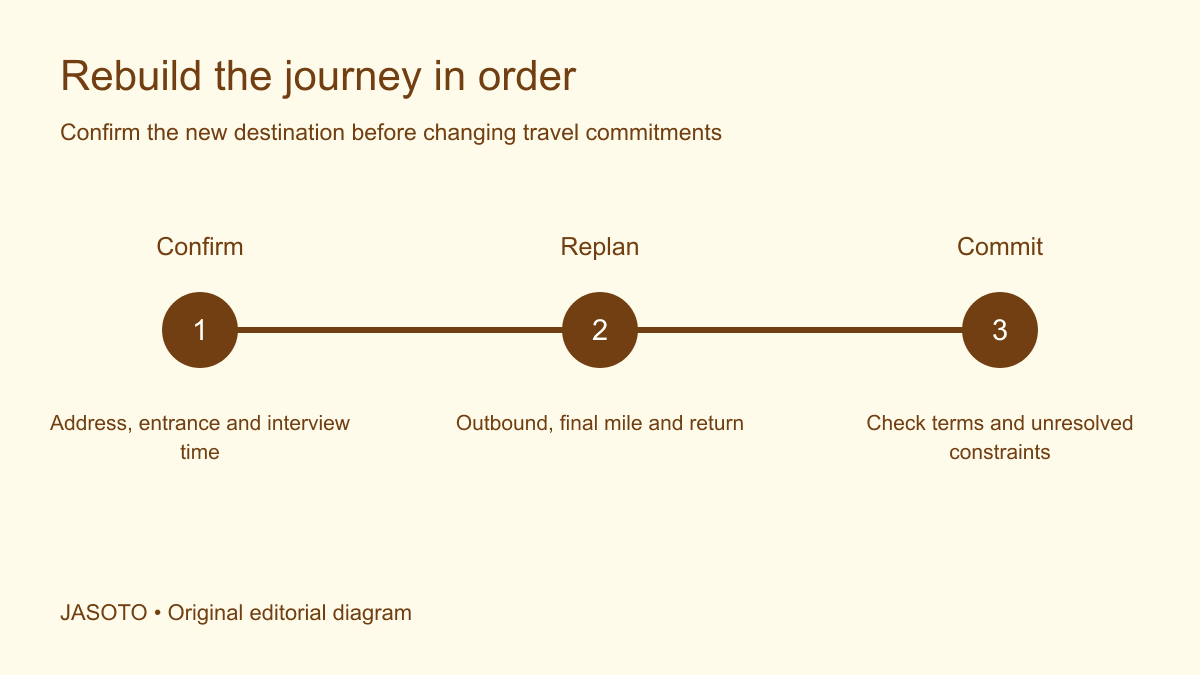
Original JASOTO editorial diagram. Its complete workflow is explained in the article; no actual customer outcome is depicted.
When an interview venue changes, confirm the full new address, entrance and arrival time before changing your travel booking. Rebuild the journey from your starting point to the actual interview reception, then check the return. An interview at the same employer's other office can require a different station, a longer final walk or an earlier service than the original plan.
This original guide is for a candidate travelling within the UK. National Rail's journey planner supports checking rail options for a chosen route and time; current services, ticket restrictions and local transport should be checked with the relevant operators. The decision method below is practical planning advice, not a promise that a connection, taxi or ticket change will be available. The employer should confirm interview arrangements directly.
The practical answer
- Confirm the full revised interview instruction.
- Replan every stage, including the return.
- Check ticket terms before changing bookings.
- Raise an unworkable arrival promptly.
Establish one confirmed new instruction
Reply through the established recruitment contact and ask for the new venue in writing if it is unclear. Request the building name, full address, relevant postcode, entrance and person to ask for. Confirm whether the date and interview time remain unchanged. A short message saying “we are meeting at the other office” is insufficient when an employer has several nearby buildings or uses a separate customer entrance.
Keep the newest confirmed instruction in one place and label the older address as superseded. Check calendar entries, saved maps and any printed notes you intend to carry. You do not need to delete the history of the conversation, but the active journey plan should present only one destination. If the new email conflicts with a calendar location, ask which is correct rather than choosing the version that produces the easier journey.
Identify what changes in the whole journey
Compare the original and revised trip stage by stage: departure point, main transport, interchange, final local leg and entrance. Note where the original plan no longer applies. A new postcode might be served by the same station but require a different exit, while a nearby-looking business park might need a bus or a booked transfer. Map distance alone does not establish a practical arrival route.
Write a fresh arrival target that allows time to reach the reception and follow the employer's instructions. Do not confuse the scheduled train arrival with being ready for the interview. If the employer asks you to arrive at a security desk before the start, include that step. Use an appropriate planning allowance based on the route and your circumstances rather than assuming every candidate needs the same fixed number of extra minutes.
Recheck the outbound service for the actual date
Use current operator information for the revised journey. For rail travel, enter the relevant stations and intended time in the official planner, then inspect the proposed connections rather than copying a headline duration. Check whether the journey involves a different terminal, interchange or local transfer. If the venue change moves you onto another route, assumptions from the original trip may no longer be useful.
Look for date-specific notices from the operator before relying on the plan. A service seen in a general map may not run in the same way on the interview day. Record the options you have checked and when you checked them, without treating that record as a guarantee against disruption. If the timetable does not support the required arrival, contact the recruiter promptly with a specific explanation instead of quietly building a journey that cannot reach the new venue on time.
Investigate the final mile and entrance
Check how you will travel from the arrival station or stop to the building. Identify the actual pedestrian route, accessible entrance where relevant, road crossings and any site access instruction. Ask the employer about uncertainty that maps cannot resolve. An industrial estate's main postal address may lead to a service gate rather than the reception used for interviews, and the correct entrance can be on another road.
If you need an access arrangement, raise it through the appropriate recruitment contact rather than assuming the new venue provides the same facilities as the old one. Describe the practical requirement you need confirmed. Do not rely solely on an image or a general statement that a building is accessible. The candidate needs a usable route for the particular visit, including arrival, entry and the place where the interview will happen.
Check existing tickets before buying replacements
Find the booking confirmation and identify what you already hold. Check the actual ticket's conditions and ask the retailer or operator what options apply to a route or timing change. Do not assume a venue change creates a right to a refund, or that every ticket allows the same alteration. The employer's decision to move a meeting and the transport provider's terms are separate matters.
Keep the cost discussion factual if you need to ask the recruiter about expenses or an alternative appointment. Explain what was booked, what the change requires and what you need them to confirm. Avoid buying a costly replacement on the assumption that reimbursement is automatic. If a decision deadline is approaching, state it clearly and ask for a response. Retain the relevant confirmations so you can follow the agreed arrangement without reconstructing details from memory.
Build a return plan before committing
Review the expected interview duration and ask whether additional activities are planned. A changed venue can affect the return even if the outbound journey remains straightforward. Identify the latest practical departure and what happens if the meeting ends later. Check the actual local leg back to the station rather than assuming it operates at the same frequency throughout the day.
Avoid a return plan that requires leaving the interview without enough notice to reach transport. Where the end time is uncertain, discuss the relevant constraint with the recruiter and check suitable ticket conditions directly. A flexible-looking plan may still have a limited final service. The point is to understand the decision before booking, not to predict exactly how long the employer will speak with you. Keep the contact details needed if timing changes on the day.
Decide when to ask for a different arrangement
If the new trip is not workable, explain the specific issue and propose a realistic next option. You might ask whether the time can move, whether the original site remains possible or whether a remote conversation is suitable. The employer decides what it can offer. Frame the request around the confirmed practical constraint rather than demanding that a particular alternative must be available.
For an invented candidate travelling to a regional office, the replacement venue requires a local bus that starts after the proposed arrival. The candidate sends the recruiter the relevant constraint and asks whether a later slot is possible before purchasing new tickets. This is clearer than saying only “travel is difficult”. It gives the contact a concrete question to resolve while avoiding a promise that the candidate can attend a timetable that does not work.
Carry an offline arrival pack
Save the confirmed address, entrance description, interview time, recruiter contact and key travel references in a form you can access without a live connection. Keep sensitive booking details private. If you print a page, make sure it uses the revised venue. A downloaded map can be helpful, but it should sit alongside a written destination and contact route in case the map does not make the entrance clear.
Include a simple message you could send if delayed: your name, interview reference or role, current position and realistic next update. Do not write a precise arrival promise before you know the revised route. The purpose is to let the employer make an informed decision. A concise, factual update is more useful than a long apology that leaves the recruiter unsure whether you are still coming or need an alternative arrangement.
Recheck at useful checkpoints
Check the current plan before the day, before departure and when a change materially affects the next leg. Use the operator's current information rather than relying on an old screenshot as though it were a live timetable. Keep the recruitment contact informed when the required arrival becomes uncertain. Do not repeatedly alter bookings in response to every speculative disruption message without checking what applies to your actual trip.
If you use JASOTO travel to explore journey options, confirm timings and conditions directly with the relevant provider before booking. For a local transfer or other service found through JASOTO businesses, check the pickup point and availability explicitly. These discovery routes help with research, while the operator and employer remain the sources for the actual travel service and interview instruction. A directory entry should not be treated as confirmation of a reservation.
Learn from the change without overcomplicating the next trip
After the interview, keep any records needed for the agreed expense or booking process and remove obsolete active reminders. Note the one or two planning details that mattered, such as the correct gate or an unexpectedly long interchange. Avoid turning one changed venue into a universal rule that every interview requires an overnight stay or a particular transport mode. Future journeys should be assessed on their actual circumstances.
When comparing further job opportunities, record location uncertainty early and ask practical questions through the recruitment process. A venue change is manageable when the new instruction is confirmed, the whole journey is checked and unworkable constraints are raised in time. If the revised plan fails, return to the last confirmed destination and contact the recruiter before committing to another assumption. The aim is a feasible arrival with clear communication, rather than a complicated itinerary built around an address nobody has verified.
Put the guide into practice
- Replace old calendar and map details.
- Check current dated transport options.
- Save an offline arrival contact pack.
- Confirm costs before assuming reimbursement.
Frequently asked questions
Should I keep my original travel booking?
Check the revised destination, timing and actual ticket conditions before deciding. Ask the retailer or operator what change or refund options apply to your booking. Do not assume the employer’s venue change alters the transport provider’s terms or automatically authorises buying a replacement at the employer’s expense.
What if the new venue makes the interview impossible to reach?
Contact the recruiter promptly with the specific route or timing constraint. Ask whether another time, location or format is available before making further commitments. Explain what you have checked and what decision you need; avoid promising attendance until a workable arrangement is confirmed.
Is the postcode enough for the new venue?
Treat it as one part of the destination. Ask for the building, entrance and arrival contact, especially on a campus, industrial estate or multi-building site. Check the final route from your transport stop to the correct reception rather than relying only on a map pin.
Explore JASOTO tools
Discover providers and check support for your specific task.
Explore roles and responsibilities →Consider the practical responsibilities involved when recruiting or joining a team.
Plan work-related travel →Research a journey when joining, training or meeting colleagues in person.
Continue with JASOTO
Compare your next step
Discover UK businesses, compare services and request written quotes before making a decision.