
Jobs & Careers · UK Guide 2026
Plan a Job Search Around Shift Availability
JASOTO · Updated 5 November 2026 · 1,646 words
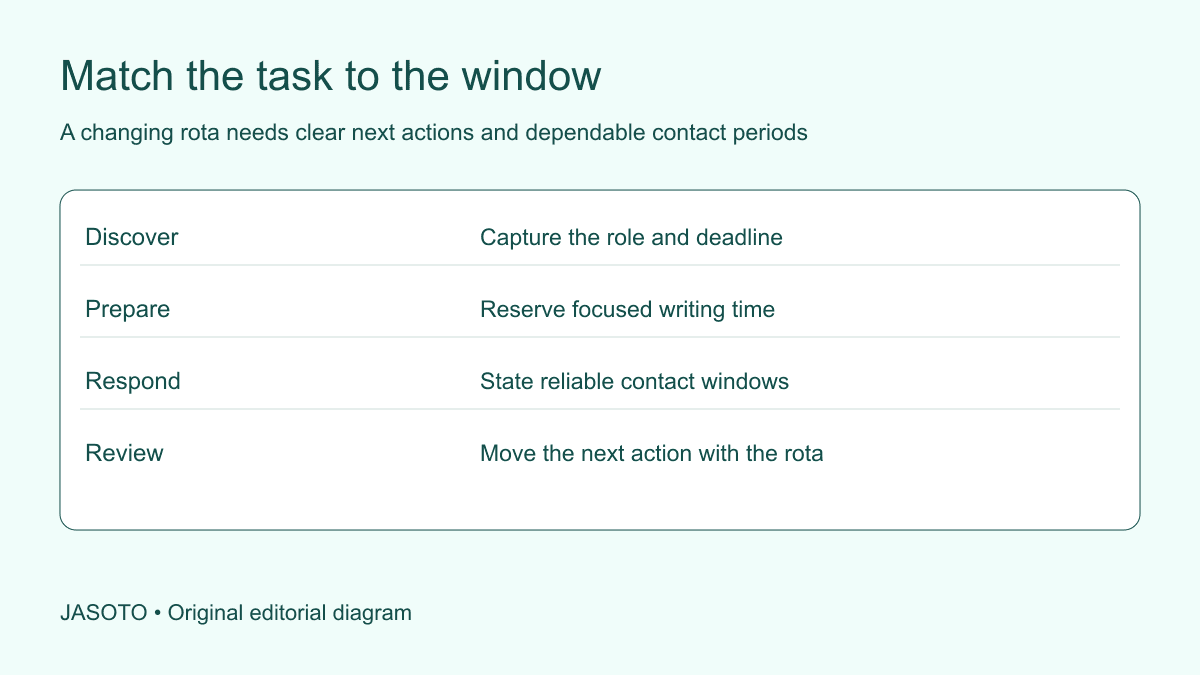
Original JASOTO editorial diagram. Its complete workflow is explained in the article; no actual customer outcome is depicted.
Plan a job search around shift work by separating the time you can research roles, the time you can prepare applications and the windows when a recruiter can reach you. Put the next useful action beside each application and schedule it against your actual rota. A long list of vacancies is difficult to use when every task depends on finding an uninterrupted evening that rarely arrives.
This guide offers an original planning method for UK applicants working early, late, overnight or changing shifts. National Careers Service guidance describes job alerts and several ways to find vacancies. The timetable, contact-window wording and examples below help turn that discovery into manageable work. Use your own circumstances and existing responsibilities to decide what is realistic, and confirm recruitment deadlines directly with the employer.
The practical answer
- Map actual time around shifts and rest.
- Separate discovery from application work.
- Keep a specific next action for each role.
- State reliable dated contact windows.
Map the week you actually have
Start with the current rota and the commitments that genuinely affect your available time. Include travel, necessary rest and other responsibilities without treating every blank calendar square as a job-search opportunity. If the rota is uncertain, mark provisional periods clearly. The plan should distinguish time you control from time that may disappear when a shift changes.
Choose a small number of dependable windows for the most demanding tasks. Writing a tailored answer may need a different setting from saving a vacancy link or checking a deadline. An invented hospital support worker might review alerts during a planned quiet period at home and reserve a longer non-working window for an application. The example is about matching task effort to available time; it does not assume breaks at work are available for personal activity or that everyone has the same recovery pattern after a shift.
Separate discovery from application work
Use a simple capture list for potentially relevant roles. Record the employer, title, official posting, deadline and one reason it may fit. This lets you save a useful opportunity without trying to complete the entire application immediately. Check the actual employer instructions before moving it to the active list, especially when a brief advert leaves the schedule or location unclear.
Give discovery a stopping point. Continually browsing new roles can consume the limited window intended for a nearly complete application. Review the captured list at an agreed point and choose which roles deserve further work. If an opportunity is unsuitable after a quick check, close it with a short reason. A clear decision reduces the chance that the same advert returns to your attention repeatedly because you forgot why you did not proceed.
Build a next-action queue
For each active role, write the next specific action rather than “apply”. Useful actions include checking a location, choosing one work example, drafting an answer, reviewing the form or submitting the checked version. Estimate the effort in practical terms such as a short check or a focused writing session. You do not need an elaborate scoring system to see which task fits today's available window.
Keep dependencies visible. A form cannot be completed accurately if you still need a required qualification date, and an interview cannot be confirmed if the proposed time conflicts with a shift you cannot change. Assign yourself the information request as the next action instead of leaving the entire application in a vague unfinished state. This makes progress possible in small steps while preserving a reliable view of what still prevents completion.
Use alerts as a collection tool
Where a suitable service offers alerts, set relevant role and location criteria and review whether the messages are useful. National Careers Service notes that job boards may allow personalized vacancy alerts. Check the service's actual settings and adjust filters when they repeatedly produce unsuitable work. An alert is a discovery prompt; it does not establish that a vacancy remains open or that a short summary contains the full application conditions.
Keep alert review separate from immediate submission. Save a promising posting, verify its current employer version and add the deadline to your queue. Avoid creating many overlapping alerts that bury the few useful messages. If the setup becomes noisy, reduce it to the criteria that change your decision. This is a practical rollback: preserve the roles already captured and simplify the incoming stream instead of abandoning an otherwise workable search because every notification feels urgent.
State contact windows clearly
Prepare a concise availability message for recruiters: the periods when you can take a call, your preferred contact route and when you will next check messages. Use actual dates for a changing rota. “Usually available after work” can be ambiguous when your working day ends at different times. A specific window lets the other person offer a feasible appointment without needing private detail about every shift.
For an invented rotating-shift applicant, the note might say, “This week I can take a scheduled call on Tuesday between the stated hours or Thursday morning. Email is the most reliable route to arrange another time.” Replace the example with your own real availability and include a time zone where relevant. Do not promise to answer during work or rest periods simply to appear responsive. A reliable commitment you can keep is more useful than broad availability that leads to repeated missed calls.
Protect interview preparation time
When an interview is offered, work backwards from the confirmed appointment and identify the preparation it requires. Include understanding the role, selecting examples, checking the format and arranging the journey or technical setup. Keep those activities distinct from the interview itself. A calendar slot that fits between shifts may leave no realistic opportunity to prepare or arrive, so assess the complete requirement before accepting it.
If a proposed time is unworkable, respond promptly with alternatives you can genuinely attend. Explain the practical conflict briefly without assuming the employer will know your rota. Ask what flexibility exists and wait for confirmation before treating a new suggestion as booked. When arrangements change, update the application record and remove obsolete reminders. One maintained appointment should guide your planning rather than several messages containing possible times.
Keep reusable facts ready without generic answers
Maintain accurate dates, qualifications, role details and permitted work examples in a private reference file. This reduces repeated administrative searching during short application windows. Check the facts before reusing them and keep sensitive documents through appropriate storage arrangements. A reference file should help you answer accurately, without becoming a public folder of personal information.
Write the role-specific parts from the actual question and requirements. The same factual example can demonstrate different capabilities, but its ownership and outcome should stay consistent. Use your limited focused time to explain the relevant connection. Avoid copying a whole answer because the role title looks similar. Saving time on repeated facts can create room for a more useful response, rather than a larger volume of applications whose answers do not address the advertised work.
Plan message checks around deadlines
Choose reliable times to check recruitment messages and record any response deadline. Where a recruiter expects a faster reply than your schedule supports, explain the available route or ask about the requirement. Do not assume every message needs an instant answer, but do not leave a stated deadline buried beneath alerts. Separate appointment changes and employer questions from general vacancy notifications.
Use a short response when you need time to review a request: acknowledge the message and give a realistic point when you can confirm. Only make that commitment if you can keep it. If a shift change affects an agreed interview, contact the recruiter as soon as you know and propose an appropriate next step. Keep factual communication focused on the recruitment action, rather than providing a running account of every disruption in your current workplace.
Review progress through completed actions
At the end of a suitable working cycle, review which actions moved applications forward. Identify the task that repeatedly stalled and ask why. Perhaps the available window is too short, the role requirements are unclear or a document is missing. Change that part of the plan. Counting browser tabs or time spent worrying about applications is unlikely to show what needs fixing.
Use job opportunities as one discovery route while keeping your own next-action record. If you seek CV or technical support through business providers, confirm the scope and appointment before using a limited free window. Once an interview venue is confirmed, research travel for the actual arrival and return times. The search plan should connect discovery, preparation and attendance, rather than treat each as a separate problem that appears only when the previous step is finished.
Make the plan sustainable when the rota changes
Keep essential deadlines fixed in view and move flexible work blocks when the rota changes. Reduce the active list if you cannot give each application the attention it needs. A smaller queue with clear decisions can be more manageable than several half-finished forms competing for the same evening. Choose based on relevance and feasibility, without treating a missed self-imposed target as evidence that the entire search has failed.
When the plan becomes too complicated, return to three items: the next deadline, the next useful action and the next dependable window. Preserve completed work and remove speculative calendar blocks that no longer fit. The result should be a search you can resume after a shift without reconstructing everything from memory. Useful organization makes your availability explicit and your next step small enough to carry out, while leaving room for the rest and responsibilities that make the week workable.
Put the guide into practice
- Record current deadlines and rota limits.
- Choose focused application windows.
- Prepare accurate reusable facts.
- Review the active queue after schedule changes.
Frequently asked questions
Should I tell recruiters my whole rota?
Provide the contact or interview windows they need, using dates when your schedule changes. You can explain a conflict briefly without sharing every shift or personal commitment. State a reliable contact route and update a confirmed arrangement promptly if your availability changes.
What if a deadline falls during a busy run of shifts?
Identify the remaining actions early and decide whether you can complete a checked application before the deadline. Ask a necessary clarification promptly. If the time is genuinely insufficient, make a deliberate decision rather than submitting inaccurate material or assuming the employer will accept a late form.
How many applications should I keep active?
Choose a number you can research, tailor and track within your actual available time. There is no useful universal target. Review the queue when your rota changes, retaining the strongest feasible opportunities and recording a clear next action for each.
Explore JASOTO tools
Discover providers and check support for your specific task.
Explore roles and responsibilities →Consider the practical responsibilities involved when recruiting or joining a team.
Plan work-related travel →Research a journey when joining, training or meeting colleagues in person.
Continue with JASOTO
Compare your next step
Discover UK businesses, compare services and request written quotes before making a decision.