
Jobs & Careers · UK Guide 2026
Plan a Job Shadowing Day Around Real Work
JASOTO · Updated 5 November 2026 · 1,677 words
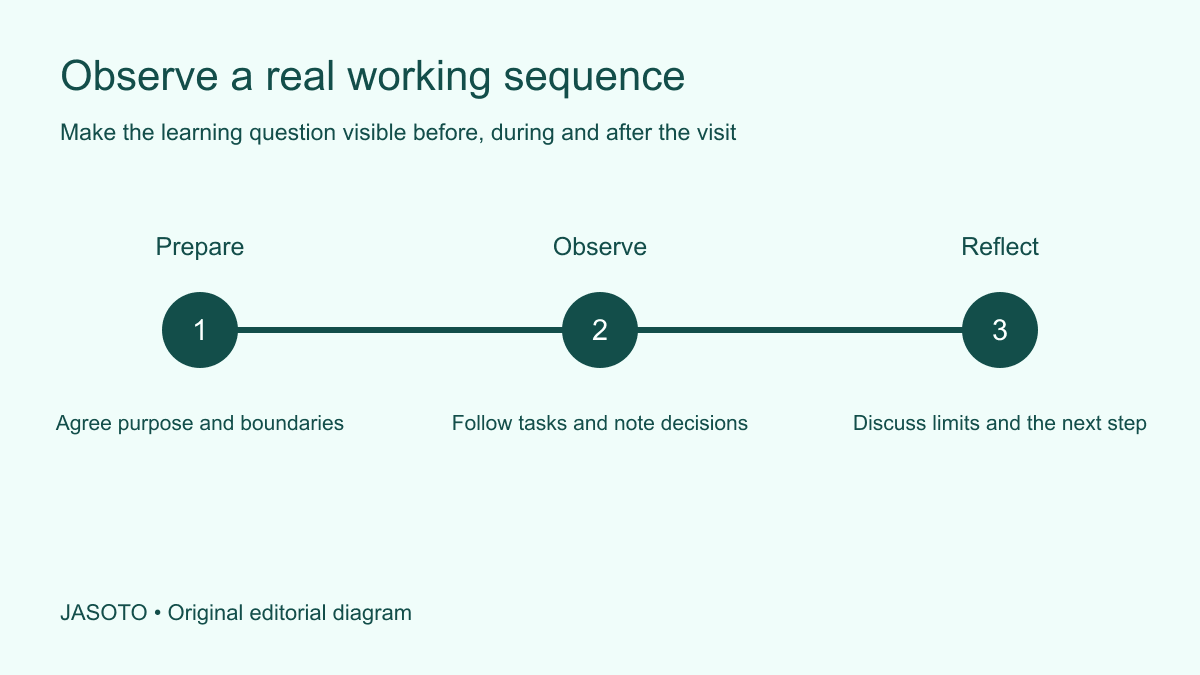
Original JASOTO editorial diagram. Its complete workflow is explained in the article; no actual customer outcome is depicted.
Plan a job shadowing day around a small number of representative activities, with a host who can explain the decisions behind them. Agree what the visitor may observe, what must remain private and when questions can be asked. The aim is a clearer understanding of the role, rather than a carefully staged day that suggests every task is easy or every working hour is exciting.
The National Careers Service describes work shadowing as watching someone do a job to understand the role, distinguishing it from hands-on experience. This guide offers an original planning method for a UK small business welcoming a colleague, career changer or visitor. The host organisation remains responsible for the arrangements appropriate to its workplace. Observing a task should not be treated as authorisation or training to perform it independently.
The practical answer
- Start with a specific learning question.
- Choose connected representative tasks.
- Explain observation and privacy boundaries.
- Use the debrief to identify the next step.
Agree the question the day should answer
Ask the visitor what they hope to understand. A colleague considering an operations role might want to know how priorities change when a delivery is delayed. A career changer might want to understand the balance between customer conversations and administrative work. Convert that interest into one or two questions the host can address through representative activities, rather than promising a complete picture of an occupation in a single day.
Tell the host about the purpose before building the agenda. They can identify which parts of their real work would illuminate it and which would be misleading without wider context. If the role includes infrequent activities that will not occur that day, plan a discussion using an approved example. Be honest about the limitation. A shadowing day gives a situated view of the job, and the visitor should know which aspects they have observed and which have only been described.
Choose a representative sequence of tasks
Select activities that show how work moves from an incoming request to a decision and then a handoff. For an invented service coordinator, that sequence might include reviewing a new enquiry, checking availability and preparing information for a field colleague. The value lies in the connections: what information was needed, which judgement was made and who receives the output next.
Avoid choosing only the most polished task or the part the host enjoys presenting. Include ordinary preparation and follow-up where appropriate, because these are part of the work's real texture. At the same time, do not expose confidential or unsuitable activity merely to achieve authenticity. Use a sanitised example or a verbal explanation when necessary. State clearly which parts are genuine observations and which are examples created to explain a process.
Set observation boundaries before arrival
Confirm where the visitor can go, what they can see and whether notes or photographs are appropriate. The host should know which discussions, records and customer interactions are outside scope. Give the visitor a plain-language explanation of these boundaries in advance, together with a contact for questions. Do not expect them to infer confidentiality requirements from a brief comment made while a sensitive screen is already visible.
Check the host organisation's arrangements for visitors, access, safety and any relevant consents. If an interaction cannot be observed, prepare an alternative activity. The visitor should not have to negotiate permission with a customer or colleague on the spot. Keep the coordination record proportionate: the agenda needs enough information to run the day, while private arrangements and sensitive details should remain in the appropriate place with the people responsible for them.
Brief the host to explain decisions aloud
Ask the host to describe the purpose of an activity, the information they use and the reason for the next action. A visitor watching silent keyboard work may see little beyond a series of clicks. A short explanation such as “I am checking the promised date before contacting the supplier” reveals the role's judgement and dependency. The host need not narrate every routine movement to make the task understandable.
Choose natural pause points for explanation. Trying to answer questions during a demanding call or a safety-critical operation can be inappropriate. Agree a way for the visitor to note a question and return to it later. The host should be comfortable saying “I need to concentrate on this; we will discuss it afterwards.” That response models a normal boundary of work instead of suggesting that a shadowing visitor must have constant access to someone's attention.
Give the visitor a useful observation sheet
Provide a short sheet with prompts about the task, incoming information, decisions, tools and the next person involved. Include a place for questions and unexpected observations. The sheet should help the visitor notice the structure of the work without requiring them to record customer information or reproduce internal records. An observation such as “host checked two sources before confirming availability” can be useful without identifying the customer.
Ask the visitor to separate what they saw from what they inferred. “The host spent time reviewing a request” is an observation; “the software is inefficient” is an interpretation that needs discussion. This distinction makes the debrief more productive. The visitor can ask why a step occurred instead of presenting a tentative conclusion as an established defect. Avoid turning the sheet into an evaluation of the host's performance; its primary purpose is the visitor's learning.
Build a schedule with normal pauses
Reserve an arrival briefing, several observation periods and a closing conversation. Include the host's ordinary breaks and time for work that cannot be shared. The visitor can use those intervals to organise notes, review an approved example or speak with another agreed contact. A day filled edge to edge with shadowing can distort the host's workload and leave little opportunity for reflection.
Name the person responsible for each interval and identify where the visitor should wait or work. If the host must leave unexpectedly, reception should know whom to contact. For visits to another location, confirm the address and arrival contact before planning the journey. An agenda that begins with “meet the team” but does not identify a host can leave the visitor unsure whether to follow someone, interrupt a meeting or remain alone in the entrance area.
Prepare a fallback for unpredictable work
Choose a secondary activity that explains the same learning question if the planned work changes. If a customer appointment is cancelled, the host might walk through an approved past example or demonstrate the preparation using sample information. Label the substitute clearly. Do not imply that the visitor observed a live situation when the session became a demonstration.
Agree how the host will decide whether the day should continue if urgent work dominates. Sometimes a shorter useful visit and a later follow-up are better than hours of unexplained waiting. Tell the visitor what changed, why the original activity is unavailable and what can still be learned. Avoid promising that the fallback is equivalent to the missing observation. The honest outcome may be a partial view with a specific remaining question to explore another time.
Keep observation separate from participation
If the visitor is invited to try something, pause and confirm the arrangement rather than letting shadowing slide into unplanned work. Ask who can authorise participation, what preparation is required and what supervision is appropriate. A safe sample activity may help explain a process, but watching the host complete it does not establish readiness to perform it with live information or equipment.
Use an approved fictional example where hands-on practice is part of the agreed plan. Clearly identify what may be changed and what must remain untouched. If the learning question concerns the role's complexity, the visitor can often explain the next decision without taking over the task. This provides evidence of understanding while respecting the original observation boundary. When formal training is needed, arrange it through the proper route instead of describing the shadowing day as a completed qualification.
Debrief using specific observations
Ask the visitor to describe a task they understood, a decision that surprised them and a question that remains unanswered. Invite the host to explain context that was not visible during the observation. This produces a more balanced conversation than “Did you enjoy it?” A visitor may enjoy a friendly day while still having little idea whether the role fits their interests or what preparation it requires.
Use ordinary examples to discuss tradeoffs. The host might explain that a quiet administrative period supports a later customer-facing activity, or that an apparent delay reflects a necessary approval. Keep claims bounded to the actual workplace and observed day. Do not generalise a single person's timetable into a universal description of an industry. If the visitor needs wider exploration, browse relevant roles and compare responsibilities rather than assuming the shadowed job represents every similar title.
Agree a next step and improve the next visit
Finish with a realistic next action: read a role description, arrange a different observation, ask a training provider about prerequisites or reflect on a specific career question. The host need not promise a job, referral or further placement. Record any agreed follow-up with an owner and an appropriate contact route. Review what may be retained from the notes and how any borrowed materials will be returned or removed.
Ask the host what preparation would improve another visit. Perhaps the approved example needs clearer context, the opening briefing needs to explain terminology or the day should avoid a particular busy period. If external coordination or training support is required, discover business providers and confirm their suitability directly. An effective shadowing plan can be rolled back by shortening observation, substituting approved examples or rescheduling an unsuitable activity. Its value comes from an honest view of work and a clearer next question, rather than a promise of comprehensive experience.
Put the guide into practice
- Confirm the host and arrival details.
- Prepare approved fallback examples.
- Give the visitor useful note prompts.
- Separate observation from authorised practice.
Frequently asked questions
Is job shadowing the same as work experience?
Shadowing focuses on observing someone doing a role and asking about what the work involves. Other work-experience arrangements may include participation. Agree the exact scope with the host, and do not assume an invitation to watch automatically permits independent work or access to confidential material.
What if the planned task does not happen?
Use an approved example or another representative activity that addresses the same learning question, and explain the difference. If the missing observation was the main purpose of the visit, record that limitation and consider a targeted follow-up rather than claiming the day covered it.
Should the visitor take detailed notes?
Take notes that support learning while following the host’s arrangements. Focus on task structure, decisions and questions rather than customer details or internal records. Ask before taking photographs or keeping examples, and clarify what should be returned or removed after the visit.
Explore JASOTO tools
Discover providers and check support for your specific task.
Explore roles and responsibilities →Consider the practical responsibilities involved when recruiting or joining a team.
Plan work-related travel →Research a journey when joining, training or meeting colleagues in person.
Continue with JASOTO
Compare your next step
Discover UK businesses, compare services and request written quotes before making a decision.