
Global Business · UK Guide 2026
Localize a Service Example When the Buying Process Differs
JASOTO · Updated November 5, 2026 · 1,536 words
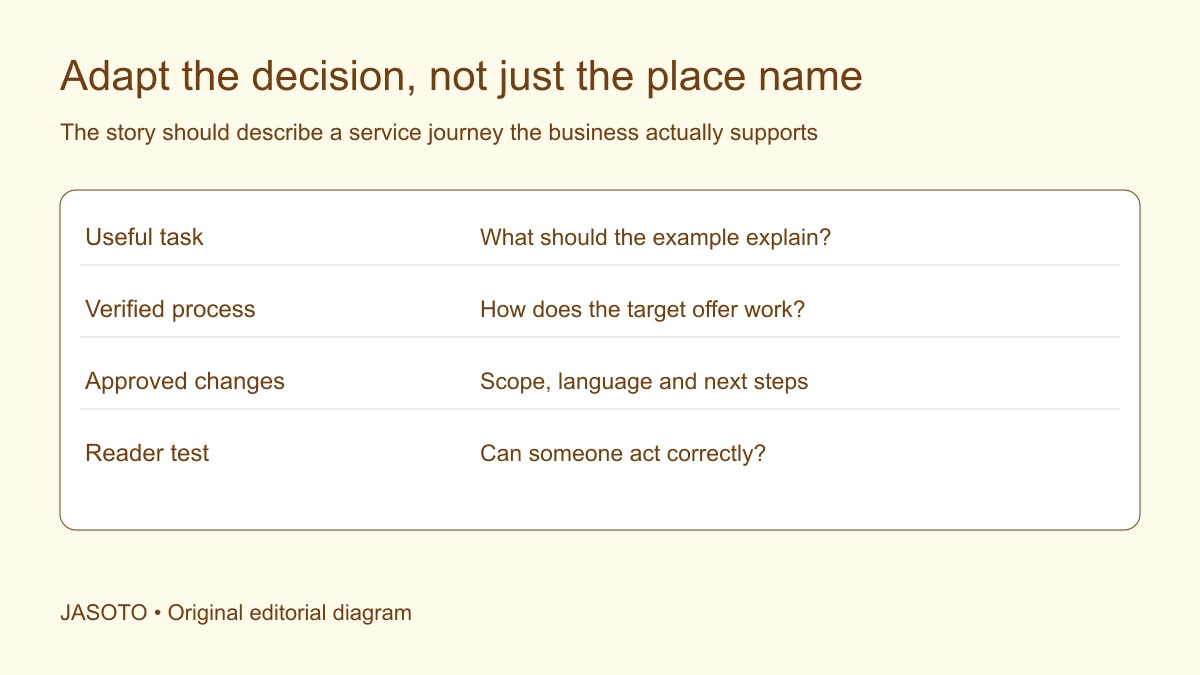
Original JASOTO editorial diagram. Its complete workflow is explained in the article; no actual customer outcome is depicted.
Localize a service example by verifying how the target audience actually requests, assesses and buys the service, then adapting the story's decisions and next steps to that process. Keep the example's purpose clear and label invented scenarios. Changing a city name, currency symbol or spelling cannot make an unsupported purchase journey accurate for another audience.
This guide uses a United States business adapting a fictional service example for international readers. It provides an editorial workflow without asserting how any particular country buys a service. Commercial, legal and technical facts need the appropriate owner and advice. The example should explain an actual supported process while keeping illustrative events separate from real customer evidence.
The practical answer
- Verify the actual buying process before adapting the story.
- Preserve the useful customer task while changing unsupported assumptions.
- Keep language adaptation separate from commercial or legal decisions.
- Label fictional scenarios and test the target reader's next action.
Identify what the original example teaches
Write the example's practical purpose in one sentence. It may show how to prepare a brief, compare offers or understand a request's status. Preserve that useful task where possible. An adaptation becomes unfocused when the team changes names and scenery without knowing which decision the reader should understand afterwards.
Check the original's evidence and status. Is it a real case, a composite requiring appropriate treatment or an explicitly fictional scenario? Do not turn a documented domestic customer story into an apparent overseas project by replacing identifiers. A real case has facts and permissions that need preservation. A fictional example can be adapted transparently without pretending it happened.
Map the actual target service journey
Ask the service owner how the relevant offer works for the intended audience: initial contact, eligibility, assessment, quotation, agreement, delivery and follow-up. Record the approved source and uncertainty. Avoid assumptions based solely on geography or an editor's memory of another transaction. The business's actual model matters alongside any relevant local requirements.
Identify meaningful differences from the original example. Perhaps the service uses an individual assessment before a quote rather than an immediate booking. That is a process distinction to verify, not a cultural stereotype. Keep the comparison specific to the actual offer and audience so the adaptation does not manufacture national rules or imply every buyer behaves identically.
Separate translation from wider adaptation
Decide which work concerns language and which changes the scenario or offer. [Google's global-audience guidance](https://developers.google.com/style/translation) distinguishes translation and localization and encourages clear writing for international readers. Use that distinction to assign responsibilities. A language reviewer can flag a purchase assumption, while the authorized business owner decides what the service actually supports.
Keep the scope explicit when briefing providers. A request to translate an example does not necessarily commission research into every local commercial condition. If wider investigation is needed, define it and identify suitable expertise. Do not let an unspoken expectation become a gap discovered only when the final draft looks fluent but still describes the wrong process.
List assumptions embedded in the story
Inspect contact channels, terminology, price presentation, visit arrangements, timing and the point at which a commitment is made. A story may imply that a message secures an appointment or that every quote follows a site visit. Identify those assumptions even when the text never states them directly.
For each, record retain, adapt, verify or remove with a reason. Keep unresolved facts visible rather than selecting the most plausible local equivalent. A fictional character can make an illustrative choice, but the business process surrounding that choice still needs to be accurate if readers may use the story as guidance for obtaining the service.
Adapt the decision sequence to the approved process
Change the order of events when the verified service requires it. If eligibility is checked before a detailed quote request, let the example show that sequence. Preserve the distinction between asking, receiving an estimate, accepting an offer and obtaining confirmation. Those stages affect what the reader believes they have after taking an action.
Avoid adding invented administrative steps to make the adaptation feel local. Each meaningful process claim should have a source or an explicit illustrative role consistent with the service. If the real process is still being designed, label the example appropriately or defer publication of guidance that would imply it already exists. Smooth narrative flow should not settle unresolved operating decisions.
Verify commercial facts separately
Check currency, charging unit, scope and relevant conditions through the responsible owner. Do not create an average price or select an exchange rate to make an example appear concrete. A symbolic service reference or qualitative comparison may explain the task without fabricated market figures. Use actual approved values only where appropriate and properly reviewed.
Identify legal or regulatory questions requiring qualified advice instead of presenting a guessed local rule. The editor can record the dependency and its effect on the example. Keep the answer within what the business can support. A scenario intended to explain a request form should not acquire unsupported claims about customer rights or tax treatment merely because it crosses a border.
Choose context that helps rather than decorates
Use names, locations and situations suited to the audience and purpose without relying on stereotypes. Explain necessary context plainly. A locally familiar sporting metaphor or joke may distract from the service decision, while replacing it with another cliché adds little. Prefer a concrete task whose relevance is easy to understand.
Avoid implying that the business has an office, team or customer relationship in a location solely because the example mentions it. If the service is remote, describe that accurately. If attendance is involved, verify the actual coverage and arrangement. Research travel where relevant after those facts are clear, rather than treating an accessible destination as proof that the business operates there.
Keep fictional status and evidence boundaries visible
Label the scenario near the example using wording appropriate to its actual status. Do not invent a customer quote, review, award or measured result. The story can end with a well-prepared request or informed choice without claiming a business outcome. Keep any actual case evidence separate and accurately attributed through the proper permissions process.
Review images and captions alongside the text. A stock photograph or generated illustration should not turn an openly fictional scenario into an apparent customer case. If the visual creates that impression, choose a clearer presentation. A small label cannot carry all the work when the headline and layout strongly suggest a real project the business never performed.
Work through a fictional request-stage adaptation
Imagine an example originally showing a customer selecting a time and receiving immediate confirmation. The target offer instead requires a service assessment before scheduling. The service owner verifies that process, and the editor changes the example so the character submits the relevant information, receives a review response and agrees any appointment separately.
The adaptation preserves the useful task of preparing a clear request while removing the unsupported booking promise. It uses no invented price or outcome. This fictional comparison illustrates a process difference within an actual service model; it makes no claim that all customers or businesses in a particular country follow one buying pattern.
Review terminology with the intended audience
Give suitable language reviewers the verified process, audience and example purpose. Ask whether key terms describe the right decision and commitment. A familiar translated word for booking or quotation may carry a stronger expectation than intended. Resolve the meaning with the service owner and choose clear wording through appropriate review.
Explore language support where expertise is needed. Keep the source and localized versions linked through stable references. If an authorized difference remains, record it so a later consistency editor does not mistakenly remove it. The aim is coherent meaning for the target task, not identical sentences or an arbitrary word-for-word resemblance.
Test the target reader's next action
Ask an appropriate reviewer to explain what the character did, what was agreed and what a reader should do in a similar situation. Require answers from the final example and linked route. Check whether the story encourages an action the current service cannot support, such as arriving without confirmation or expecting a fixed price from an assessment request.
Open the actual next page or form in an appropriate review environment. Compare providers using the same attention to the real purchasing steps. A localized example can be accurate while its action link leads to an older contradictory process. Assign that issue rather than declaring the content complete because the story alone reads naturally.
Maintain the example with the service
Record the source facts, approved adaptations, reviewers and publication locations. Set review triggers for changes to service scope, coverage or booking process. Consider localization roles when ongoing coordination needs capacity. Preserve earlier wording and a correction path so an inaccurate adaptation can be reviewed and reversed.
Use genuine customer questions to identify future improvements, noting the limits of the evidence. Do not claim commercial success from a more locally familiar story without measurement. The practical result is an example that explains a useful decision in a supported service journey, with language and context adapted deliberately and fictional events kept clearly separate from real-world proof.
Put the guide into practice
- Identify the example's purpose and factual basis.
- Map the real target-market service journey with its owner.
- Record which assumptions need adaptation.
- Review language, commercial facts and final actions.
- Maintain localized examples when the service changes.
Frequently asked questions
Is replacing city names and currency enough?
Check whether the example still reflects how the service is actually bought and delivered. Contact routes, assessment, quotation and confirmation may differ. Adapt only from verified information and keep the customer task useful. Surface unresolved questions instead of filling them with plausible local details.
Can a fictional localized example use an invented result?
Keep the scenario clearly illustrative and avoid presenting an outcome as a measured customer achievement. Often the useful example ends with an informed decision or defined next step. Do not add fabricated savings, reviews or performance figures to make a localized story appear proven.
Who approves a change to the buying process described?
The responsible service or commercial owner should verify the underlying process, with appropriate specialist advice where required. A translator or editor can identify unclear assumptions but should not invent a new offer. Keep linguistic approval and business approval explicit.
Explore JASOTO tools
Research the actual request and purchasing steps relevant to the service.
Explore localization roles →Define ownership for audience research and process verification.
Check visit assumptions →Review journeys only after the example reflects the actual visit process.
Explore language review →Consider suitable expertise for audience and terminology adaptation.
Continue with JASOTO
Compare your next step
Discover UK businesses, compare services and request written quotes before making a decision.