
Travel · UK Guide 2026
Plan Luggage Storage Around an Afternoon Appointment
JASOTO · Updated 5 November 2026 · 1,642 words
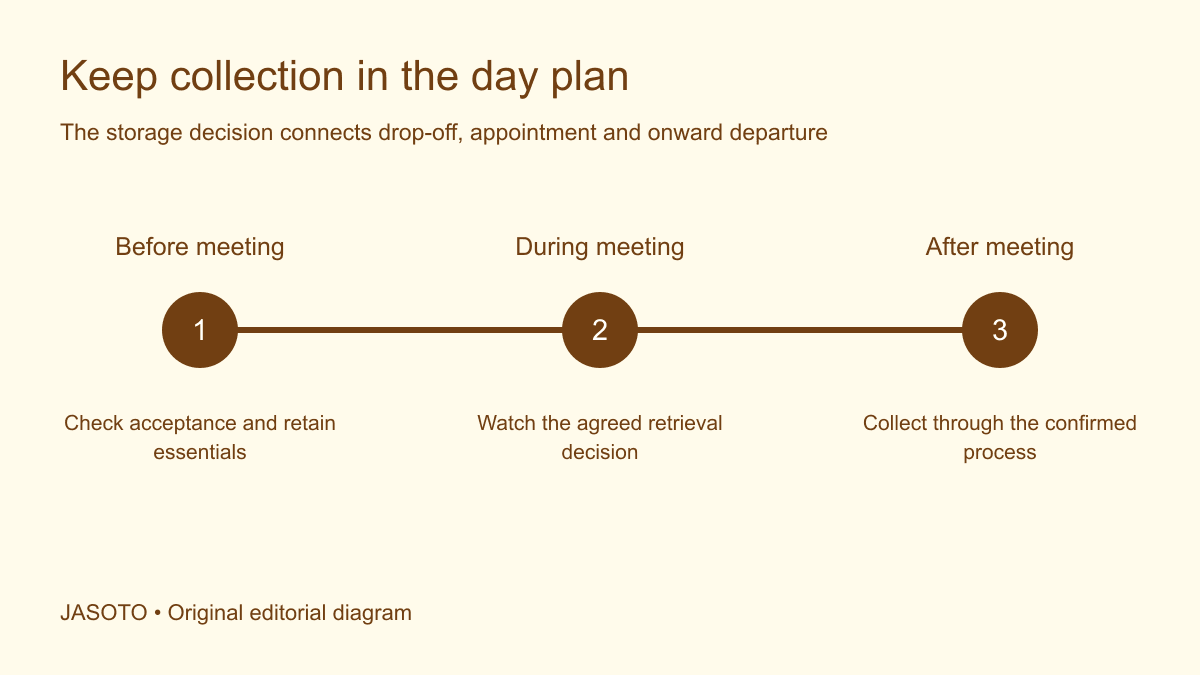
Original JASOTO editorial diagram. Its complete workflow is explained in the article; no actual customer outcome is depicted.
Plan luggage storage by working backwards from the afternoon appointment and the onward departure. Confirm where bags can be accepted, what the provider will take, how collection works and whether the retrieval route fits the day. A storage point near a station can be convenient, but only if dropping off and collecting the bag do not create an unworkable detour around the meeting.
This original guide is for UK work trips where checkout or arrival happens before an afternoon appointment. The St Pancras operator's website lists a luggage-storage service as one example of a facility to investigate. That listing does not establish suitability for your items or confirm a booking. Check the provider's current conditions, availability and operating arrangements directly before relying on storage.
The practical answer
- Map the bag and traveler separately.
- Check actual acceptance and collection conditions.
- Retain what the appointment and retrieval require.
- Work backwards from the onward departure.
Map the bag's journey separately from yours
Write the sequence from arrival or checkout to storage, appointment, collection and onward travel. Mark where the bag and traveler separate and where they need to rejoin. This reveals a common planning gap: the meeting route looks feasible, but collecting the bag requires returning to a different part of the city before the final train or appointment.
Use the actual appointment entrance and departure point. A storage service described by a station name may be inside a particular area, with its own approach and collection process. Check that route rather than treating the whole station as a single point. For an invented visitor with an afternoon client meeting, storage near the arrival station may add backtracking if the return leaves elsewhere. The map should expose that tradeoff before a convenient-looking location becomes a commitment.
Confirm the appointment's bag arrangements first
Ask the host whether the bag can appropriately accompany you and where it would be kept during the visit. A small case may be acceptable in one meeting room while a different site has restrictions or no suitable space. Do not assume reception can store luggage merely because staff are present. Confirm the actual arrangement through the host or building's responsible contact.
Keep the request practical: describe the relevant number, size or type of items without sending unnecessary personal detail. If the host cannot accommodate them, use that answer to research storage. If the host can, clarify whether collection remains possible when the meeting ends and whether access depends on someone staying late. An informal promise can become fragile if it has never been connected to the actual timing and the person responsible for releasing the item.
Compare storage at the points you actually pass
Investigate options at the accommodation, a transport hub or another provider where relevant to the route. Treat each as a possible arrangement until confirmed. A property may have a particular service for guests, while an independent facility may use a different acceptance process. Ask the provider what applies to your date and items instead of assuming a standard rule across all storage locations.
Compare total movement rather than the distance from one point. The useful question is how much the option adds to drop-off and collection around the appointment. A location near the morning arrival can still be awkward after the meeting. Keep the alternatives focused on the trip's actual geography and approved business process. You do not need a large list of storage companies to make a useful choice if two carefully checked options answer the relevant route question.
Check acceptance and collection conditions
Read the provider's current terms and ask about anything unclear before handing over the bag. Check what items are accepted, any relevant restrictions, the applicable size or quantity limits and how the service identifies the person collecting. Do not assume a general luggage-storage description covers specialist equipment, unusual containers or valuable business materials. The actual provider determines its service conditions.
Identify what evidence you need at collection and keep it available appropriately. Avoid storing the collection reference, necessary identity item or only usable payment method inside the bag if that would prevent you retrieving it. This is a practical dependency check, not a universal list of required documents. Follow the provider's instructions for the actual service and avoid guessing a workaround if you cannot meet a condition. Ask before booking rather than discovering the problem at a crowded counter.
Decide what must remain with you
Pack a small accessible set containing the items needed for the appointment and onward travel. This might include permitted work material, essential personal items and the relevant travel or collection information. Choose according to your actual needs and the storage provider's conditions. A bag being temporarily unavailable should not leave you unable to enter the meeting or complete the next journey.
Check business information and equipment through your organization's arrangements. Do not assume a third-party storage service is an approved place for confidential material simply because it accepts suitcases. Ask the appropriate owner when the content creates a separate security or handling question. The purpose is to make the storage decision with knowledge of what the bag contains, while keeping specialist judgement with the person responsible for it. Avoid placing details of sensitive contents into a general itinerary shared with everyone on the trip.
Allow for the drop-off process
Check how and where the provider receives items. Include the walk to the facility, the actual acceptance process and the return to your meeting route. A reservation can confirm an arrangement without eliminating every queue or local delay. Do not plan to arrive at the counter at the last possible moment if the afternoon appointment depends on leaving immediately afterwards.
Use an allowance appropriate to what you have confirmed, rather than treating a universal number as a guarantee. If the process or opening arrangement is uncertain, ask the provider and preserve that uncertainty in the itinerary. A checked route should describe the actual facility, not just “leave bag at station”. The traveler needs enough information to find the right place and recognize whether the intended service is available before handing the item to anyone.
Work backwards from collection and departure
Identify the latest practical collection point that supports the onward journey under the provider's current arrangements. Include reaching the facility, completing collection, moving to the departure point and the relevant transport requirements. Ask the host about the expected meeting finish and whether it can vary. The collection plan should not depend on every conversation ending at its shortest possible duration.
If the timing is tight, consider another storage location or a different approved travel arrangement before committing. Do not assume the provider will remain open or release a bag outside its stated process because a meeting ran late. Check what applies and keep the contact route available. A realistic plan makes the retrieval dependency visible while there is still time to change it, rather than leaving the traveler choosing between a bag and a departure at the end of the day.
Plan the response to an overrunning appointment
Agree a decision point for leaving or contacting the relevant business owner if the meeting threatens the collection route. Keep the discussion proportionate to the appointment: the host may be able to move a final topic, or the traveler may need an authorized change to onward travel. The responsible people should decide using the actual conditions rather than a vague promise that collection can somehow be managed.
Prepare a concise update identifying the time constraint and decision needed. If you contact the storage provider, use its established route and ask what options genuinely exist. Do not send someone else to collect unless the provider's process permits it and the arrangement is properly confirmed. A friend or colleague knowing the bag's description does not automatically authorize release. Keep the fallback tied to the real service rather than an improvised assumption about what staff will accept.
Keep the handover record useful and private
Retain the relevant collection reference and note the provider, location, item count and current retrieval plan. Follow the provider's guidance for any condition record or identification step. Avoid photographing unrelated people or exposing address labels and private contents unnecessarily. Store the information where you can access it while the bag is out of your possession, including an appropriate offline form if needed.
Use travel research to explore the surrounding route and verify transport directly with operators. For a service discovered through business listings, confirm the precise facility and terms with the provider. Where coordinating such logistics is part of a continuing role, describe it accurately when planning relevant jobs. An itinerary can point to the private collection record without distributing every sensitive booking detail to people who only need the appointment time.
Recheck the route before handing over the bag
Before using the service, confirm that the appointment and onward plan still match the researched sequence. A changed venue, delayed arrival or revised departure can make the original storage location less useful. Update the retrieval calculation before relying on it. If an essential condition is no longer met, preserve the confirmed parts of the trip and ask the appropriate owner or provider about a workable alternative.
After collection, close the storage item in your itinerary and retain only the records appropriately needed for the agreed business or payment process. Note the specific route lesson for next time without claiming one experience proves a provider's general reliability. The rollback for an unsuitable plan is to change the storage or appointment arrangement before the bag becomes inaccessible. Useful luggage planning keeps the item, the traveler and the next commitment connected through a checked sequence, with a clear route back together after the afternoon meeting.
Put the guide into practice
- Ask the host about bag arrangements.
- Compare complete drop-off and retrieval routes.
- Confirm provider terms and identification needs.
- Set a response to an overrunning appointment.
Frequently asked questions
Can I assume my accommodation will store luggage after checkout?
Ask the property about its current arrangement for your booking and items. Confirm drop-off, collection and any relevant conditions before building the day around it. A service offered by another property or on an earlier stay does not establish what applies now.
Should I choose storage nearest the arrival station?
Compare the whole sequence, including the meeting and onward departure. The nearest arrival option can create backtracking later. Check actual drop-off and retrieval routes so the choice supports the complete day rather than only the first leg.
Can a colleague collect my bag if I am delayed?
Only use that option if the provider permits it and the required authorization or identification arrangement is confirmed. Ask through the provider’s established route. Do not assume knowing the reference or describing the bag is sufficient for another person to collect it.
Explore JASOTO tools
Discover providers and check support for your specific task.
Explore roles and responsibilities →Consider the practical responsibilities involved when recruiting or joining a team.
Plan work-related travel →Research a journey when joining, training or meeting colleagues in person.
Continue with JASOTO
Compare your next step
Discover UK businesses, compare services and request written quotes before making a decision.