
Global Business · UK Guide 2026
Review Machine Translation of Safety-Sensitive Text
JASOTO · Updated 5 November 2026 · 1,569 words
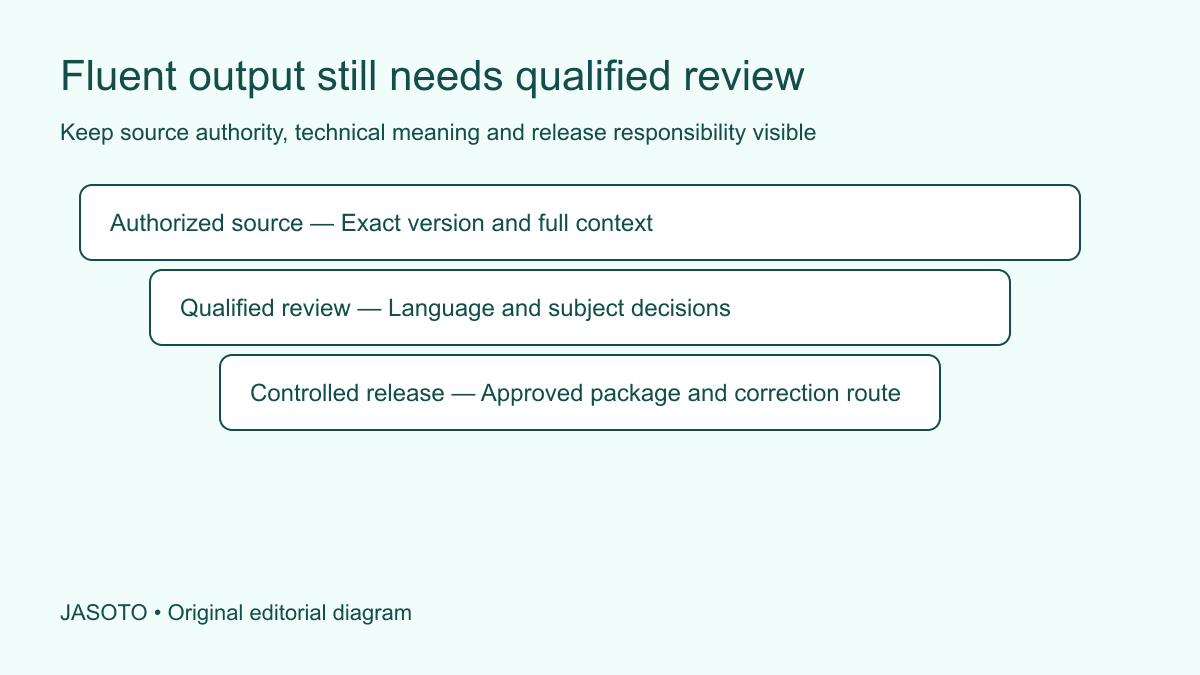
Original JASOTO editorial diagram. Its complete workflow is explained in the article; no actual customer outcome is depicted.
Review machine translation of safety-sensitive text through a qualified process that verifies the authorized source, technical meaning and final publication package. Identify the consequences of error before deciding whether a tool is appropriate. Give unresolved meanings to the responsible subject owner and suitable language reviewers. Readable output, familiar terminology and a completed automated check do not establish that consequential instructions are ready for use.
This guide concerns publication preparation for a UK business. It provides no product operating or emergency instructions. Use the actual sector requirements, authorized technical content and competent professional advice. The fictional document examples below explain review control without inventing a technical procedure or claiming that one checklist certifies safety.
The practical answer
- Identify the consequences and required competence before choosing a workflow.
- Use the approved source and include every relevant visual and condition.
- Have qualified language and subject reviewers resolve meaning through a query process.
- Release only through the responsible owner's approved arrangements.
Identify what makes the content consequential
Ask the responsible owner how a reader might act on the text and what could happen if its meaning is wrong or incomplete. Include conditions, limits, warnings and references that affect action. A short sentence can be consequential even when the surrounding document appears routine. Do not classify risk solely by word count, tone or whether the material resembles a familiar template.
Record the applicable review process and required expertise. Medical, legal, technical and other specialist contexts may have different requirements. The editorial coordinator should identify and involve those owners rather than deciding the complete standard independently. If the necessary competence or source authority is missing, raise that gap before a publication deadline turns an unresolved issue into an assumed approval.
Confirm that tool use is appropriate and permitted
Check the organization's approved technology, confidentiality and information-handling arrangements before submitting material to a translation system. A public interface may not be suitable for restricted documents. Keep the decision with the responsible owner and appropriate advice. Do not treat the ability to paste text into a tool as authorization to share it.
[ITI's publication on FIT's AI ethics report](https://www.iti.org.uk/resource/fit-ethics-of-ai-in-translation-and-interpreting.html) emphasizes professional judgment and human oversight, particularly in high-stakes contexts. Use suitable professional guidance for the actual task. The workflow here organizes review responsibilities; it does not claim that every use of machine translation has the same risk or that a generic label determines suitability.
Establish the exact authorized source
Record the source identifier, version, applicability and approving owner. Confirm that it is the text intended for the actual product, service or audience. A correct translation of an obsolete source remains an obsolete instruction. Resolve conflicting drafts before commissioning review rather than asking a reviewer to choose which version the business meant.
Keep the source context intact. Include referenced diagrams, headings, conditions and attachments needed to understand the material. Isolated sentences can conceal dependencies or change the apparent subject of an instruction. If the source itself is unclear, record the issue and obtain an authorized clarification. Translation review should not silently repair technical meaning that the source owner has not settled.
Define the reviewers' responsibilities
Identify who checks target-language meaning, subject accuracy, figures and units, visual relationships and final output. Assign a release authority and the evidence it needs. One suitably qualified person may cover several tasks, but that should be explicit. Avoid a general “human reviewed” claim when the reviewer only checked spelling or was unable to assess the specialist content.
Confirm how reviewers communicate and resolve disagreement. A language professional may identify an ambiguity while a subject specialist explains the intended meaning. Keep both contributions connected in the query record. The aim is a controlled decision about the actual content, rather than a sequence of approvals where each person assumes another has checked the difficult part.
Preserve an inspectable record of the draft
Keep the source and machine-generated draft in the approved working environment with their versions clear. Record relevant tool and workflow details according to the organization's process. This helps reviewers distinguish raw output, edited drafts and approved material. Do not overwrite the only draft in a way that makes a material correction impossible to trace.
Use stable section or content identifiers for comparison. They allow reviewers to connect a target passage to its source even when sentence order changes naturally. Keep the mapping practical and avoid unnecessary personal data in review notes. The record should support substantive checking and correction, not collect extensive metadata that nobody uses to make a release decision.
Check omissions and changed relationships explicitly
Have qualified reviewers compare the complete meaning, including negatives, conditions, exceptions and sequence relationships. A draft may retain the central action while omitting the circumstance that makes it applicable. It may attach a qualification to the wrong subject or transform a limit into a suggestion. Those are meaning issues even when the result reads fluently.
Use a completeness map where it helps the actual material. Record whether each required meaning is present and correctly connected. Do not substitute a word-count comparison for that review. Equal length cannot establish equivalence, and a shorter natural translation is not automatically incomplete. The appropriate reviewers should assess the actual meaning and consequence in context.
Verify terminology, quantities and references
Supply approved terminology and identify unresolved terms. Check component identifiers, document references, quantities and units with the appropriate owners. Familiar-looking digits can be attached to the wrong condition or diagram. Preserve relationships as well as individual fields. Do not invent a technical value or standard conversion to make a draft appear complete.
Review words that express obligation, permission or prohibition through the relevant specialist process. The target should preserve the authorized meaning without strengthening or weakening it casually. Where a term has several plausible meanings, document the question and resolution. A repeated machine choice is not proof that the terminology is suitable for the product, audience or task.
Keep graphics and nearby text in scope
Include labels inside diagrams, tables, screenshots and signs. Check whether a translated caption still describes the current visual and whether references point to the intended element. A corrected body paragraph can conflict with an unchanged embedded label. Give the visual files and their versions stable references so cross-file changes can be tracked.
Inspect layout after editing. Text expansion may clip a condition, separate a notice from its subject or make a key label difficult to read. Ask appropriate technical and accessibility reviewers to verify the final presentation. Do not remove important content to preserve a box size without authorization. Layout pressure should trigger a controlled design decision, not an unrecorded change in meaning.
Resolve queries through the authorized owner
Record the source reference, uncertainty, relevant consequence, owner and decision. Keep unresolved material issues visible to the release authority. A reply to a comment does not necessarily mean the approved correction reached every affected version. Have the appropriate reviewer verify implementation and close the item based on the actual result.
If the source is corrected, update connected language versions through the established process. Avoid leaving the clarified meaning only in one target draft while the original and other translations retain the problem. Record which materials are affected and who coordinates replacement. The correction route is part of review readiness, especially when content is distributed through several channels.
Work through a fictional condition mismatch
Imagine document D21 contains an approved condition linked to a numbered component reference. Review finds that the draft target attaches the condition to another component. The language reviewer raises a query, the subject owner confirms the intended relationship and the correction is checked in text and diagram together. No technical action is invented by the editor.
The release record identifies the corrected versions and the reviewer who verified the relationship. This fictional example demonstrates how a fluent sentence can still require substantive correction. It does not establish that the remaining document is safe or compliant, which depends on the actual complete review and applicable requirements.
Check the final package before release
Review the customer-facing export or publication, including title, applicability, revision labels, attachments and links. Confirm that the approved target is the one delivered. A review of an editing file does not establish that the published package preserved every correction. Test the actual distribution route through the responsible technical process.
If an onsite review is appropriate, plan the visit with the responsible team and keep any practical assessment within authorized arrangements. Research qualified providers against the subject, language and review scope. The brief should say what needs verification and who controls release, rather than requesting a generic quick proofread of consequential material.
Maintain controlled corrections after publication
Keep the approved package, evidence and relevant earlier versions according to the organization's process. Identify distribution locations so a later correction can reach the right materials. Assign ownership, considering technical documentation roles where recurring work needs capacity. A review date is useful only when someone can act on the trigger or reported issue.
When new errors or source changes appear, assess them through the appropriate owner and update affected versions. Explore professional language support where additional expertise is required. The practical outcome is an accountable publication decision grounded in the authorized source and qualified review, with uncertainty resolved visibly and a usable route to correct material that later needs change.
Put the guide into practice
- Identify sensitive content and the applicable review process.
- Confirm source authority and permitted tool use.
- Assign qualified reviewers and escalation owners.
- Resolve omissions, conditions and cross-reference issues.
- Approve the final package and control later corrections.
Frequently asked questions
Does fluent machine output show that the meaning is accurate?
No. Readability does not establish that conditions, warnings, quantities or technical relationships match the authorized source. Use appropriate qualified review and the responsible publication process. Do not rely on a confident tone or a few familiar terms as evidence that consequential information is ready for use.
Can we back-translate the text and publish if it looks similar?
A back translation may support investigation in an appropriate workflow, but it does not replace qualified review of the source and target in context. The same ambiguity can survive several transformations. Give material questions to the authorized subject owner and have the final target meaning reviewed by suitable professionals.
What should happen when an important meaning remains uncertain?
Keep the issue visible and resolve it through the responsible owner and qualified reviewers before release under the actual process. Do not guess a technical instruction or remove a condition to make the sentence smoother. Record the decision and update the source and affected versions where necessary.
Explore JASOTO tools
Brief suitable language and subject specialists with the actual risk and scope.
Explore technical documentation roles →Define ownership for queries, approvals and controlled release.
Plan authorized review visits →Coordinate any necessary onsite review through responsible people.
Explore professional language support →Consider appropriate expertise for consequential communication.
Continue with JASOTO
Compare your next step
Discover UK businesses, compare services and request written quotes before making a decision.