
Business Operations · UK Guide 2026
Separate Useful Inquiries from Spam in a Manual Log
JASOTO · Updated 5 November 2026 · 1,536 words
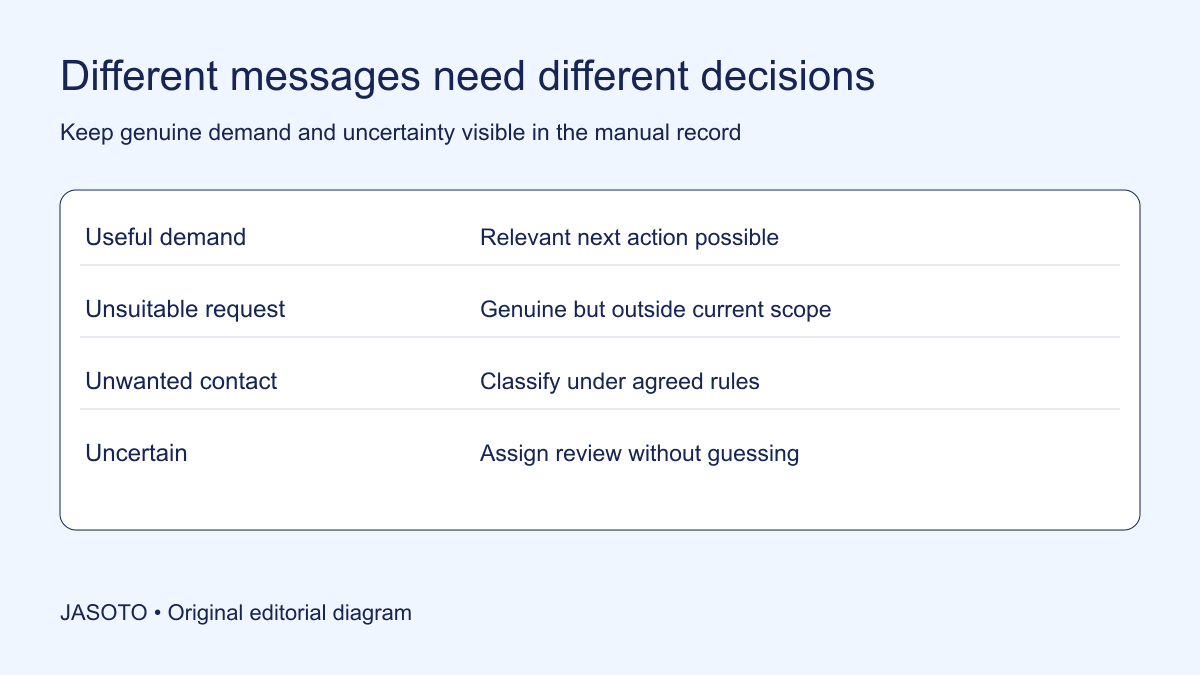
Original JASOTO editorial diagram. Its complete workflow is explained in the article; no actual customer outcome is depicted.
Separate useful inquiries from spam by defining clear categories, linking each entry to a controlled original message and giving uncertain cases a review owner. Keep genuine unsuitable requests distinct from unwanted or suspicious contact. A manual log should explain what happened to the message and support a sensible next action, rather than turn every inquiry that fails to become a sale into spam.
The workflow below suits a small UK business reviewing ordinary incoming contact. It is a classification and measurement method, with fictional examples. Handle suspicious material through the organization's security process and appropriate technical support. Keep personal information and retention decisions within the responsible business arrangements rather than copying every message into an unrestricted worksheet.
The practical answer
- Define categories by the message's purpose and the business's next action.
- Separate irrelevant contact, uncertain messages and suspected malicious activity.
- Record only the evidence needed for review and measurement.
- Audit classifications so useful inquiries are not silently discarded.
Define the purpose of the log
Decide whether the log supports daily triage, demand analysis, form-quality review or several linked tasks. State who uses it and what decision each field informs. A sales report may need a count of genuine suitable requests, while an operational queue needs an owner and next action. Keep those functions understandable rather than forcing one ambiguous status to serve every purpose.
Choose the channels and period covered. An email-only record cannot represent every phone or website inquiry unless the process includes them. Record gaps and unusual conditions. The log can still provide useful evidence within its scope, but the report should not describe a partial sample as the complete volume of business demand.
Agree categories that describe distinct situations
Use a small set with clear definitions: useful service inquiry, genuine but unsuitable request, duplicate, unrelated solicitation, suspected malicious contact and uncertain. Adapt the labels to actual needs without overcomplicating the record. The important distinction is whether the contact represents genuine demand, repetition, unwanted material or unresolved uncertainty.
Write examples and boundaries for each category. A customer outside the service area can be genuine but unsuitable. A supplier proposing a service may be a solicitation rather than a customer inquiry. A duplicate can link to an existing case. These distinctions help the business understand its audience and workload without inflating or concealing one category for reporting convenience.
Keep security handling separate from commercial suitability
Follow the organization's process when a message may be malicious. [NCSC's phishing guidance](https://www.ncsc.gov.uk/collection/phishing-scams/spot-scams) explains recognizing and reporting suspected scams, including the limitations of superficial signs. Use appropriate support rather than assuming polished language proves authenticity or poor grammar proves fraud. The log should not encourage unsafe investigation.
Record the relevant handling state without reproducing dangerous links or attachments in a shared sheet. A controlled reference can preserve traceability. If staff are unsure, assign review through the approved route. Do not treat every unusual request as an attack, and do not ask an unprepared colleague to open suspicious material merely to improve the completeness of a marketing count.
Choose a minimal usable record
Useful fields may include reference, received date, channel, service topic, category, reason, owner and next action. Add classification date where timing matters. Link duplicates to the original record. Avoid collecting personal details that do not support the stated purpose. Keep access and retention aligned with the organization's actual information-handling process.
Use structured reasons where recurring analysis needs consistency, with a short note for meaningful exceptions. “Outside area” or “service not offered” is more informative than “bad lead.” The note should explain evidence, not speculate about a person's motives or identity. A reviewer should be able to understand why the category was selected without reading an unnecessarily copied case history.
Classify using the message's task
Ask what the sender is trying to obtain and whether the business can take a relevant next action. A brief question can be useful even without a complete project brief. Do not require every genuine customer to know technical terminology or submit all information at first contact. Define what missing detail can reasonably be clarified.
Keep suitability separate from outcome. A relevant inquiry may never convert because of timing, price or a changed customer decision. That does not retrospectively make it spam. If the business later measures conversion, retain the original classification and record the subsequent outcome separately. Otherwise the team can unknowingly improve reported inquiry quality by reclassifying every unsuccessful case after the fact.
Give uncertain messages an owner and review point
Create a defined uncertain category instead of forcing a guess. Specify who reviews it, what evidence is appropriate and how the next action is decided. An uncertainty queue needs coverage; leaving it indefinitely can silently discard useful demand. Keep any security concern within the approved process and avoid unnecessary interaction with suspicious content.
Record the review outcome and reason. If the classification changes, retain appropriate history so the business can identify recurring ambiguity in its rules. Do not treat uncertainty as a performance failure for the first reviewer. A good process lets someone flag a genuine limit in the available evidence and obtain a responsible decision.
Link duplicates without losing the customer conversation
Define what counts as a duplicate across channels and time. A repeated message may relate to an existing case, while a new request from the same customer may be separate. Use the actual task and reference rather than matching only an email address or company name. Keep the customer-facing next action with the case owner.
Count duplicates according to the report's purpose and explain the rule. A workload measure may include repeated contacts, while a demand measure may count the underlying request once. Preserve the relationship so both can be understood. Avoid deleting repeated messages solely to make the spreadsheet tidy if the controlled record needs them for customer handling or review.
Work through a fictional mixed inbox
Imagine a small repair business receives a relevant service request, a genuine request from outside its coverage, a repeated follow-up and an unrelated promotional message. The log records four contacts with distinct categories and links the follow-up to the original case. The outside-area request remains evidence of genuine demand and a possible coverage question.
Another message raises a security concern and goes through the approved suspicious-message process. It is not opened casually to settle the marketing label. This fictional example shows why one useful-versus-spam checkbox can hide important differences. It provides no rule for declaring a particular real message safe, fraudulent or commercially suitable without its actual context.
Audit a sample of classifications
Have an appropriate reviewer inspect selected useful, unsuitable and uncertain records through controlled access. Compare the decision with the definitions and evidence. Record disagreements and whether the rules or individual classification need correction. Focus on cases where a useful inquiry could be lost or reports could materially misrepresent demand.
Do not use an audit only to reward higher useful counts. The goal is consistent evidence-based classification. If the business changes its service area or offer, record the effective point and update the rules. A message may be unsuitable under an earlier offer and relevant under a later one, so historical interpretation needs the correct context.
Keep period comparisons honest
When reporting, state channels, period, definitions and uncertain records still open. Keep genuine unsuitable demand visible where it helps a decision. A rise in spam counts may reflect broader coverage of the log or a changed rule rather than an actual increase in unwanted messages. Investigate before claiming a trend.
Use stable categories for comparison and disclose material changes. Avoid calculating a precise quality improvement from a small or incomplete sample. The log's immediate value is traceability and a useful workload picture. Commercial outcomes and security effectiveness need their own appropriate evidence rather than being inferred from a cleaner spreadsheet.
Connect the process to staffing and coverage
Name the person responsible for incoming review, case ownership and uncertain classifications. Arrange coverage during absences and business travel. A log that nobody monitors becomes another unattended queue. Check that staff know what action each category triggers and how to obtain help when the rules do not settle a case.
Research business support for a defined handling or security need, and explore customer service roles when volume requires capacity. Keep specialist security decisions with appropriate people. The manual process should help legitimate inquiries reach a responsible next action while preserving uncertainty honestly and handling unwanted contact through the proper route.
Review the log's usefulness and reduce unnecessary work
Ask which fields informed a real decision and which created effort without value. Simplify the record where evidence supports it, preserving the distinctions needed for customer care and measurement. Follow the organization's retention process for original messages and working records. Do not keep detailed personal information indefinitely merely because storage is convenient.
Retain definitions and relevant change history so later reports remain interpretable. Correct misclassifications through the agreed route and use recurring questions to improve the process. The useful result is a manual record that distinguishes genuine demand, unsuitable requests, duplication, unwanted contact and uncertainty with enough evidence for accountable handling.
Put the guide into practice
- Agree useful, unsuitable, duplicate, spam and uncertain categories.
- Link records to controlled original messages.
- Use the organization's suspicious-message handling process.
- Review uncertain and rejected samples with an owner.
- Keep classification rules stable when comparing periods.
Frequently asked questions
Is every inquiry outside our service area spam?
No. It may be a genuine request the business cannot serve. Record it as unsuitable or outside scope according to the agreed definitions. Keeping that distinction helps the team understand real demand and coverage confusion without inflating spam counts or treating a prospective customer as malicious.
Should staff open attachments to decide whether a message is genuine?
Follow the organization's security process for suspicious material and obtain appropriate technical help. Classification should not require risky investigation by an unprepared colleague. Use controlled references and record uncertainty rather than treating a need for more evidence as permission to interact with a potentially malicious attachment or link.
How much personal detail belongs in the log?
Keep only what is necessary for the defined review and reporting task, using the organization's information-handling and retention arrangements. A controlled message reference and category may be enough. Avoid copying entire conversations, sensitive attachments or unrelated personal details into a broadly accessible spreadsheet.
Explore JASOTO tools
Continue with JASOTO
Compare your next step
Discover UK businesses, compare services and request written quotes before making a decision.