
Travel · UK Guide 2026
Prepare a Travel Fallback When a Meeting Runs Late
JASOTO · Updated 5 November 2026 · 1,647 words
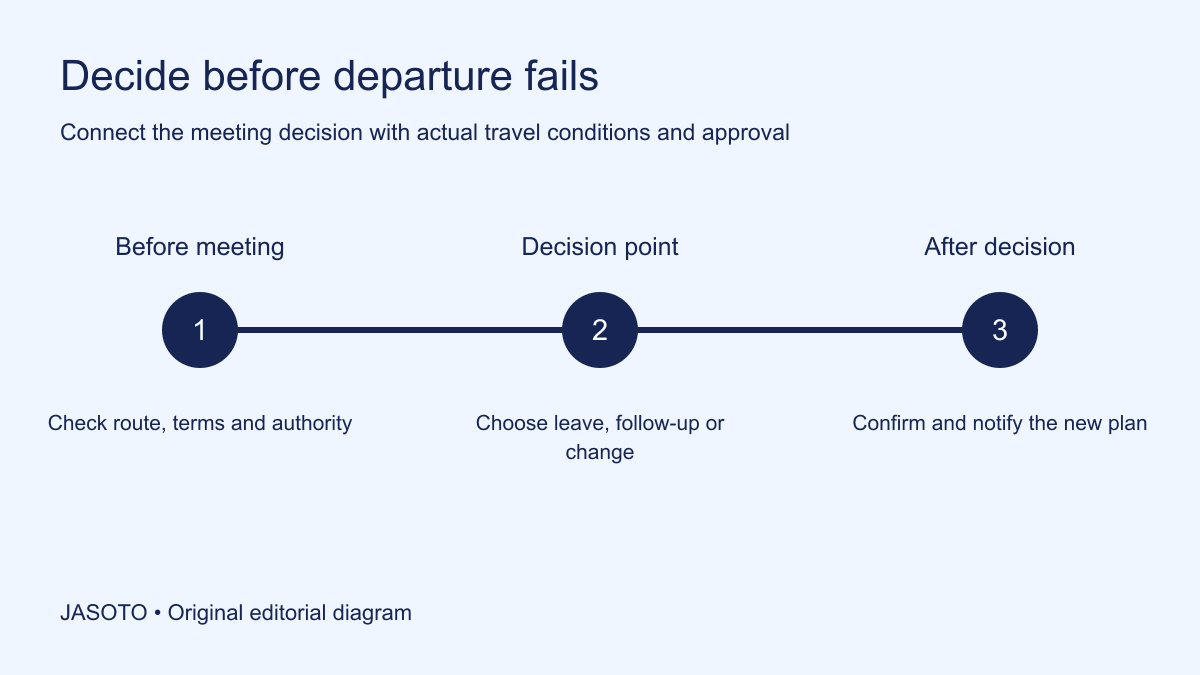
Original JASOTO editorial diagram. Its complete workflow is explained in the article; no actual customer outcome is depicted.
Prepare an overrun fallback by identifying the latest practical time to leave, the decision needed before that point and a checked later travel option if one exists. Confirm who can approve a change and how the meeting host will be told. A fallback should give you a usable action while time remains, rather than a vague instruction to find another train after the planned departure has gone.
This guide provides an original method for UK work meetings. National Rail's Advance-ticket guidance illustrates why the conditions of the actual ticket matter when a schedule changes. Check your booking with the retailer or operator and follow your business's approval arrangements. The scenarios below organize a decision; they do not establish a refund entitlement, promise availability or authorize using a different service without checking the relevant conditions.
The practical answer
- Calculate the actual meeting-room departure limit.
- Check the terms of the booking you hold.
- Agree who decides before the limit.
- Consider unfinished-work options alongside travel changes.
Establish the full departure requirement
Work backwards from the booked or intended service to the meeting room. Include packing, leaving the site, any local transfer and the steps needed at the departure point. Use the actual route and equipment rather than treating the advertised service time as the moment you can stand up from the meeting. A station close to the venue can still require a specific entrance or interchange.
Record the latest practical meeting departure as a planning point with a clear basis. It is not a guarantee that every journey will work if you leave then. Check current information and any local dependency before relying on it. If the site exit or pickup is uncertain, resolve that question with the host or provider. The purpose is to understand what the original plan requires, so the overrun decision is connected to reality rather than an arbitrary alarm set shortly before the train.
Ask about the meeting's expected finish
Confirm the likely duration and whether additional activities are planned. A discussion scheduled to end at one time may be followed by a site walk or informal review that matters to the business purpose. Ask which part is essential and who can decide a change. Avoid assuming you can leave midway through a necessary activity simply because the calendar invitation contains a convenient finish time.
Tell the responsible host about a material departure constraint at an appropriate point. A brief explanation lets the agenda owner consider the sequence before the final minutes. Keep the communication factual: identify when you need to leave and what decision would be required if the work continues. The host may adjust the agenda or say that a different travel arrangement needs discussion. Either answer is more useful before the constraint becomes urgent.
Distinguish a longer meeting from transport disruption
Identify why the original route is at risk. An overrun in your appointment and a disrupted transport service can involve different provider conditions and business decisions. Keep that distinction in the record when asking for help. Do not assume a late meeting gives the same options as a cancelled service, or that a transport disruption means the meeting itself must be extended.
Use current operator information for the actual journey and contact the relevant provider about booking conditions. The coordinator's message should state the observed facts without drawing a legal conclusion. For an invented client visit, the meeting still has an unresolved decision while the train is operating normally. The traveler needs a business decision about staying and a provider answer about changing travel. Combining them into “the train plan changed” hides the separate responsibilities.
Read the actual ticket or reservation conditions
Find the confirmation, ticket type and relevant retailer or operator route for changes. National Rail explains that Advance tickets are tied to the specified date and train, with change conditions. Other bookings and transport modes have their own terms. Check what applies to your actual purchase before deciding that the next departure is usable or that an unused ticket can simply be refunded.
Record the practical action and any timing point the provider confirms. Keep a link or contact route available, along with the private booking reference where appropriate. Do not paste sensitive details into a broad group message merely to demonstrate that you have checked. A fallback is stronger when you know how to ask the right provider about the booking than when you rely on a general rule remembered from a different journey or an old online discussion.
Identify one plausible later route
Research a later option for the whole journey, including local transport and the final destination. A later main service is insufficient if it leaves you unable to complete the last leg. Check whether the option operates on the actual day and what needs booking or approval. Treat current availability as information to revisit, rather than a permanent promise made by the itinerary.
Consider the practical effect of arriving later, such as a changed pickup or access arrangement at the destination. Keep personal and business implications visible to the relevant decision owner. Avoid assuming an overnight stay or expensive transfer will always be available. If no feasible later route exists, say so clearly. That fact may make leaving the meeting on the original plan more important, or require a different approved arrangement before the trip begins.
Set an earlier decision point
Choose a point before the latest practical departure when there is still time to contact the host, business approver and provider. The interval depends on the actual action required. A change needing approval and a booking step cannot reliably be managed at the same instant as leaving the room. Keep the decision point connected to the process rather than applying a universal number of minutes to every trip.
Define the question to be answered at that point: leave as planned, move a remaining topic, authorize a later journey or use another confirmed arrangement. Name who can decide. If the traveler does not have approval authority, make the contact route explicit. A person should not have to guess whether staying for a useful conversation authorizes new costs or changes a commitment elsewhere in the day.
Prepare concise messages for the decision
Write the essential information you would send: current meeting state, original departure constraint, checked alternative and approval needed. Use actual facts when the situation arises. A message such as “The final agenda decision remains open; to use the original route I need to leave at the agreed point. A later option needs confirmation and approval. Should I stay or close this topic for follow-up?” gives the owner a clear decision.
Keep the wording respectful and focused on work. You do not need a long apology or an unsupported promise that a later service will solve everything. If the alternative is still unconfirmed, say so. The decision owner can then understand the uncertainty. Record the response and tell the people affected, including any local transfer contact or destination host. A private approval is incomplete coordination when another person still expects the original arrival.
Use a meeting fallback as well as a travel fallback
Consider whether the unfinished work can move to a documented action, a shorter follow-up conversation or another appropriate format. The responsible meeting owner should decide what is acceptable. A travel change is not the only response to an overrun, and it may be unnecessary when the remaining question can be assigned clearly. Keep the actual business purpose central when assessing the options.
For the invented client visit, a remaining technical detail belongs to someone absent from the room. The host records the question and owner, allowing the traveler to leave on the original route. This example does not imply that every meeting should be shortened for transport. It shows why identifying the unresolved work can create a practical option. A vague feeling that the discussion must continue may lead to unnecessary changes when the next useful step is actually a later answer from another person.
Update the current itinerary after a decision
If the plan changes, confirm the provider arrangement and update the working record. Mark the old route replaced and notify anyone relying on the original timing. Keep confirmed changes separate from options still being checked. A message saying “I will try the later train” should not become a confirmed arrival time in another person's calendar without the necessary evidence.
Use travel research to investigate possibilities and verify actual services and terms with operators. For a local pickup found through business listings, agree the revised arrangement directly. If coordinating travel decisions is part of a recurring role, describe the authority boundary in relevant jobs. The traveler, itinerary owner and budget approver can be different people, and the fallback should make the handoff between them usable rather than expect one person to infer every permission.
Review what made the original plan fragile
After the trip, note whether the issue was an unrealistic meeting finish, an omitted local leg, unclear approval or an unavailable alternative. Record the specific planning improvement. Do not claim that one missed departure proves an entire route unreliable or that a new rule has saved a measured amount without evidence. A factual lesson is enough to improve the next itinerary.
If the fallback becomes elaborate, return to the key decision: what must happen before the original route stops being feasible? Preserve the checked conditions and remove speculative alternatives. The rollback may be leaving as planned and assigning the remaining meeting work, subject to the responsible owner's decision. A useful overrun plan lets you recognize the constraint early, obtain the right approval and communicate a confirmed next step while options still exist.
Put the guide into practice
- Confirm expected finish and local route.
- Research a feasible later journey.
- Prepare a concise approval question.
- Update affected contacts after any change.
Frequently asked questions
Can I use any later train after a meeting runs late?
Check the actual ticket and provider conditions. A late meeting does not automatically change the validity of a booking. Contact the retailer or operator through the appropriate route and obtain any business approval needed before relying on a different service.
When should I raise the departure constraint with the host?
Raise a material constraint early enough for the agenda owner to consider it, then use the agreed decision point if the meeting approaches the limit. Explain the latest practical departure and the decision needed. Avoid waiting until the service is already impossible to reach.
What if there is no later route home?
Make that fact visible before the trip and discuss the appropriate plan with the responsible business contact. A fallback might involve preserving the original departure and assigning remaining work, or another approved arrangement. Do not rely on an unspecified service or accommodation option that has not been checked.
Explore JASOTO tools
Discover providers and check support for your specific task.
Explore roles and responsibilities →Consider the practical responsibilities involved when recruiting or joining a team.
Plan work-related travel →Research a journey when joining, training or meeting colleagues in person.
Continue with JASOTO
Compare your next step
Discover UK businesses, compare services and request written quotes before making a decision.