
Business Operations · UK Guide 2026
Write a Monthly Learning Review with Facts and Uncertainties
JASOTO · Updated 5 November 2026 · 1,586 words
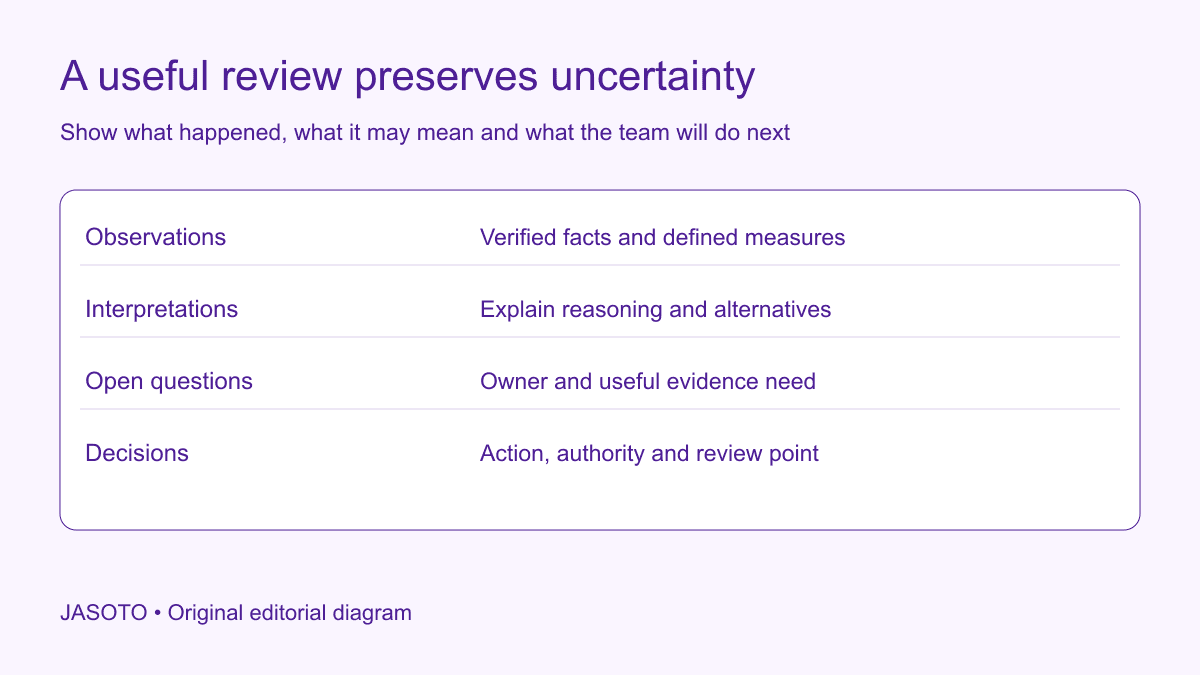
Original JASOTO editorial diagram. Its complete workflow is explained in the article; no actual customer outcome is depicted.
Write a monthly learning review by stating the decisions it should inform, summarizing verified observations and separating interpretations from unresolved questions. Review earlier actions and record what the team will do next, with owners and evidence needs. Keep uncertainty visible. A useful review can say that a change was implemented while its effect remains unknown, or that a metric moved without an established explanation.
Start with the relevant service or business scope and the actual period. This guide uses fictional UK examples and no invented performance figures. It provides a practical editorial structure for a review grounded in real records. Handle sensitive material through the organization's appropriate process and keep conclusions within the quality and scope of the evidence available.
The practical answer
- Choose the decisions the review should inform.
- Keep measured facts, estimates and interpretations distinct.
- Carry unresolved questions forward with owners and evidence needs.
- Record decisions, corrections and proportionate next checks.
Define the purpose and audience
Ask which decisions the review should support and who will act on them. A team planning next month's service work needs different detail from a reader approving a specific investment. Keep the scope explicit. A report attempting to explain every business event may become too broad to help anyone choose a useful action.
Write the review question in ordinary language, such as what became clearer about inquiry handling or which delivery dependency needs attention. Keep commercial objectives visible without treating them as achieved outcomes. The review should connect evidence to a decision, rather than collect a large set of activity numbers because they are easy to export.
Fix the period and source boundaries
Record the dates, services, channels and relevant versions included. Identify missing evidence and known gaps. A monthly label does not guarantee that every data source covers the same period. Check export dates, reporting delays and any material difference in scope before combining figures or drawing a trend.
Keep a concise source index with controlled references and owners. Avoid copying full private case records into the review. A reader should be able to verify an important observation through appropriate access without receiving unrelated personal information. The structure needs traceability, not indiscriminate duplication.
Verify definitions before comparing numbers
Check what each measure means and whether the definition changed. An inquiry, suitable request, confirmed appointment and completed job are different events. A new system may record them differently from the previous one. Preserve that context so an apparent performance change is not simply a change in classification or measurement.
[GOV.UK's performance-data introduction](https://www.gov.uk/service-manual/measuring-success/using-data-to-improve-your-service-an-introduction) connects measurement with understanding and improving service performance. Use that principle for the local review while distinguishing its government reporting requirements from this business's actual obligations. Choose measures that inform the stated task and explain their limits.
Present observations before interpretations
Write what the evidence establishes, with the relevant scope and source. Keep measured values, estimates and staff recollections distinguishable. A statement that a request category increased is different from a claim that a new page caused the increase. Put the interpretation in a separate sentence or field so the reasoning can be assessed.
Avoid turning every observation into a narrative of progress. Some changes may be neutral, unclear or unfavorable. Record them accurately and prioritize what matters to a decision. The review's credibility comes from a faithful account of the available evidence, including the parts that do not fit the team's earlier expectations.
Add context that could change the meaning
Note service changes, campaigns, outages, staffing and unusual demand where relevant. Do not bury the review in every event; include context that materially affects interpretation. A lower contact count during a closure and a lower count after clearer guidance are different situations. Keep those plausible influences visible.
For work affected by travel or attendance, record the actual dependency without assuming every delay has the same cause. A missed journey, changed venue or absent reviewer may explain part of the month. Use verified records and avoid turning a one-off event into a permanent rule about customer or staff behavior.
Review prior actions against their intended outcome
List earlier decisions with their owners, status and expected benefit. Distinguish action completed from benefit verified. Publishing a corrected page can be confirmed directly, while improved customer understanding may require later evidence. Do not close both simply because the implementation task is finished.
Keep overdue or unresolved actions visible with a useful next step. A review should not become a repeated recital of the same open item without investigating its dependency. Ask whether the action remains appropriate, needs authority or should be revised. Preserve the reasoning rather than silently removing inconvenient work from the list.
Record failed assumptions and corrected interpretations
Identify what the team expected and which evidence changed that view. Keep the original assumption traceable. A test may contradict it, fail to support it or remain inconclusive because implementation was incomplete. Those outcomes deserve different descriptions. Avoid rewriting the plan afterwards to imply that every unexpected result was anticipated.
If an earlier report contained an inaccurate interpretation, correct it with the reason and source. Maintaining credibility includes revising conclusions when evidence changes. Do not preserve a flattering claim simply because it was already presented to management. The learning record should help later decisions rely on the current best-supported account.
Separate customer evidence from population claims
Use relevant questions, observations and feedback to illustrate specific issues. State whether the material is selected or representative through an appropriate method. One customer can reveal a definite contradiction without proving how often it affects everyone. Keep that distinction clear in headings and summaries as well as detailed notes.
Handle quotations and personal context accurately through the organization's process. Generalize examples where appropriate without inventing testimonials or outcomes. The review can use a fictional explanatory scenario if clearly labelled, but it should not replace actual evidence or appear as a measured customer result.
Give uncertainty a useful structure
For each important unknown, record the question, current evidence, plausible alternatives, owner and what would help decide it. Avoid a vague caveat that everything is uncertain. The point is to identify which gaps matter and what proportionate investigation can resolve them.
Some unknowns need no immediate action because the decision is low consequence or other evidence is sufficient. Record that choice where useful. Do not create endless research tasks merely to make the review appear thorough. Prioritize questions whose answers could change an actual business or customer-facing decision.
Work through a fictional monthly finding
Imagine a business publishes a clearer service boundary and later records fewer unsuitable requests. The review verifies the content change and classifies the observed inquiries, while noting that traffic and campaign mix also changed. It records a plausible benefit but does not claim the wording alone caused the difference.
The next action checks a specific remaining misunderstanding at the request form. This fictional example supplies no fabricated percentage or financial return. It shows how facts, interpretation and uncertainty can lead to a useful decision without forcing the month into a simple success or failure story.
Choose decisions with visible trade-offs
State what the responsible owner will retain, change, stop or investigate. Link each choice to evidence and note material trade-offs. A faster process may shift work elsewhere, while a clearer boundary may reduce unsuitable contact without increasing sales. Keep the intended customer and business outcomes understandable.
Research improvement providers with a defined unmet need when support is appropriate. A useful brief identifies the evidence gap or operational problem. Avoid commissioning generic optimization from a vague monthly trend. The decision should be concrete enough for review and proportionate to what the evidence supports.
Assign next checks and correction triggers
Give each material action an owner, appropriate review point and evidence of completion. Keep implementation verification separate from later outcome review. Record conditions that would prompt correction or rollback of a customer-facing change. Preserve earlier accurate versions and the actual decision record.
Do not invent arbitrary targets to fill the plan. Use supported commitments and suitable analysis where needed. The next review should be able to determine what happened without reconstructing the original discussion. A clear action record turns learning into accountable work rather than a collection of interesting observations.
Edit the review for a reader outside the discussion
Ask a suitable colleague to identify the main facts, the strongest interpretation and the unresolved questions from the draft. If they infer a guarantee or causal claim the evidence does not support, revise the wording or presentation. Check tables, headlines and graphics alongside prose. A cautious footnote may not repair an overconfident summary.
Keep technical detail only where it helps assess the conclusion. Link supporting records through appropriate access. Consider analysis or coordination roles if recurring preparation needs capacity. The role should maintain evidence quality and follow-through, rather than simply make a report longer or more visually impressive.
Maintain the learning trail across months
Store the review with source references, definitions and material decisions. Record revisions and preserve appropriate history. Follow retention and access arrangements and remove unnecessary duplication. A later reviewer should be able to understand why a decision was reasonable at the time and what new evidence changed it.
Revisit the format when it stops informing action. The practical outcome is a monthly record that distinguishes what happened, what the team believes it means and what remains unknown, then connects those statements to responsible next steps. That supports improvement without manufactured metrics, selective success claims or false certainty.
Put the guide into practice
- Define the period, scope and evidence sources.
- Verify definitions and material changes in measurement.
- Summarize observations before interpreting them.
- Assign decisions and unresolved questions.
- Review prior actions and preserve the learning trail.
Frequently asked questions
Should a learning review include only successful work?
Include evidence relevant to the decisions, including failed assumptions, incomplete work and uncertainty. A review that selects only favorable outcomes can mislead the next plan. Describe what was actually learned and distinguish a verified improvement from an implemented action whose effects remain unknown.
Does every metric need an explanation?
Prioritize changes that matter to the review's decisions, and state when a cause is unknown. Do not invent a story for every movement. Keep definitions, context and plausible alternatives visible where they affect interpretation, and assign further investigation only when it can inform a useful action.
How detailed should the review be?
Use enough detail for a colleague to understand the evidence, its limits and the decision. Link controlled supporting records rather than reproducing every operational log. A concise review can be rigorous when its sources, definitions and unresolved questions remain traceable.
Explore JASOTO tools
Continue with JASOTO
Compare your next step
Discover UK businesses, compare services and request written quotes before making a decision.