
Customer Communication · UK Guide 2026
Write a Multilingual Temporary Closure Notice
JASOTO · Updated November 5, 2026 · 1,541 words
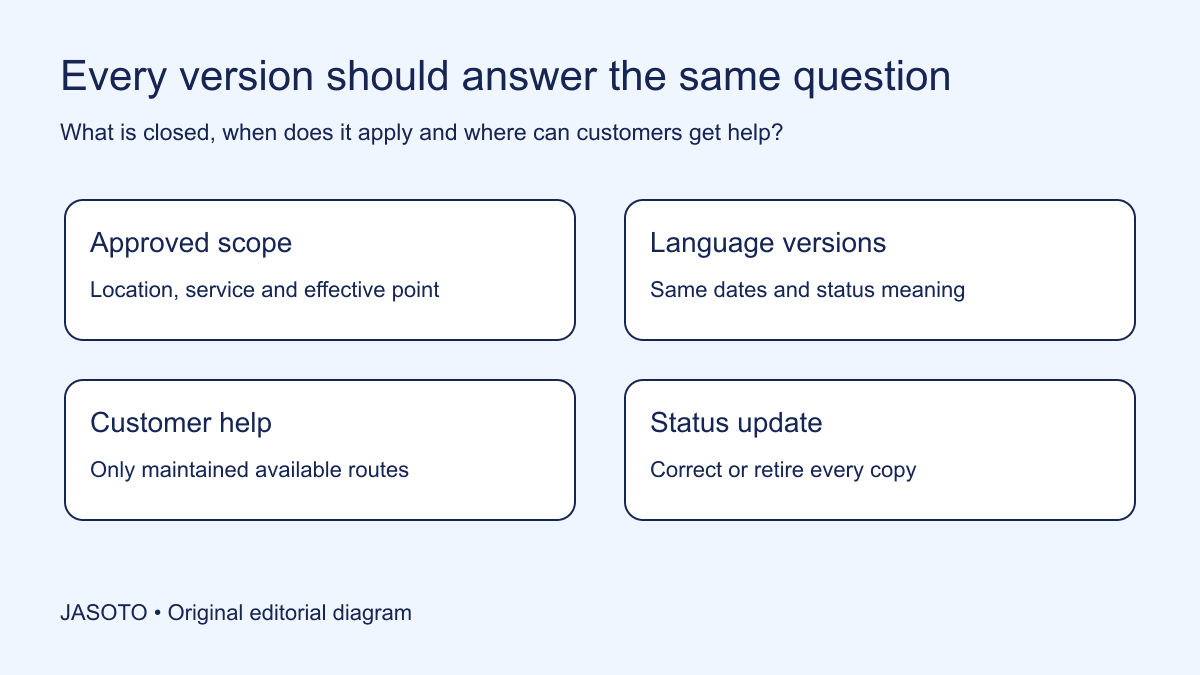
Original JASOTO editorial diagram. Its complete workflow is explained in the article; no actual customer outcome is depicted.
Write a multilingual temporary closure notice from one approved status record: what is closed, when the closure applies, what remains available and where customers can obtain help. Give language reviewers the meaning of the dates, including any uncertainty about reopening. Track every published or printed version so a later correction reaches the same audience as the original announcement.
This workflow serves a small United States business with multilingual customers. Its focus is coordinated notice publication, rather than ordinary weekly hours or a detailed translation audit. The example business is fictional. Use the actual operational decision and appropriate language review, with individual customer arrangements handled through the responsible team's established process.
The practical answer
- Approve what closes and what remains available before translation.
- Give every version the same dated status and customer next step.
- Separate a confirmed return from a review date or estimate.
- Control corrections across printed notices, pages and messages.
Define the closure's exact scope
Confirm whether the whole business, one location, a department or a particular service is unavailable. State what continues where that matters to customers. A shop may close to visits while phone support handles existing orders, but that arrangement must be real and staffed. Avoid writing a broad “we are closed” notice when it would misrepresent continuing activity.
Record the effective date and time where relevant. Distinguish a planned closure from a current interruption and an indefinite pause from a confirmed period. Give unresolved facts an owner. The writer should not supply a hopeful return date because the notice looks incomplete without one. Accurate uncertainty is a legitimate status that can be explained clearly.
Decide which audiences need the notice
Identify customers with existing arrangements, new visitors and anyone likely to arrive from a saved reference. They may need different communications. A general announcement can state the status, while affected bookings require individual handling through the normal authorized route. Do not assume publication establishes that every person with a commitment has been informed.
Choose languages using relevant audience evidence and requests, avoiding assumptions about individuals. Record the decision and a route for questions not covered by the initial versions. Explore language support where appropriate expertise is needed. A translated notice should not imply that every future conversation is available in that language unless the business has arranged the corresponding support.
Create a master record of the essential facts
Use a compact table containing notice identifier, affected activity, start, return status, available help, source owner and next review. Separate confirmed facts from estimates and pending decisions. This record gives translators and channel owners one reference without requiring them to reconstruct operational decisions from several messages.
Keep a controlled source version and record amendments. A change to reopening information may affect a single sentence in every language, but that sentence controls the notice's practical meaning. Stable fact identifiers help reviewers compare the same information even when natural sentence order differs. Avoid distributing several drafts without making the current status clear.
Write a short actionable source notice
Lead with the affected activity and closure period or current status. Follow with the relevant help route and return information. Use full dates where the message may be shared or retained. A notice saying “closed tomorrow” becomes ambiguous in a screenshot or forwarded message. Keep the source plain enough that reviewers can identify the intended action without interpreting an idiom.
Explain only the reason useful and appropriate to share. Customers generally need the operational consequence before a long account of internal problems. Do not speculate about suppliers, staff or technical causes. A factual statement that the location is temporarily unavailable can be accurate while investigation or planning continues, provided the notice is maintained when the position changes.
Distinguish return, estimate and review point
Define whether the business has a confirmed reopening, an estimate or a date to review the status. Tell language reviewers explicitly. “We will update this notice on Monday” should not become “we reopen Monday.” If the business cannot support a review commitment, provide the maintained status route it can actually offer.
Check boundary wording such as through, until and from. Ask suitable reviewers whether a reader will understand which day is included and when access resumes. Keep a practical question in the review brief: “Can a customer visit at this date and time?” That task exposes ambiguity more effectively than asking only whether a sentence is grammatically natural.
Keep help routes useful during the closure
Confirm who receives inquiries, when they are reviewed and which cases the route can handle. Test the actual path. A contact form behind the unavailable system or a phone line at an unattended premises may offer no useful help. If the route records messages for later response, explain that accurately rather than implying immediate service.
Give existing customers a way to identify their case through the appropriate process without sending unnecessary sensitive information. Keep private details out of the public notice. For a need the business cannot meet during the closure, research other providers independently. Do not invent an endorsed alternative, partnership or availability claim merely to make the announcement appear more reassuring.
Brief translators with the operational meaning
Supply the approved source, audience, channel limits and fact record. Explain business and service labels that must remain recognizable. Ask how questions will be raised and name the person who can settle factual uncertainty. The translator should not have to decide whether “closed” means no visits or no activity at all.
Arrange suitable linguistic review and a separate factual comparison of dates, scope and contact information. Do not treat a machine-generated version as approved because its digits match. A translated phrase may change the meaning of a return date or the availability of help. Hold unresolved material questions with an owner rather than burying them in a comment that disappears during export.
Choose appropriate public status fields
Review platform settings alongside the notice. [Google's business-closure guidance](https://support.google.com/business/answer/15300196?hl=en) distinguishes temporary and permanent location status. Follow current instructions for the actual business situation. A notice about one unavailable service should not automatically become a whole-business closure field if that misrepresents continuing operations.
Record submitted changes and visible results separately. External channels may not show an edit immediately. Keep the website and other controlled channels accurate while a profile issue is resolved through its proper process. Avoid claiming the status is consistent everywhere until the relevant customer views have been checked and remaining discrepancies have named owners.
Track printed and distributed copies
List door notices, reception sheets, website pages, social posts and automated messages that carry the status. Assign each an owner and version reference. A corrected master document does not replace a sheet already printed or a message scheduled earlier. Make withdrawal and replacement part of the update plan.
Consider how customers encounter excerpts. A social image may circulate without its accompanying text, so essential scope and date meaning should remain understandable in that format. Keep captions and links current. For people preparing a visit, check travel and appointment plans through the actual arrangement rather than assuming a general notice cancels or confirms an individual booking.
Work through a fictional reopening correction
Imagine a business announcing a short location closure while retaining phone support. A later operational review finds that the return date is not yet confirmed. The owner updates the master record, identifies every language and channel carrying the earlier date and assigns replacements. Reviewers preserve the difference between an unknown reopening and a specific next status review.
The team checks the door notice, public page and appointment reply, while affected customers receive individual handling. This fictional example shows why version tracking matters beyond the initial translation. It does not establish that a particular closure duration is appropriate or that every customer has been informed merely because the replacement notices are published.
Test a visitor's question in every version
Ask suitable readers whether they can use the affected service on a selected date and what help remains available. Require the answer to come from the actual notice and linked route. Inspect final layout and readability. A review document can be clear while the printed version clips a condition or makes the help contact difficult to find.
Record remaining ambiguity and correct its source. Consider customer communication roles if maintaining several versions needs dedicated capacity. Keep responsibilities practical: someone approves status, someone verifies language and someone confirms each channel. A generic “team owns updates” label can leave every person assuming another colleague replaced the physical notice.
Close the notice with a verified status change
Confirm reopening or any new arrangement with the operational owner before removing limitations. Update active versions together and withdraw expired copies. Retain the historical record through the business's process so corrections can be understood. If the service becomes permanently unavailable, make that a new decision with its own communication and customer-handling plan.
Review questions about scope, wrong-day arrivals and unavailable help using actual evidence. Identify the channel and wording involved instead of assuming the translation caused every problem. The useful outcome is a maintained set of notices whose versions preserve the same current status and give customers a truthful, usable next step.
Put the guide into practice
- Confirm closure scope, effective point and help arrangements.
- Prepare a plain master notice with stable facts.
- Arrange suitable language and factual review.
- Track every distributed version and its owner.
- Verify reopening updates and withdraw obsolete copies.
Frequently asked questions
What if the closure is announced before all translations are ready?
Use the organization's appropriate communication plan and make the current status and help route available through the channels it can support. Record missing versions with owners and communicate uncertainty honestly. Do not present an unreviewed translation as approved merely to make the version list appear complete.
Should every version say ‘closed until’ the same date?
First define whether that date is a final closed day, a confirmed reopening or a review point. Those meanings can differ across phrasing and translation. Give reviewers the approved operational boundary and check that each version supports the same practical answer about when customers may use the service.
Does closing one department mean marking the whole business closed?
Describe the actual scope and follow each platform's current rules for its business-status fields. A service pause and a location-wide closure are different situations. Avoid a broad status that misrepresents continuing activity, and make relevant service limitations clear through the channels the business controls.
Explore JASOTO tools
Compare options when a temporarily closed service cannot meet the need.
Explore customer communication roles →Define ownership for status updates and affected inquiries.
Review visit plans →Check the relevant service and appointment before a journey.
Explore language review →Consider suitable support for clear closure information.
Continue with JASOTO
Compare your next step
Discover UK businesses, compare services and request written quotes before making a decision.