
Global Business · UK Guide 2026
Keep Names and Addresses Accurate During Translation
JASOTO · Updated 5 November 2026 · 1,596 words
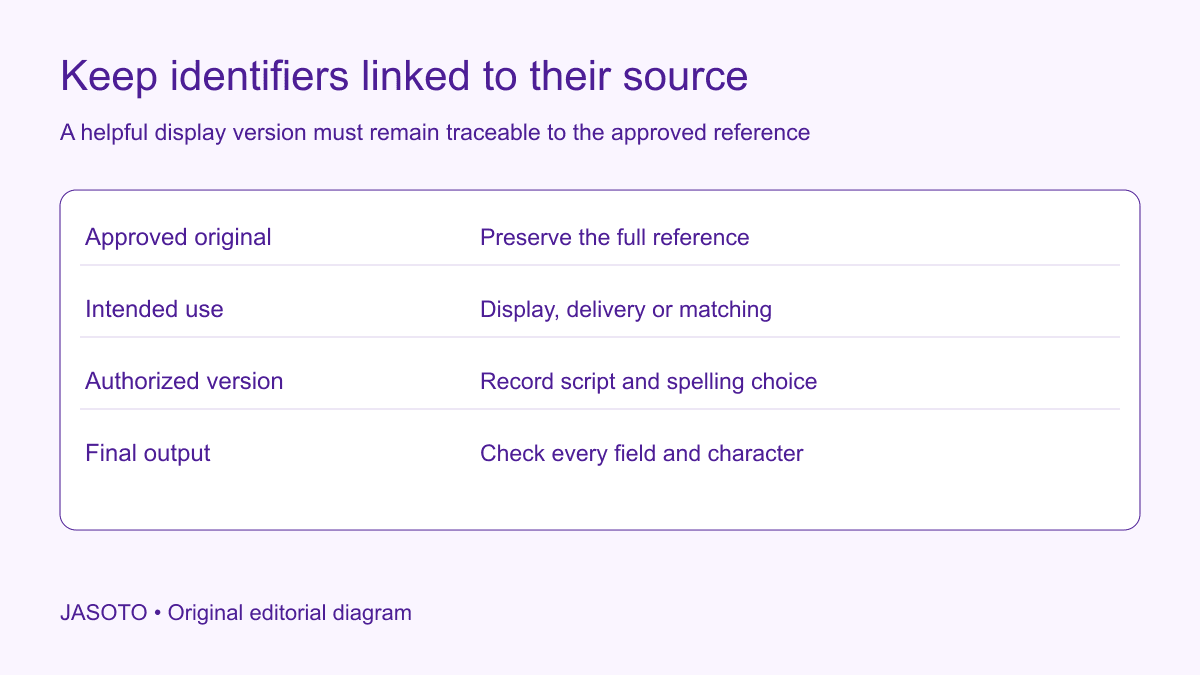
Original JASOTO editorial diagram. Its complete workflow is explained in the article; no actual customer outcome is depicted.
Keep names and addresses accurate during translation by identifying their purpose, preserving an approved reference and documenting any transliteration or localized display. Verify the final form, label or document against that reference. A name that reads naturally in one language can still lose an important component, and an address can become harder to deliver or recognize when an editor translates its identifiers without considering the task.
This guide focuses on a UK business handling ordinary multilingual customer and supplier documents. Use the actual requirements of any official matching, shipping or regulated process. The examples are fictional. The workflow helps writers and reviewers preserve information while leaving legal identity, postal rules and system requirements with the relevant authoritative sources and responsible owners.
The practical answer
- Preserve the person's or organization's approved reference details.
- Separate a translated explanation from an identifier used for delivery or matching.
- Agree how another script is represented and retain the connection.
- Check final forms, labels and exports for omissions or changed order.
Identify what each field is used for
List the names and addresses in the material and explain their functions. A greeting, delivery label, company heading and record-matching field may need different treatment. Do not assume one convenient display form is suitable everywhere. If a particular process requires a prescribed reference, record that requirement and the authority responsible for checking it.
Keep the original approved value accessible in the controlled record. Avoid overwriting it when creating another script or a shortened display. Linked fields can preserve the relationship while allowing a useful presentation for the audience. The reviewer should know which version is intended for which task, rather than choosing between several similar spellings based on appearance.
Confirm the reference through an appropriate source
Ask the person or authorized business contact to confirm the relevant details where appropriate. Use the actual reference required for a specific task and the organization's information-handling process. Do not infer a formal organization name from a social profile or reconstruct an address from an old invoice when a current approved source is available.
Record who confirmed the reference and when, without distributing unnecessary personal evidence. If two sources conflict, assign the discrepancy for resolution. A translator should not have to choose which legal entity or delivery location the business intended. Keep that factual decision separate from the language work and publish only the version approved for the purpose.
Avoid assuming a universal name structure
Check whether the system or document imposes given-name, family-name or initials fields that do not suit the actual information. [W3C's personal-names guidance](https://www.w3.org/International/questions/qa-personal-names) describes variation and warns against narrow assumptions in forms and data design. Use the relevant principle without copying cultural examples as rules for every individual.
Ask for the needed information clearly and preserve the person's chosen or required form for the task. Do not automatically reorder components, remove spaces or infer a surname from position. If the software cannot handle the reference correctly, raise the limitation with the technical owner. A workaround should be explicit and verified, rather than quietly changing the person's information to satisfy a template.
Agree transliteration and script handling
Where another script is needed, confirm the appropriate approach with suitable language expertise and the relevant reference owner. Record whether the result is an approved preferred display, a task-specific transliteration or another defined form. Do not describe a plausible spelling as the single official version unless the source and task justify that statement.
Keep the relationship to the original visible in the working record. If both forms appear publicly, choose a clear presentation that suits the audience and preserves recognition. Explore language support for appropriate expertise when the team lacks it. A reviewer recognizing the script does not necessarily have the competence to approve every transliteration or the authority to change a reference used for matching.
Separate address explanation from postal formatting
An explanatory direction can help a visitor, while a postal address must follow the relevant delivery requirements. Keep those purposes clear. A translated description such as a building's location near a landmark should not replace a street or unit identifier unless the responsible source confirms the required format. Retain the approved delivery reference alongside helpful context where appropriate.
[The Universal Postal Union's addressing resources](https://www.upu.int/en/Postal-Solutions/Programmes-Services/Addressing-Solutions) provide country-specific addressing information and standards context. Check the applicable postal operator's requirements for the real shipment or document. Avoid imposing a familiar domestic address order on every country merely because the business's form template uses that sequence.
Preserve unit, postcode and organization details
Compare all parts of the address, including building, suite or unit, locality, postal code and country where relevant. Short labels may look optional while being necessary to distinguish destinations. Check that a line break or table cell has not detached a unit from the correct organization. Do not assume an attractive single-line format preserves every required component.
For business names, distinguish a brand from the entity or site used in the actual transaction. A translation may describe the business without becoming a replacement official identifier. Ask the responsible owner what should remain unchanged and what explanatory wording may be added. Keep the reviewer focused on the real use instead of treating every proper name as either always translatable or never translatable.
Check characters through the full output path
Test the actual document, form, export and printed label where relevant. Characters can be lost or replaced when information moves between systems. A correct source spreadsheet does not establish that the final PDF or mailing label preserves it. Ask the technical owner to investigate encoding or field-limit problems rather than correcting them through unrecorded manual changes.
Check punctuation, spaces and line wrapping for meaning and usability. Avoid automatic “cleanup” rules that remove accents, apostrophes or name components without an approved reason. If an external system imposes a limitation, document the accepted workaround and verify it for the task. The goal is a traceable controlled change, not a claim that every system will support every format identically.
Keep linked documents consistent
Identify where the same reference appears: quotation, booking, delivery instruction, contact record and translated attachment. Use stable record identifiers to connect them without unnecessarily duplicating private details. A correction in one document should trigger review of the connected uses. Otherwise staff may continue selecting an older spelling from a familiar template.
For agreed visits, keep travel planning connected to the confirmed destination and entrance information. A translated place description can help context while the approved address remains the shared reference. Do not assume that a map search using an approximate transliteration returns the intended site. Verify the actual destination through the responsible local source.
Work through a fictional supplier record
Imagine a business receiving a supplier's name and delivery address in another script. A draft translation shortens the organization name and drops a unit number to fit a table. The reviewer compares it with the approved reference and identifies both changes. The supplier contact confirms the intended display and delivery form through the established process.
The final record preserves the original, approved display and delivery fields with their purposes clear. The label export is checked separately. This fictional example shows why a fluent-looking translation and a tidy layout can still lose operational information. It does not recommend a particular transliteration system or address order for another supplier.
Provide a usable correction route
Tell customers or contacts how to report an incorrect reference and give the receiving team a defined action. Check whether the correction affects a current transaction or only future display. Do not leave the person repeatedly explaining the same change because each department maintains a separate unlinked copy. Assign an owner to coordinate the relevant records.
Confirm corrections appropriately and retain the necessary change history through the organization's process. Research document and language providers with the actual reference-handling task when outside support is needed. If recurring corrections require capacity, define the work before exploring customer-data roles. The useful skill is accurate handling and escalation, not merely fast retyping.
Check sorting and salutations separately
If the translated information feeds a mailing or contact list, verify how the system creates a greeting and displays sorted results. A correctly stored full name can still be used incorrectly by a template that assumes its final word is a surname. Ask the technical or operational owner to test the actual output using appropriate non-sensitive test records.
Keep preferred address and greeting details distinct from a task-specific matching reference where the process needs both. Do not make a customer repeatedly accept an inaccurate salutation because the underlying database record appears correct. Record the correction at the point producing the mistake and review connected templates so the same assumption does not return in another language version.
Approve the final reference set and maintain it
Record the source, intended uses, approved variants, reviewers and current version. Check the final customer-visible output, not just the internal record. Keep unresolved differences visible and prevent an unapproved draft from becoming the default template. Preserve earlier material appropriately so a change can be understood and corrected if it was applied incorrectly.
Review the process when new languages, systems or delivery destinations are added. Use real errors to identify where information was altered, rather than blaming translation for every mismatch. A dependable workflow lets the team explain which reference was approved, how another version relates to it and whether the final output still preserves the information needed for its actual task.
Put the guide into practice
- Identify the purpose of every name and address field.
- Confirm the reference with an authorized source.
- Record any approved transliteration or localized display.
- Check postal formatting through relevant official guidance.
- Test complete output and a correction path.
Frequently asked questions
Should every name be forced into first-name and last-name fields?
Check what the task actually needs and avoid assuming all names share that structure. Some systems require specific fields, so involve the responsible technical or operational owner where a limitation exists. Preserve the approved full reference and give people a usable correction route rather than silently dropping parts.
Can a street name be translated to make directions clearer?
Distinguish a helpful explanation from the address used for delivery or identification. Keep the approved reference recognizable and check the relevant postal or local guidance. A descriptive translation can help context, but should not silently replace the actual street identifier in a way that makes matching or arrival harder.
Who should approve a transliterated name?
Use the person or authorized organization where appropriate, together with any reference required for the specific task. A preferred display name and a name used to match an official record can serve different purposes. Explain the distinction and do not assume one spelling is universally correct for every context.
Explore JASOTO tools
Brief providers with the reference fields and actual use.
Explore customer-data roles →Define ownership for corrections and linked records.
Check arrival references →Keep travel and visit information connected to confirmed destination details.
Explore language services →Consider appropriate support for scripts and transliteration.
Continue with JASOTO
Compare your next step
Discover UK businesses, compare services and request written quotes before making a decision.