
Jobs & Careers · UK Guide 2026
Plan a New Starter's First Useful Task
JASOTO · Updated 5 November 2026 · 1,641 words
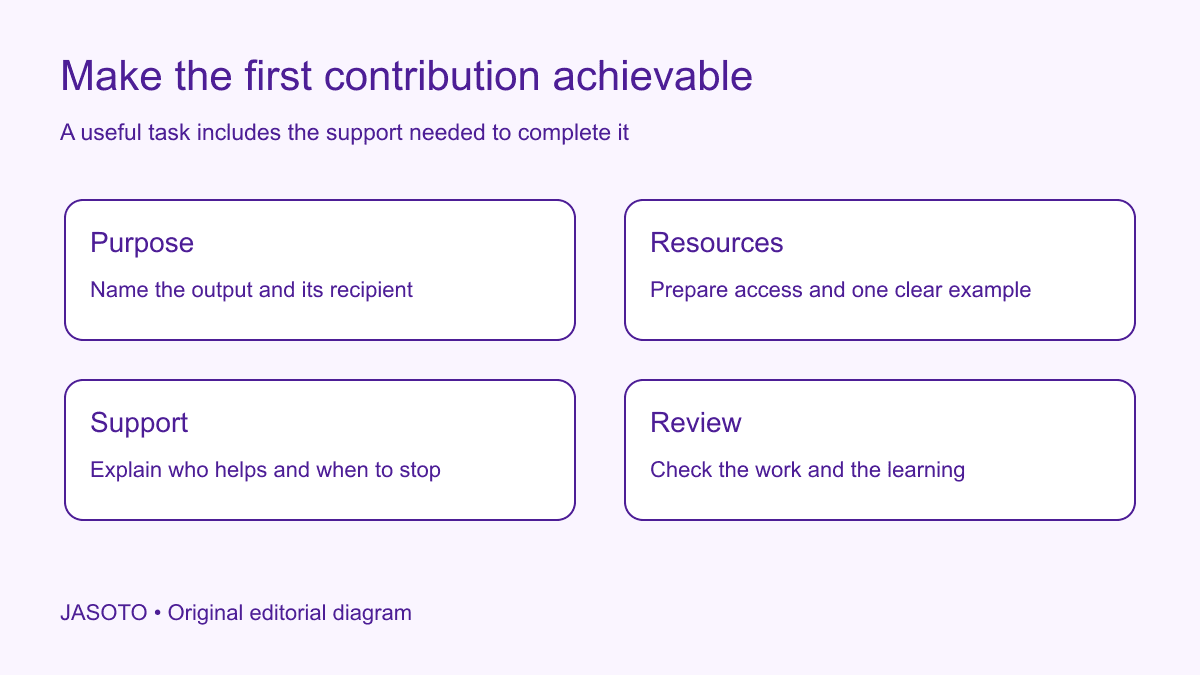
Original JASOTO editorial diagram. Its complete workflow is explained in the article; no actual customer outcome is depicted.
A new starter's first useful task should produce a small real contribution with a clear purpose, prepared resources, available support and an agreed review point. Choose work they can understand and complete within their induction, then explain exactly what they can change and where they should ask for help.
For a small UK employer, useful first work can build a bridge between introductions and everyday responsibilities. It needs preparation: a task that is simple for an experienced colleague may depend on several unwritten decisions. Make those decisions visible so the starter can learn the work and contribute without having to guess how the organisation operates.
The practical answer
- Choose a real bounded contribution with a clear recipient.
- Prepare access, examples and support before assigning the task.
- Define what the starter can change and where they should stop.
- Review the output together and agree the next learning step.
Choose a real contribution with a recipient
Start with an output someone will genuinely use. It might be a checked list of meeting materials, a draft internal schedule or a small update prepared for review. Name the recipient and explain how the output supports their work.
Avoid choosing a task only because nobody else wants to do it. The first activity should introduce something meaningful about the role, such as finding an authoritative record, checking information or following a clear handover. A bounded administrative contribution can teach that pattern without requiring independent responsibility for a whole process.
Ask the recipient what they actually need and whether they can review the result at the planned time. A supposedly useful task becomes frustrating if the starter completes it and nobody knows why it was assigned. Agree the purpose before turning it into an induction instruction.
Fit the task into the wider induction
[Acas recommends planning induction before a worker starts and tailoring it to the person](https://www.acas.org.uk/inductions/planning-an-induction-programme). Use that principle to place the first task after the introductions, training and practical arrangements it depends on.
Check the relevant prerequisites for the actual role. The starter may need a system introduction, a local procedure, appropriate safety training or an explanation of confidentiality arrangements before handling particular work. Do not use a small task as a reason to skip those steps.
Consider the person's working location, experience and agreed support needs when scheduling it. A remote starter may need a deliberate way to ask a quick question that an office colleague would raise at the next desk. The useful output matters, but so does ensuring that the person has a reasonable opportunity to understand and complete it within the employer's induction arrangements.
Set a clear boundary around the work
Describe the start and finish in concrete terms. “Prepare a draft list of the materials required for Thursday's internal meeting, using the confirmed agenda” is easier to follow than “help with meetings.” State what is outside the task as well as what completion means.
Identify decisions the starter can make and decisions that require review. They might flag a missing quantity without ordering supplies, or prepare a draft message without sending it. Those limits should come from the actual role and process, rather than an arbitrary desire to make the activity seem easy.
Give a stop instruction for uncertainty. For example: “If the agenda and booking record disagree, note the difference and ask the coordinator before changing either.” A starter should know that raising a genuine discrepancy is part of doing the task well, rather than an admission that they cannot cope.
Prepare access and materials in advance
Check that the relevant account, workspace and permissions are ready through the organisation's proper access process. Test the task from the starter's expected level of access where practical. A manager's ability to open a record does not prove that the new employee can open it.
Collect the source material and identify its purpose. Explain which version is current, whether the record is a draft and where the completed work should go. If an example is provided, make clear whether it illustrates format, reasoning or both.
Use appropriate information for the person's role and stage of induction. Do not solve a preparation problem by sharing credentials or copying sensitive material into an unsuitable location. If access is delayed, use a prepared alternative with a clear learning purpose. Let the starter practise the relevant workflow without encouraging a workaround that undermines the organisation's normal arrangements.
Explain the task through one worked example
Show a short example of a completed item and explain the reasoning behind it. The example should reveal how the source information becomes the required output. Simply displaying a polished final document may leave the important decisions hidden.
For instance, demonstrate how a confirmed agenda item becomes one line in a meeting-materials list. Explain why a quantity was used, where it came from and what would trigger a question. Then let the starter apply the same pattern to a small remaining section.
Ask them to describe their understanding of the next action in their own words. This is a check on the instruction as well as their understanding. Correct any ambiguity before they spend time completing the wrong version. Keep the exchange conversational and supportive, with room for questions about terms that experienced colleagues no longer notice are organisation-specific.
Name available support and a review point
Give the starter one named person for task questions and explain how to reach them. Check that person is actually available during the task. A general instruction to ask anyone can feel unhelpful when the starter does not yet know who owns which part of the work.
Agree a review point before any consequential next action. That might be a short check after the first few items, followed by a review of the completed draft. Choose the checkpoints around the work's dependencies and the person's induction needs rather than an arbitrary promise that every first task should take the same time.
Explain what happens if support is temporarily unavailable. The starter might save the draft and note the question, then continue with an independent portion. They should not feel obliged to guess an approval, send an uncertain message or change a live record simply to appear productive.
Work through an internal-workshop example
Imagine a fictional organisation welcoming an office assistant. Their first task is to prepare a draft materials list for an internal workshop. The coordinator provides the confirmed agenda, expected attendance and a previous list showing the required format.
The starter can list the ordinary materials specified in the agenda and note quantities supported by the attendance figure. They are asked to flag anything missing or contradictory. They will not place orders, contact attendees or change the room booking. The coordinator checks the first two entries before the starter completes the rest.
The output is useful because the coordinator can review and use it when preparing the workshop. The starter learns where confirmed information lives, how to handle a discrepancy and who approves the next step. This example concerns supported employee induction, rather than a recruitment exercise or a claim about a real employee's performance.
Review the output and the instructions together
At the review, connect feedback to the task's purpose. Explain which parts are ready to use, what needs correction and why. Show the appropriate correction rather than replacing the starter's work silently and leaving them unsure whether they understood it.
Ask where the instruction required a guess. A missing definition or inaccessible reference may explain an error more clearly than a broad judgment about care or initiative. Review the source material and support arrangements alongside the output.
Give the starter an opportunity to explain their reasoning. They may have spotted a genuine inconsistency that the example overlooked. Resolve it with the responsible colleague and update the instruction if needed. The first task can improve the induction material as well as produce a contribution. Keep feedback specific enough that the starter knows what to repeat and what to change next time.
Increase complexity one dependency at a time
Use the review to choose a sensible next activity. The next step might introduce another source, a new recipient or a wider decision boundary. Explain the change so the starter knows which part of the familiar pattern still applies.
Avoid assuming that one successful draft demonstrates independent competence across the whole role. A task completed with close guidance shows what happened under those conditions. Broader responsibility needs the appropriate training, observation and authorisation for the work concerned.
Equally, do not keep assigning disconnected miniature activities with no explanation of how they fit together. Show the larger process gradually: where the request starts, what the role contributes and what the next colleague does with the result. That context helps the starter understand why the checks matter and how their work connects to the team's responsibilities.
Keep a practical record of the next step
Record the activity completed, the support given, useful feedback and the agreed next learning step in the organisation's appropriate induction record. Keep it proportionate. A clear note about locating the current source and checking discrepancies is more useful than an unsupported statement that the person is a natural fit.
Confirm who will prepare the next activity and when the starter can expect another review. Check any unresolved access or training need with the responsible person rather than leaving the new employee to chase an unfamiliar internal process alone.
Explore business support providers where induction preparation needs help, connect the early activity to the actual role responsibilities, and confirm the working location before planning travel. The first task is ready when the output has a real purpose, the starter has a clear route through it and someone is available to help them learn from the result.
Put the guide into practice
- Name the useful output and its recipient.
- Check prerequisites, appropriate access and support availability.
- Explain the scope, example and review point.
- Review both the output and the instructions before increasing complexity.
Frequently asked questions
Should the first task be a test of whether the new employee can cope?
Treat this as supported work within induction. Explain the purpose, provide the information and access needed, and make help available. A hidden challenge with missing instructions tells you little about how the person will work with an appropriate introduction to the role.
What if the starter cannot access the required system?
Pause that task and resolve access through the proper process. Do not share another person's credentials or ask the starter to improvise around an access restriction. Use a prepared alternative that still introduces a real part of the work without requiring unauthorised access.
How large should the first useful task be?
Choose a bounded activity the starter can understand, complete and review with available support. Its size depends on the role, prerequisites and individual induction needs. A small checked contribution is more useful than a large assignment that remains unclear or cannot be safely reviewed.
Explore JASOTO tools
Discuss practical onboarding preparation and documentation with relevant providers.
Connect induction to the actual role →Keep early work aligned with the responsibilities communicated during recruitment.
Prepare confirmed workplace travel →Research the journey after the employer confirms the starter's location and attendance plan.
Continue with JASOTO
Compare your next step
Discover UK businesses, compare services and request written quotes before making a decision.