
Jobs & Careers · UK Guide 2026
Plan New Starter Introductions Across Time Zones
JASOTO · Updated 5 November 2026 · 1,726 words
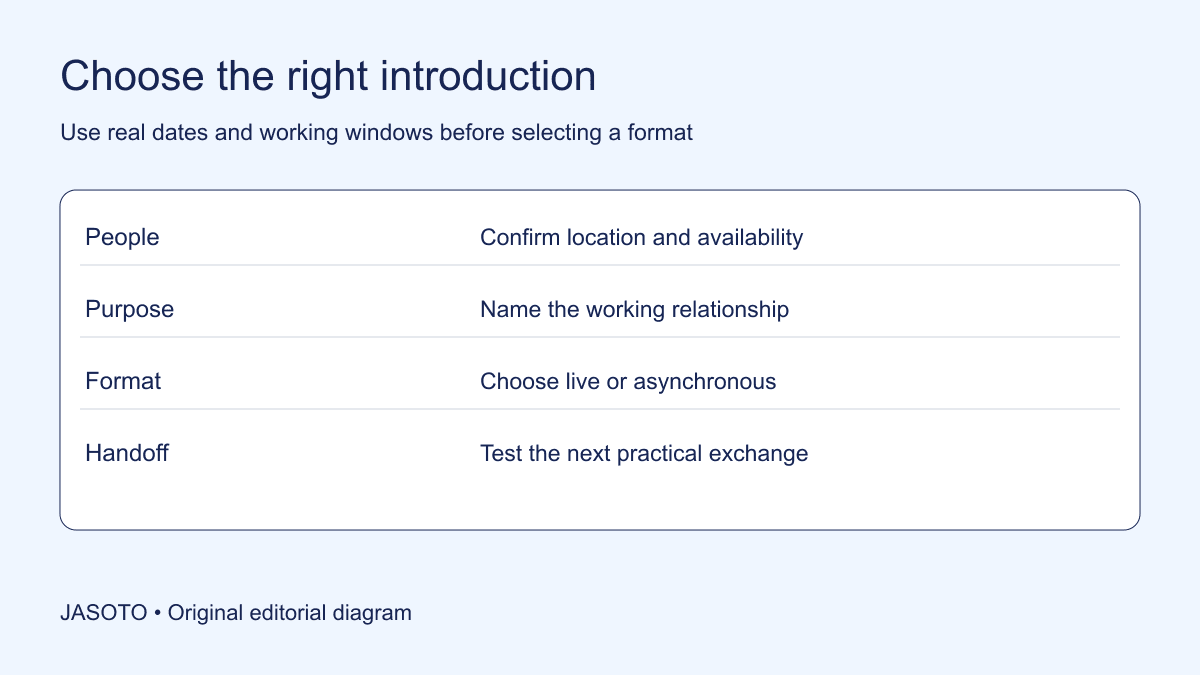
Original JASOTO editorial diagram. Its complete workflow is explained in the article; no actual customer outcome is depicted.
Plan introductions across time zones by confirming each person's working hours for the actual meeting date, choosing who truly needs to meet live and giving everyone an explicit local-time invitation. Do not build the timetable from a remembered difference between two cities. An introduction is useful when the new colleague learns how to work with someone, even if part of that exchange happens through a short written briefing rather than a group call.
This guide presents an original scheduling method for a UK-based team welcoming a colleague who will work with people elsewhere. Google Calendar documents creating events with a time zone and displaying them in invitees' local zones. GOV.UK and NIST publish their respective clock-change information. Those sources support the date-checking steps; the meeting priorities, contact cards and fallback examples below are editorial recommendations rather than universal rules for distributed teams.
The practical answer
- Convert for the actual meeting date.
- Confirm working windows directly.
- Reserve live calls for useful interaction.
- Practise a realistic cross-zone handoff.
Map working windows instead of collecting city names
Ask each person for their normal available window, the relevant location or time zone and any date-specific restrictions. A city name alone does not tell you whether somebody works an early shift, has a non-working day or is travelling that week. Keep the question practical: “When could you join a short introduction on this date?” Avoid asking for private reasons behind every unavailable period.
Record a single coordinator's working view of the windows and tell contributors how to correct it. Distinguish confirmed hours from assumptions inherited from an old team directory. In an invented project team with colleagues in London, New York and Singapore, the coordinator should confirm the proposed dates with the actual people. Do not assume that every colleague in one country shares a time zone or that a large region can be represented accurately by one convenient abbreviation.
Use the real date for every conversion
Select the date before checking the time difference. UK and US clock changes do not always occur on the same dates, and not every place follows the same clock rules. Confirm relevant current information rather than hard-coding a permanent offset in a welcome pack. For future introductions, revisit the conversion if the date changes. Moving a meeting by a week can alter what a remembered time difference produces.
When using Google Calendar, set the event's appropriate time zone and inspect the resulting invitation. Ask a participant to confirm the time shown locally if there is any doubt. Do not manually edit a local time into the title and then move the event without updating that text. The calendar event and its written description should agree. A correct invitation can still cause confusion when a copied email continues to advertise the previous time.
Decide which introductions require a live conversation
List what the starter needs from each contact. A manager may need a live discussion of priorities. A colleague responsible for a routine handoff might be able to provide a short contact card and answer one question asynchronously. Reserve shared time for decisions, relationship building and demonstrations that benefit from immediate exchange. Do not assume every name in the company directory needs a separate meeting during the first week.
Give each introduction a concrete outcome. “Understand who approves a changed delivery promise” is more useful than “meet operations”. The outcome helps you choose the format and participants. A three-person discussion may solve a handoff question that would otherwise generate several disconnected calls. Equally, a large welcome call can make it difficult for the starter to ask a practical question. Select the format for the purpose instead of defaulting to the biggest available gathering.
Build a contact card before the meeting
Ask each contact to provide their name, role, typical responsibilities, preferred work channel and a short explanation of when the starter should contact them. Include a concrete example such as “ask me before confirming a delivery that requires a special collection”. This turns a person's name into a useful route through the work. Keep the card short enough to review before the introduction.
State what the contact cannot decide where that boundary matters. Someone may explain a process but need a different colleague to authorise an exception. A clear card reduces the risk that the starter interprets friendliness or availability as decision-making authority. Use business contact details and relevant working information, rather than personal phone numbers collected merely because time zones make spontaneous contact inconvenient. Keep the cards in a place the starter can access through their approved account.
Allocate overlap fairly and consciously
Identify the actual overlap before selecting a slot. If there is no reasonable common window, change the meeting design rather than silently assuming one person will join outside agreed hours. Split the introduction, exchange a briefing first or ask the manager how to handle the scheduling constraint. Make any exception explicit and agreed through the organisation's arrangements; an automated calendar suggestion is not consent to an inconvenient working pattern.
Consider the starter's whole day, not just each meeting in isolation. Several individually plausible calls can create a very early start and a very late finish. The coordinator should inspect the complete schedule and ask whether it is workable. For recurring introductions, rotate unavoidable inconvenience only where appropriate and agreed. Do not describe rotation as inherently fair if some participants still cannot attend because of their work arrangements. Fairness begins with checking constraints rather than dividing discomfort mathematically.
Write an invitation that survives copying
Include the date, expected duration, named host, purpose, joining link and fallback contact. State the main organising time zone and, where helpful, the confirmed local times for the specific participants. Use an unambiguous written date when communicating across places that use different numeric date conventions. Avoid “tomorrow morning” in a message that recipients may read on different local dates.
Keep one current event. When the time changes, update the invitation and tell participants which version replaces the earlier proposal. If a briefing contains a second written time, correct that too. Ask the starter to check their calendar's configured zone before treating a displayed time as correct. The point is not to make the employee responsible for fixing the team's scheduling errors; it is to catch mismatches before someone sits alone in a call waiting for a colleague on another continent.
Make asynchronous introductions actionable
Provide a short written or recorded introduction with a clear prompt. A contact might explain the handoff they own, show a sample request and ask the starter to identify which information they would include. Give the starter a route to reply and tell them when a response is expected. A recording without a question or follow-up route can become another document in an unread welcome folder.
Choose information suitable for the medium and follow the organisation's arrangements for recording and sharing. A written example can often replace a recorded live customer screen. If a recording is used, provide an appropriate alternative and keep essential instructions available in a form the person can revisit. Do not assume everyone can hear a short video or has the same connection quality. The goal is a useful exchange that works across time zones, rather than a particular media format.
Rehearse a cross-time-zone handoff
Use an invented, low-impact task to test the working relationship after the introductions. For example, the UK coordinator prepares a sample request for a colleague whose working day begins later. The request should state the decision needed, supporting information and what can wait until the recipient is available. Ask the starter to write the handoff, then have the recipient explain whether they could act without another round of questions.
Review what happened at the transition between working days. Was the next action clear? Was somebody waiting for a response that was not due until the next local morning? Did an unfamiliar abbreviation obscure the deadline? This exercise reveals more than asking participants whether they enjoyed the welcome call. Correct the actual handoff instructions and keep the sample available, labelled as an example. Avoid using a real urgent customer issue as the starter's first test of an unfamiliar coordination arrangement.
Prepare the missed-call fallback
Tell the starter what to do if a contact does not appear. Give a reasonable waiting point, a named person to notify and an alternative activity. A missed introduction should not lead to repeated calls to personal numbers or an assumption that the absent colleague has ignored the employee. The event may have been displayed in the wrong zone, the host may be delayed or a local working arrangement may have changed.
Afterwards, establish the cause and update the plan. If the issue was a time-zone mismatch, correct the recurring event and any written schedule. If availability was wrong, repair the contact information rather than merely sending another invitation. Where outside coordination support is needed, discover relevant business services and confirm the provider's working hours. If a future in-person introduction is proposed, agree its location and purpose before researching travel options, including the effect of arrival dates on working availability.
Review the contact map after real work
At the end of the first working cycle, ask the starter which contact they used, which handoff was unclear and which person they still need to meet. Add targeted introductions based on actual gaps. Remove unnecessary recurring calls once their purpose is complete, preserving the contact cards and current instructions. A welcome programme should evolve into an ordinary working relationship rather than leave a permanent layer of induction meetings in everyone's calendar.
When describing distributed roles, explain the expected collaboration pattern and where cross-time-zone work occurs. The schedule should reflect those expectations rather than introduce them as a surprise after joining. If the original plan is too demanding, the rollback is straightforward: shorten the live list, move nonessential introductions and use clear asynchronous exchanges. Success means the new colleague knows whom to approach and how to hand work over across working windows, with a timetable people can actually keep.
Put the guide into practice
- Collect confirmed availability.
- Check dated calendar invitations.
- Prepare concise contact cards.
- Review the first real handoff.
Frequently asked questions
Can I use a fixed UK-to-US time difference in a welcome pack?
Use date-specific conversions instead. Check the actual locations and the meeting date, because clock changes and regional differences can affect the result. Keep the calendar event and any written local times consistent, and recheck both when moving an introduction to another date.
Does every introduction need a video call?
No. Choose a format that serves the purpose. A written contact card, sample handoff and reply prompt may work for a routine process, while a live discussion may be better for expectations or a complex decision. Give asynchronous introductions a clear route for questions and a follow-up owner.
What if there is no shared working window?
Split the conversation or use an asynchronous exchange before asking for an exception to normal hours. Discuss any unavoidable constraint with the responsible manager and participants. Do not treat an empty calendar space as proof that someone is available or has agreed to work outside their normal pattern.
Explore JASOTO tools
Discover providers and check support for your specific task.
Explore roles and responsibilities →Consider the practical responsibilities involved when recruiting or joining a team.
Plan work-related travel →Research a journey when joining, training or meeting colleagues in person.
Continue with JASOTO
Compare your next step
Discover UK businesses, compare services and request written quotes before making a decision.