
Business Operations · UK Guide 2026
Track Corrections After a New Supplier's First Order
JASOTO · Updated November 5, 2026 · 1,550 words
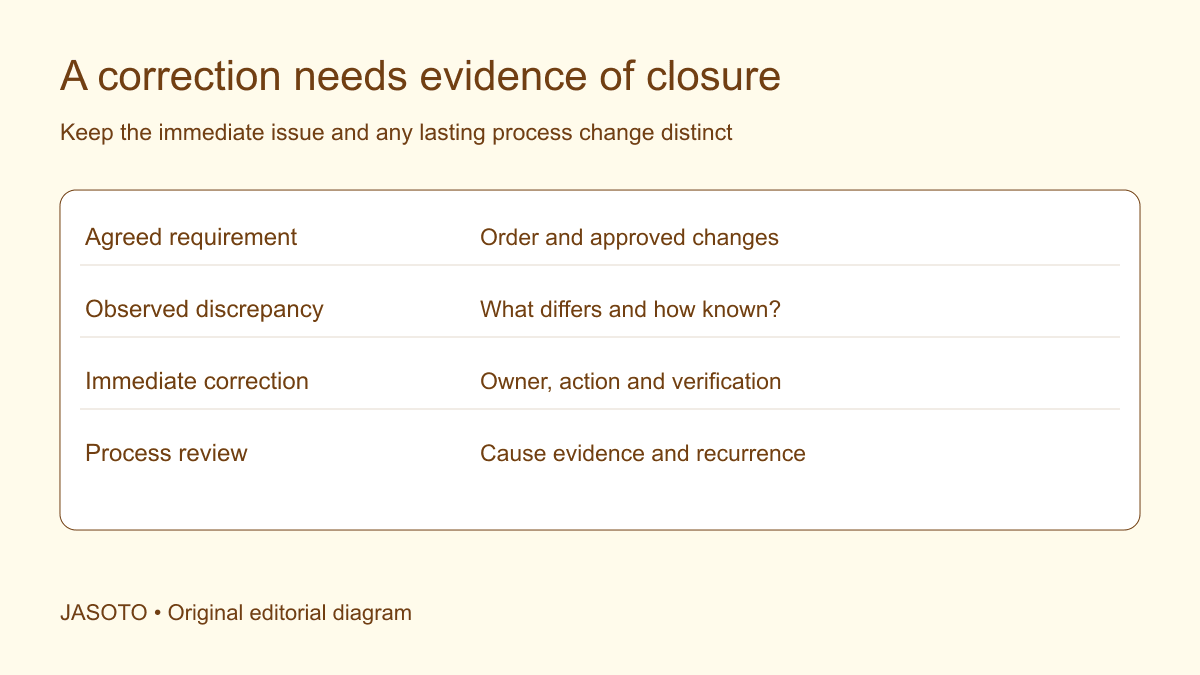
Original JASOTO editorial diagram. Its complete workflow is explained in the article; no actual customer outcome is depicted.
Track corrections after a new supplier's first order by comparing the delivery with the approved agreement, recording each discrepancy with evidence and assigning an owner for the next action. Verify the actual correction before closing it. Keep the immediate replacement or document fix separate from any investigation of why the issue occurred and whether the process needs to change.
The first order can reveal misunderstandings that were invisible during setup, but it is only one observation. This guide uses fictional United States business records and provides an operational review structure. Contractual disputes, acceptance rights and specialist product judgments belong with the authorized owner and appropriate expertise. The log should preserve evidence without pretending to decide those matters through a status label.
The practical answer
- Compare the delivered order with the approved agreement and changes.
- Record the discrepancy and evidence without guessing its cause.
- Assign immediate correction and any process investigation separately.
- Verify closure and inspect the next relevant order for recurrence.
Collect the agreed order baseline
Gather the purchase order, accepted specification, relevant quotation and approved changes. Identify which version governed the delivery. A buyer may remember an informal request that the supplier never accepted, while a revised instruction may sit outside the main order record. Resolve the document relationship before labelling every difference a supplier error.
Keep the actual receiving record and controlled supporting material linked. Record dates and who can explain the delivery. The review should let another colleague reconstruct the agreed requirement and observed result without searching several private mailboxes. Avoid copying unnecessary personal or financial details into a general correction worksheet.
Define the discrepancy precisely
State what was expected, what was observed and how the difference was established. Use product, quantity, document or delivery references appropriate to the task. “Wrong order” leaves too much unclear. A specific record makes it easier for the supplier and buyer to investigate the same issue and avoid talking about different items.
Keep observation separate from cause. A label mismatch may be real while its origin remains unknown. Do not assume poor training, negligence or a system defect without evidence. Record uncertainty and give investigation to the appropriate person. The log's credibility depends on accurately preserving what the business knows, not supplying a confident explanation for every problem.
Give each correction a stable reference
Assign an issue identifier and link it to the relevant order and receiving record. Include current status, owner, next action and review point. Keep several independent discrepancies distinguishable even when the supplier proposes one combined response. That lets the business verify each outcome without assuming a single closed email resolves everything.
Use plain states such as raised, clarification needed, action agreed, correction received and verified. Define what qualifies for closure. A supplier acknowledging the message is a different event from a corrected item arriving. Avoid a status called resolved that nobody can explain when a later colleague asks what evidence supported it.
Assess consequence and choose a proportionate response
Ask the responsible owner how the discrepancy affects the intended work, customer commitment or next order. Use appropriate specialist advice where product safety or technical suitability is involved. The administrative reviewer should not improvise a workaround or authorize use of an item merely to keep the schedule moving.
Prioritize based on actual consequence and uncertainty. A minor clerical correction can be handled simply, while a repeated or consequential issue may require a deeper process review. Record the rationale. The first-order review should improve decisions without turning every harmless difference into an elaborate investigation or overlooking a significant problem because the supplier is new.
Agree the immediate correction and its owner
Record what the parties have actually agreed: replacement, corrected document, additional information or another approved action. Identify the responsible person and the evidence needed to verify completion. Keep commercial and acceptance decisions with their authorized owners. Do not treat an informal suggestion as a confirmed remedy.
Confirm relevant timing through the actual arrangement without inventing a universal turnaround target. If an estimate is unconfirmed, label it. Record what the buyer must do, such as provide a reference or arrange an authorized collection. A correction often depends on actions on both sides, and the log should make those dependencies visible.
Separate correction from investigation of cause
A replacement can address the immediate need while the source of the discrepancy remains unresolved. [ASQ's root-cause analysis guidance](https://asq.org/quality-resources/root-cause-analysis) distinguishes investigation of causes within a broader problem-solving process. Use suitable methods and expertise for the actual issue rather than declaring a root cause from one plausible explanation.
Record any proposed process change separately, with its owner and evidence. If the cause is unclear, say so. Do not require a lengthy analysis for every small issue, but avoid claiming a permanent fix when the record only establishes a one-time correction. That distinction helps the next order review focus on the dependency that may recur.
Check the buyer's contribution to the problem
Review whether the requirement was complete, understandable and sent through the agreed route. A supplier may have followed an outdated document because the buyer's update did not reach the operational contact. Investigate the actual handover rather than assigning blame based on which organization noticed the issue first.
If the buyer's process needs correction, record that action with an internal owner. Preserve the original evidence and approved change history. Do not rewrite the purchase record retrospectively to imply that the corrected requirement was always clear. Honest shared learning gives both sides a more useful basis for the next transaction.
Keep communications attached to the issue
Use the correction identifier in relevant messages and documents. Summarize decisions and link supporting records through appropriate access. Avoid distributing a long uncontrolled email chain as the only status record. A colleague covering an absence should be able to identify the current agreement and next action quickly.
If a supplier call settles a material point, record and confirm the relevant outcome through the established process. Keep disputed interpretations visible. A friendly conversation can improve cooperation, but it does not automatically establish every commercial or technical decision. The correction log should reflect what was actually authorized and verified.
Verify the received correction
Compare the replacement, revised document or other action with the agreed correction. Use appropriate receiving and specialist checks. An item arriving is not proof that it is the right one, and an updated file may still contain an old reference. Record the exact evidence and reviewer supporting closure.
Keep any unresolved part open with an owner. Do not close the whole issue because the most visible component is fixed. If the correction creates another discrepancy, link the records and investigate through the same controlled process. The goal is a coherent account of the actual state, not a tidy table in which every row must turn green.
Work through a fictional specification mismatch
Imagine a supplier's first delivery includes labels matching an earlier specification. The buyer records the observed mismatch and links the approved change. Review shows the change reached the sales contact but its operational transmission is not yet established. The parties agree the immediate correction and separately investigate the document handover.
The corrected delivery is verified against the agreed reference. A later order checks whether the revised handover process works. This fictional example supplies no claimed defect rate or savings. It illustrates how evidence, immediate remedy and process learning can remain distinct without making an unsupported judgment about either party's motives.
Review recurrence on the next relevant order
Choose what evidence would show the proposed process change is working. Inspect a relevant later order rather than treating a generic assurance as verification. Keep the context visible: different products, volumes or delivery arrangements may not test the same dependency. A single successful repeat provides limited evidence, not proof that the issue can never recur.
If recurrence appears, reopen the investigation with the new evidence. Avoid simply repeating the same administrative reminder without asking why it failed. The appropriate response depends on the consequence and actual agreement. Give supplier relationship or sourcing decisions to the authorized owner, supported by a factual record.
Keep costs and effort separate from invented savings
Where useful, record actual correction effort, delay or documented cost through the responsible process. Define what is included and avoid converting every hour into a financial loss without an approved basis. A learning log can be valuable without a dramatic monetary claim. Keep estimates distinct from observed records.
For an agreed onsite review, plan supplier travel through the responsible team. Research support providers with the documented problem if assistance is needed. Do not use the correction process to manufacture a supplier comparison from incomparable first orders or unsupported reputation claims.
Close with a reusable learning note
Summarize the agreed requirement, discrepancy, verified correction, remaining uncertainty and any process change. Identify what should carry into the next purchase. Keep the record accessible to relevant colleagues and follow appropriate retention arrangements. Explore purchasing coordination roles if continuing ownership needs capacity.
Preserve earlier documents and a correction path for mistakes in the record. The practical result is a first-order review that can show what went wrong, what was actually fixed and what still needs evidence. That supports a more reliable supplier relationship without turning a single delivery into a fabricated performance verdict.
Put the guide into practice
- Collect the approved order and receiving record.
- Give each discrepancy a stable reference.
- Agree owners, evidence and correction status.
- Verify the actual replacement or document change.
- Review recurrence before claiming the process is fixed.
Frequently asked questions
Does a replacement item close the whole supplier issue?
It may resolve the immediate delivery problem, but a separate process question can remain. Record what was corrected and what still needs investigation. Do not claim the cause is eliminated merely because one replacement arrived, especially if later orders depend on the same unclear specification or handover.
Should every small issue become a formal investigation?
Choose a proportionate response based on consequence, uncertainty and recurrence. A simple documented correction may be enough for a minor understood issue. Keep significant or repeated problems visible and use suitable expertise when the cause or impact needs deeper investigation.
What if the supplier and buyer disagree about the order?
Preserve the relevant approved documents and describe the discrepancy precisely. Refer scope, acceptance and commercial questions to the authorized owner and appropriate advice. Avoid recording a disputed interpretation as a proven defect or changing the purchase record to make the disagreement disappear.
Explore JASOTO tools
Continue with JASOTO
Compare your next step
Discover UK businesses, compare services and request written quotes before making a decision.