
Travel · UK Guide 2026
Prepare Office Arrival Instructions a Guest Can Follow
JASOTO · Updated 5 November 2026 · 1,657 words
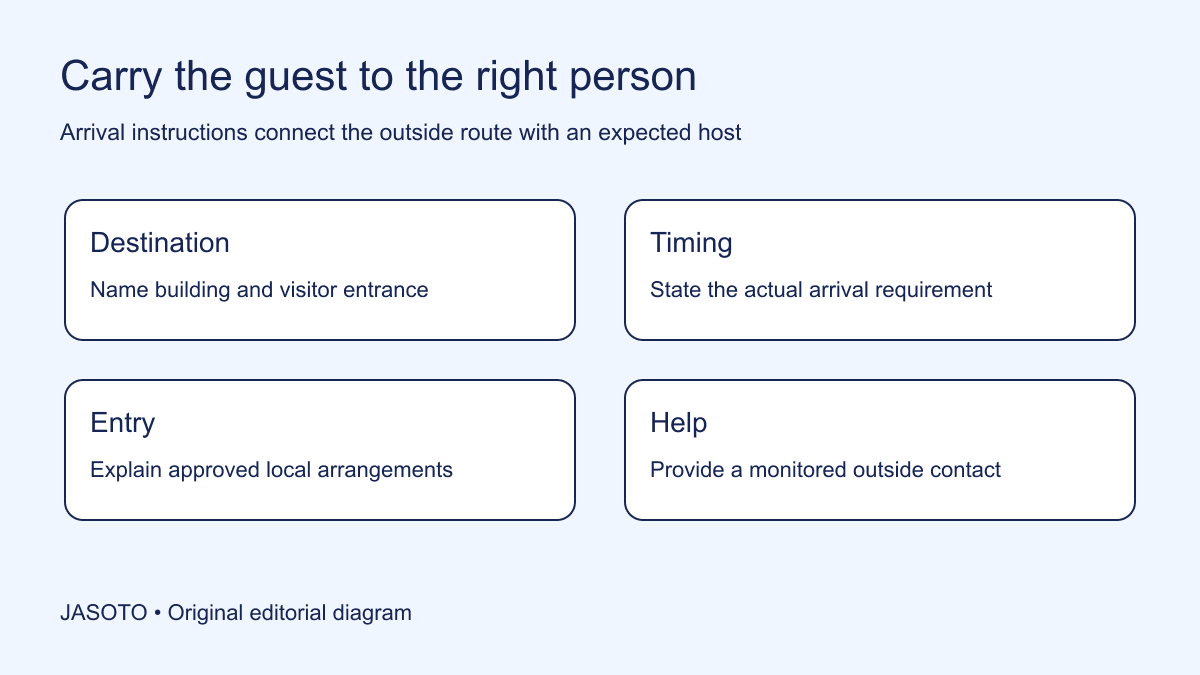
Original JASOTO editorial diagram. Its complete workflow is explained in the article; no actual customer outcome is depicted.
Send an office guest one current arrival message containing the confirmed date and time, full destination, correct entrance, named host and a contact that works when they are outside the building. Add the practical entry requirements and ask about any arrangements needed for the visit. The instructions should carry the guest from an unfamiliar street or station to a person expecting them.
This original guide is for small UK workplaces hosting business visitors. The National Audit Office's public contact page illustrates separating office addresses, visiting requirements and access information. Its procedures apply to its own buildings; use your workplace's actual approved arrangements. The message structure and walkthrough below help a host identify missing information before a guest has to telephone from the wrong entrance.
The practical answer
- Name the host and receiving owner.
- Describe the actual visitor entrance.
- Confirm local entry and access arrangements.
- Provide a fallback usable outside the building.
Confirm who owns the visit
Name the host responsible for the appointment and confirm who will receive the guest on arrival. If reception handles entry, agree how it will contact the host and what happens if the host is unavailable. Copying someone into an invitation does not establish that they have accepted responsibility. A visitor should not have to negotiate an internal ownership gap while waiting at the desk.
Record the purpose and expected duration in the appropriate appointment system. Keep the information necessary for the people managing arrival, without circulating unrelated personal or commercial details. For a supplier demonstration, reception may need the guest's name, company and host, while the full technical brief belongs elsewhere. The arrival plan should connect those roles clearly so each person knows the action they own and the guest receives consistent information.
Establish the actual destination and entrance
Use the full building address and a plain description of the entrance. If the trading name differs from the sign outside, explain the difference. On a campus or business estate, identify the relevant building and route rather than giving only the site's postal address. Add a useful map reference where appropriate, while keeping enough written information for the visitor to recognize the destination without a live connection.
Check the entrance from outside if practical. A familiar employee may automatically use a staff gate or side door that a guest cannot enter. The correct visitor approach can be different. Ask the building owner or reception about uncertainty and use the approved route. Do not publish an improvised shortcut through a restricted area simply because it saves a walk. Clear instructions should reflect what a visitor is actually permitted and able to use.
Explain the arrival time precisely
Distinguish the meeting start from the requested arrival point. If a check-in or setup step must happen first, state when and where the guest should present themselves. Use a clear date and include the time zone when relevant to a visitor coming from elsewhere. Avoid relative wording such as “tomorrow morning” in a message that may be forwarded or read after a delay.
Give any flexibility honestly. If the host can receive guests only during a specific window, say so and provide the contact route for a change. Do not ask the guest to arrive very early merely because the internal preparation is uncertain. The host should settle the practical requirement with reception and the meeting owner. A precise instruction lets the visitor plan a feasible journey without confusing an advisory suggestion with a necessary condition of entry.
Provide the entry requirements through the approved process
Tell the guest what the workplace actually requires for the visit, such as a prior registration step or an agreed identification requirement. Check the wording with the responsible owner. Do not copy another organization's security rules into your invitation or collect extra information merely because a visitor-management template contains a field. The National Audit Office states its own identification requirement publicly; that is an example of making a local instruction explicit, not a rule for every office.
Use the appropriate route for information that should be provided privately. The arrival message can explain the requirement and point to the process without attaching a list containing other visitors' details. If the guest cannot meet a stated requirement, direct the question to the person authorized to resolve it. Reception and the host should share the current answer, rather than expecting the guest to repeat a private conversation to several employees on arrival.
Ask about access arrangements before sending the final route
Offer a clear contact for discussing requirements that affect arrival, entry or the meeting. Ask what arrangement is needed, without requiring the guest to explain private circumstances to everyone copied into the invitation. Confirm the practical route with the relevant building contact. A general statement that the office is accessible may leave unanswered questions about a particular entrance, lift or room.
Keep the confirmed instruction specific. If an alternative entrance is agreed, explain how the guest reaches it and who will meet them. Check that the arrival contact knows the arrangement and that it applies at the time of the visit. Avoid placing an access request in a shared diary note where it can be overlooked or viewed unnecessarily. The host's task is to connect the guest with a usable arrival plan while handling personal information through the appropriate channel.
Give travel context without promising services
Identify relevant public information the guest can use, such as the operator's route planner or the building's approved directions. If you describe a nearby stop or parking arrangement, check the current detail and its scope. A car park existing near the office does not establish that a visitor can use it, reserve a space or enter through its vehicle gate. Confirm any arrangement the visit depends on.
Use travel research to help explore options, while current operators and building contacts remain the sources for actual services and access. For a local transfer found through business listings, agree the specific pickup or destination directly. Keep advice about routes separate from a booking confirmation. The visitor should be able to tell whether you have arranged a transfer or merely identified a possible service they need to contact themselves.
Add a fallback that works outside the building
Provide a business contact method the visitor can use before entering. An internal extension alone may be unusable from the pavement, and a message sent only through a guest network cannot help someone who cannot get inside. Confirm who monitors the contact during the arrival window. A mobile number copied from an old invitation should not be assumed current or appropriate for this visit.
Agree what happens if the guest is delayed, cannot find the entrance or reaches reception while the host is occupied. The message can say whom to contact and what information to give, such as the appointment name and current location. Avoid instructing the guest to follow another person through a controlled door or wait in an unsuitable area. The fallback should preserve the building's actual arrangements while making the next action clear enough to follow under ordinary travel pressure.
Brief reception with matching information
Send reception the approved details needed to recognize and receive the guest. Check that the host name, appointment time and entrance arrangement match the visitor's message. If equipment or a delivery accompanies the visit, ask which receiving process applies. A business meeting guest and a courier may need different routes, and the invitation should not leave the visitor deciding which desk seems most plausible.
For an invented product demonstration, the guest arrives with a small case of permitted sample materials. The host confirms the appropriate entrance and informs reception of the expected arrival. The technical discussion remains in the meeting brief. This allows the guest to reach the right person without exposing the full project to every staff member. It also prevents reception from sending the guest to a delivery area simply because a case appears in the arrival description.
Test the message as an unfamiliar guest
Ask a colleague who did not organize the visit to read the instructions and explain how they would arrive. Can they identify the correct building, entrance, host and fallback? If practical, have them follow the route from the likely approach point. Notice where they need local knowledge that the message never states. A host's familiarity with the building can hide those missing steps.
Revise specific gaps rather than adding a long general guide to the town. A short sentence about the visitor entrance may be more useful than several pages of transport history. Keep images or maps focused on the decision the guest needs to make, and provide text for essential details. Test any link through a suitable visitor view. A route document that opens only to employees can look complete to the writer while remaining unavailable to its intended reader.
Maintain one current arrival instruction
When the venue, time or host changes, update the maintained appointment and tell the guest which instruction replaces the old one. Check reception's record too. A revised calendar event with an unchanged address in the email body creates a conflict the visitor should not have to resolve. Keep the confirmation traceable through the established business conversation.
After the visit, note the practical issue that would improve the next invitation, such as an unclear sign or a contact that was not monitored. Assign the correction to the appropriate owner. If hosting visitors is a recurring responsibility, include it accurately when planning relevant roles. The rollback for confusing directions is to restore the last confirmed destination, remove unsupported route assumptions and send a concise correction. A useful arrival message leaves the guest with one clear route to an expected welcome and a workable action if the route fails.
Put the guide into practice
- Check the route from a visitor viewpoint.
- Match reception and guest information.
- Test visitor-facing links.
- Update all instructions when arrangements change.
Frequently asked questions
Is a map link enough for an office visitor?
Include the full address, correct entrance, host and fallback contact in text as well. A map pin may point to a postal or vehicle entrance that differs from the visitor route. Check that the essential details remain understandable if the guest cannot open the map.
Should every office require the same identification?
Use your workplace’s actual approved requirements and explain them clearly. Do not copy another organization’s procedures into an invitation. If a guest cannot meet a requirement, route the question to the person authorized to decide the arrangement.
What if the host changes on the day?
Update the guest and reception through the established route, identifying the new receiving contact and any changed arrival detail. Keep one current instruction. The visitor should not discover an internal change only after reaching a desk that no longer knows whom to call.
Explore JASOTO tools
Discover providers and check support for your specific task.
Explore roles and responsibilities →Consider the practical responsibilities involved when recruiting or joining a team.
Plan work-related travel →Research a journey when joining, training or meeting colleagues in person.
Continue with JASOTO
Compare your next step
Discover UK businesses, compare services and request written quotes before making a decision.