
Jobs & Careers · UK Guide 2026
An Onboarding Question Log That Leads to Answers
JASOTO · Updated 5 November 2026 · 1,710 words
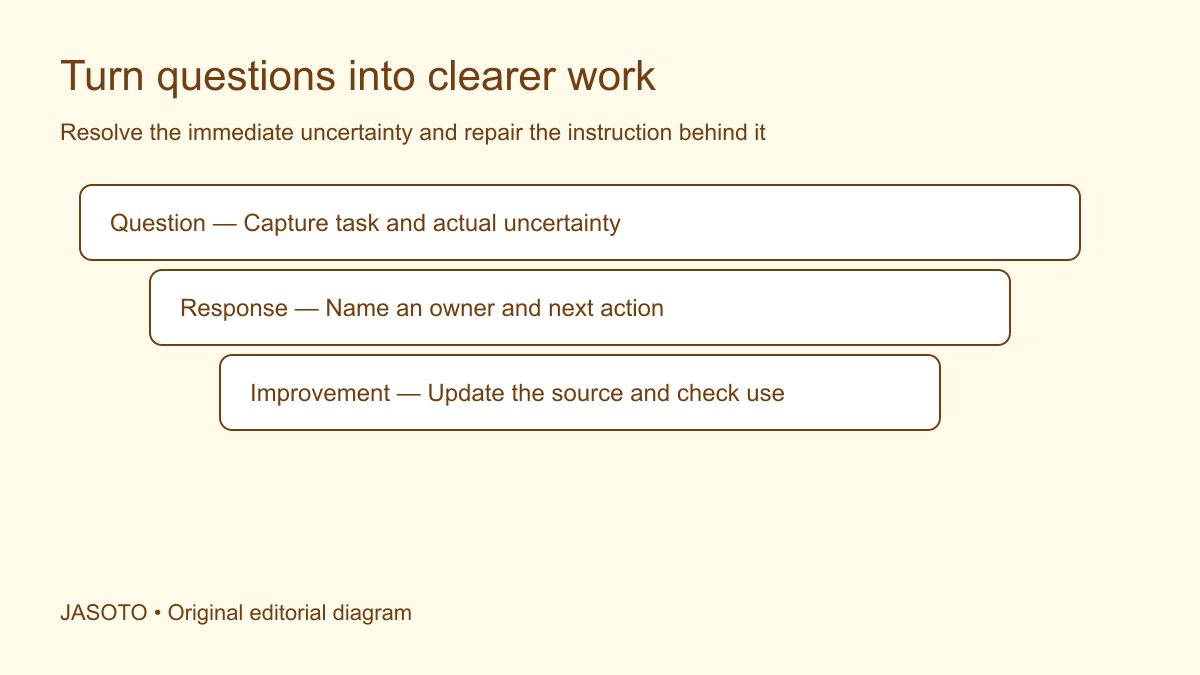
Original JASOTO editorial diagram. Its complete workflow is explained in the article; no actual customer outcome is depicted.
An onboarding question log should help a new colleague get an answer and help the team repair the instruction that was missing. Record the question in the starter's words, what they were trying to do, who will respond and what happens next. Avoid making the log a public test of how much the person already knows or a growing list that nobody owns.
This guide offers an original method for a small UK team where questions currently disappear into meetings and private messages. Acas's induction checklist explains that induction should support someone becoming effective, rather than simply completing ticks. The log below is one practical support tool. It belongs alongside accessible conversations with a manager and the appropriate confidential channels, rather than replacing them.
The practical answer
- Record the task behind the question.
- Name an accountable responder.
- Confirm an answer enables the next step.
- Repair repeated sources of confusion.
Give the log a narrow purpose
Explain that the log is for questions about how work is done, where information lives and who decides an issue. It is not the place for passwords, private employment concerns, customer secrets or detailed personal information. Tell the starter how to raise something that should remain private. Without that distinction, a well-intended shared document can quickly become a storage location for material the whole team does not need to see.
Choose an owner who can keep questions moving without needing to know every answer. Their task is to assign the question, follow up and make its status visible. The manager still handles role expectations and individual support. State this arrangement in a short introduction to the log: “Add ordinary process questions here; speak directly to your manager about anything personal or sensitive.” Repeat the explanation during the first conversation, rather than relying on the starter finding a policy link unaided.
Capture the question before polishing it
Let the employee write the question in ordinary language. “Which version of the confirmation email should I use?” is more informative than an edited category such as “communications compliance”. Include the task they were attempting and the document or screen involved. These details help the responder understand what prompted the uncertainty without asking the employee to reconstruct an entire session several days later.
Keep the original wording when adding clarification. A team's preferred terminology may be exactly what the starter has not learned yet. If a helper rewrites every question into specialist language, the record stops showing which words caused difficulty. Add a short clarification beside the original instead: “This refers to the appointment confirmation template, not the sales follow-up.” That provides enough precision for routing while preserving the learning opportunity for whoever maintains the instructions.
Separate a blocker from a learning question
Give each entry a practical impact field. A blocker prevents the next safe or authorised step; a learning question can wait while other work continues. Ask the starter to describe the effect rather than assign an elaborate priority score. “Cannot send today's approved message because no template is identified” tells the owner more than “high priority”. The owner can then decide how quickly it needs a response in the context of the team's actual work.
Make it clear that an urgent issue should use the established contact route as well as being recorded. The log must not become a queue where somebody waits quietly before reporting a safety concern, customer incident or time-critical failure. For ordinary questions, specify when the owner reviews new entries. A simple commitment that is actually maintained is more useful than a promise of immediate responses that the small team cannot consistently provide.
Assign a responder with the right authority
Name one person responsible for the answer and, where relevant, distinguish them from the person who can approve a decision. A colleague may know how to prepare a purchase request but cannot authorise the purchase. If the log blurs those roles, a helpful explanation can accidentally become an apparent instruction to spend money or make a customer promise. Route the decision to the proper owner before marking the entry resolved.
Ask responders to acknowledge a question they cannot answer and name the next route. “I do not own this; Alex maintains the current template” is useful when Alex has agreed to take it. Simply tagging several names can leave everyone assuming someone else is acting. The log owner should resolve that ambiguity. If the right person is absent, record the interim arrangement and the next review point rather than presenting a guess as a settled business rule.
Write answers that another starter could use
A useful answer names the action, the current source and any boundary. For example: “Use the appointment confirmation in the approved templates folder; edit the date and address fields; ask the manager before changing the cancellation wording.” That gives the starter something they can do and a clear limit. “Use the usual one” only works for people who already know the answer.
Link directly to the relevant instruction where possible, and check that the starter can open it. A link to a folder containing many similarly named files can reproduce the original problem. If the answer is temporary, label it and name who will confirm the longer-term position. Do not turn an exception agreed for one example into a general rule by omitting its context. The question log should preserve useful distinctions instead of flattening every response into universal advice.
Confirm resolution through the next task
Use statuses that describe what has happened: received, assigned, answer provided, clarification needed and resolved. An answer being posted does not establish that it answered the question. Ask the starter whether they can now complete the intended step or explain the route. This is a check on the usefulness of the explanation, rather than a test designed to expose the person asking.
For an invented booking assistant, the question concerns which address to place in a confirmation. The responder links the venue record, but the employee discovers that two addresses are present. The entry remains open until the record owner identifies the customer entrance and corrects the underlying ambiguity. Marking the first reply as resolved would hide a process defect and leave the next colleague with the same choice. The question becomes useful because it leads to a clearer source of truth.
Repair instructions instead of collecting repeat answers
At a regular review, look for repeated questions about the same step. Decide whether the underlying issue is a missing instruction, a difficult-to-find file, unclear ownership or a genuine need for practice. Different causes need different responses. Adding another training session will not fix a link that consistently opens an obsolete template, and rewriting a page will not necessarily teach a task that requires supervised practice.
Assign the improvement separately from the immediate answer. The starter can receive help today while the document owner repairs the instruction later. Link the improvement action back to the question so the owner can see the original confusion. Once the source has changed, replace old links and label outdated responses. Retaining a historical answer without a visible correction can create a competing instruction that survives long after the process has moved on.
Keep private routes easy to use
A person joining a small team may hesitate to post a question that appears basic, particularly when the manager and senior colleagues can see it. Offer a direct conversation and allow the log owner to add an anonymised process question where appropriate. Do not promise anonymity that the details cannot realistically provide; a question about a unique task can still identify its author to colleagues.
Explain who can see the log and why. Limit access to those who need to support the work or improve the relevant instructions. Do not copy private concerns into the public log merely to demonstrate responsiveness. Where specialist training or process support is needed, research suitable business services using a brief that describes the task without exposing unnecessary employee or customer details. The aim is to obtain better support while preserving the appropriate boundaries around the original conversation.
Build the habit into real working time
Give the starter a short opportunity to add questions after practice, and give responders protected time to review them. A log introduced as extra homework is unlikely to represent the questions that arise during a busy day. Mention it during existing check-ins, then use the conversation to identify anything that needs immediate support or a private route. Keep spoken answers connected to the record so useful decisions do not remain only in one person's memory.
For colleagues joining from another site, use the log to capture practical uncertainty before arranging visits. Confirm the host and location before planning travel. When recruiting for a continuing coordination role, explain whether maintaining instructions and routing questions are part of the work. A question log needs ownership as much as software. A small shared document can work well when the team consistently closes the loop; a sophisticated tool will still fail if everyone assumes somebody else is responding.
Retire the onboarding log without losing its lessons
Agree when the log will be reviewed, archived or moved into ordinary team support. Keep the reusable process lessons in the relevant instructions, and handle the original record according to the business's retention arrangements. Do not retain an identifiable history indefinitely just because it might one day be interesting. The manager should distinguish support needed for the person from process information useful to future starters.
Review the log with the employee: which answer helped them act, which question was difficult to ask and which problem remains open? Carry unresolved work into the normal task system with an owner. If the log has become burdensome, simplify its fields or replace it with a supported conversation plus concise action notes. The rollback is to preserve answers and open actions while removing an unhelpful mechanism. Success is clearer work and a reliable route to help, rather than a large number of recorded questions.
Put the guide into practice
- Explain public and private question routes.
- Name the log owner and review routine.
- Keep blockers visible until resolved.
- Transfer improvements into current instructions.
Frequently asked questions
Should every question be logged?
No. Log ordinary questions when recording them will support an answer or improve instructions. Use direct contact for urgent matters and the appropriate confidential route for sensitive concerns. A quick clarification need not become a formal entry unless the team or starter would benefit from preserving it.
Who should maintain the log in a very small team?
Choose one coordinator who can route questions and follow up, even if different colleagues provide the answers. Name a backup for absences. The coordinator does not become the authority for every process; they make sure the appropriate owner responds and that unresolved questions remain visible.
What if the same question keeps appearing?
Check why the answer is not sticking before assuming someone needs more training. The source may be hard to find, contradictory or incomplete. Ask the person to walk through the point of confusion, then change the instruction, access route or practice arrangement that addresses the actual cause.
Explore JASOTO tools
Discover providers and check support for your specific task.
Explore roles and responsibilities →Consider the practical responsibilities involved when recruiting or joining a team.
Plan work-related travel →Research a journey when joining, training or meeting colleagues in person.
Continue with JASOTO
Compare your next step
Discover UK businesses, compare services and request written quotes before making a decision.