Websites & Visibility · UK Guide 2026
One-Page or Multi-Page Website?
Updated 9 September 2026 · 2,631 words
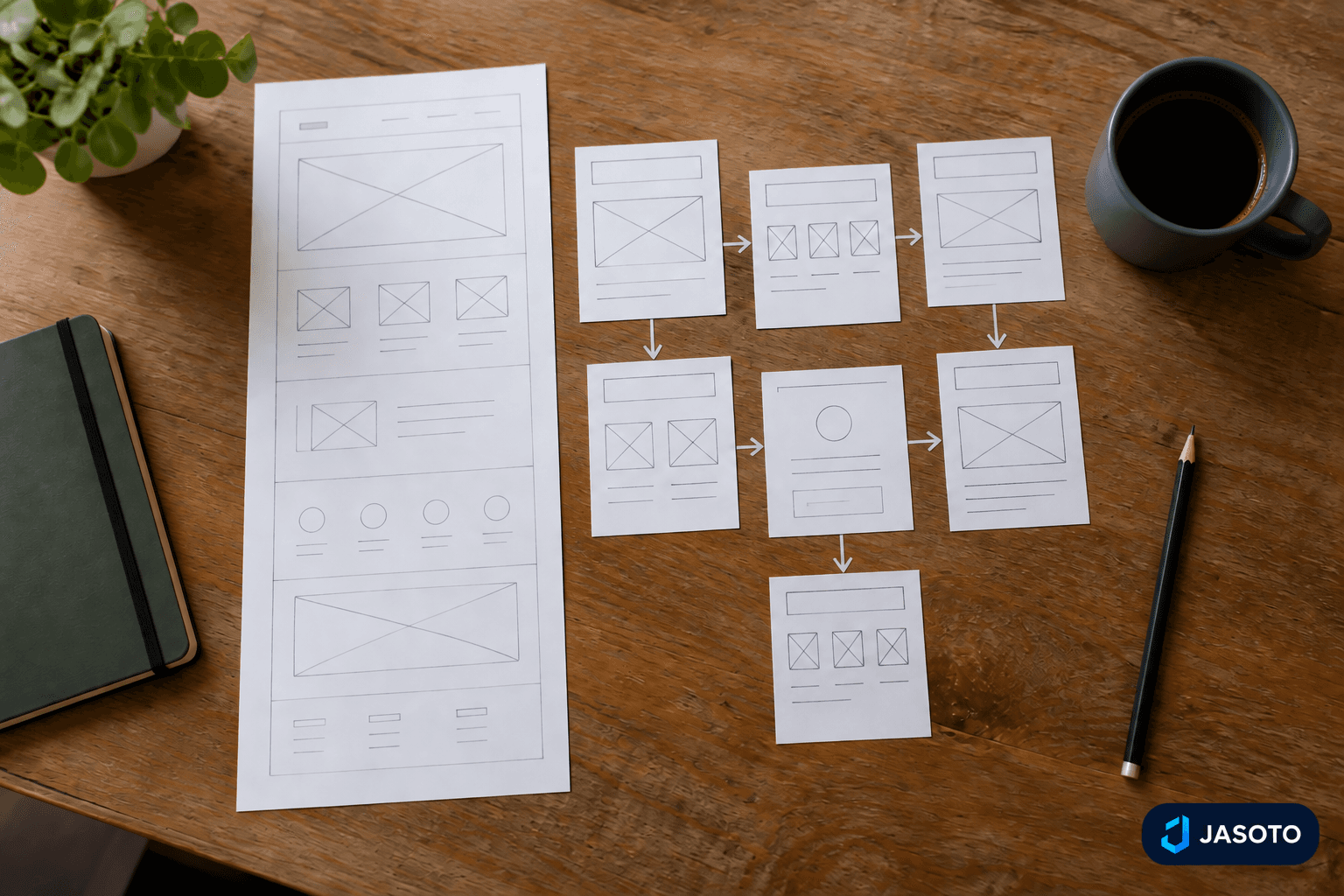
AI-generated illustrative image. It does not depict an actual customer project or a tested product.
Choosing between a one-page website and a multi-page website is less about fashion and more about how customers make decisions. Before they enquire, what do they need to know? What questions do they ask? What proof do they look for? A structure that answers those questions clearly will usually be more useful than one that simply looks neat on paper.
A one-page website can suit a business with a focused offer and a straightforward next step. A multi-page website becomes more useful when different services, audiences or enquiry routes need separate explanation. Neither structure guarantees enquiries or better search performance. The real test is whether the site helps the right visitor understand the offer and take the next step without confusion.
For a small business, the choice also affects maintenance. A single page can be easier to picture at the start, but it can still become crowded or outdated if it tries to do too much. A multi-page site may take more planning, yet it can make content easier to separate, update and share. The best choice is usually the one that matches the business, not the one that sounds simpler in theory.
At a glance
- A one-page website can work when the offer is narrow, the next step is straightforward and the content can be organised clearly on one page.
- A multi-page website is often more useful when services, audiences or enquiry details are different enough to need separate explanation.
- Page count alone does not guarantee enquiries or search performance; clarity, purpose and maintenance matter more.
- The best structure is the one that matches the customer’s questions and the business’s ability to keep the site current.
Start with the customer’s questions, not the page count
The most useful way to choose a website structure is to begin with the questions a customer needs answered before they enquire. Some businesses face a short decision process. Visitors mainly need to know what is offered, where it is available, what evidence supports the service and how to contact the business. In those cases, one clear page may be enough if it is well organised and the next step is obvious.
Other businesses face a more varied decision process. A visitor may need to compare service types, check different examples, understand who each service is for and see separate enquiry details. When that happens, the page count should reflect the decision-making process rather than the owner’s preference for a simpler-looking site. If customers are likely to ask different questions, the website should make space for different answers.
When a single page can work
A one-page website can work well for a focused business with a narrow offer. If the service is straightforward and the main purpose of the site is to explain one thing clearly, a single page can keep the reading path simple. The visitor can move from the headline, through the explanation and evidence, to the contact route without jumping between multiple sections or menus.
This approach is strongest when the business does not need to explain several separate services. A single page can cover service description, location, evidence and contact information in one organised flow. It can also make updates easier because there is only one core page to review. That said, simple does not mean sparse. A one-page site still needs enough detail for a customer to understand what is offered and whether it fits their needs.
The risk comes when the business is not truly narrow. If visitors have to scroll past unrelated services, mixed messages or repeated paragraphs to find what they want, the page may feel simple only from the owner’s point of view. A long page that tries to do too much can become harder to read than a small site with several well-chosen pages. The deciding factor is not whether the business is small, but whether the offer is genuinely focused.
When separate pages help
Separate pages become useful when a business offers distinct services, serves different audiences or needs different enquiry details for different jobs. A dedicated page allows each service to be explained in its own space. That means the customer can arrive directly at the relevant information instead of reading through everything else first. It also gives the business a specific page to share in conversations, emails or directory profiles.
A practical example is a photographer who offers commercial product work and family portraits. Those services may sound similar at a glance, but the customer questions are often different. Commercial clients may want to know about product presentation, while family clients may be looking for a very different style of portfolio and preparation guidance. Separate pages let the business express those differences clearly, without forcing every visitor through both sets of information.
This structure can also help with FAQs and enquiry routes. Different services may raise different concerns, such as what to prepare, how to book or what happens next. If all of that sits on one page, the information can become tangled. A separate page makes it easier to keep each service relevant and to guide each visitor to the correct next step. The page should still feel connected to the rest of the site, but it does not need to carry every answer at once.
Think about how much explaining each offer needs
A useful test is to ask how much explanation each offer requires before a customer can make a decision. If the answer is only a little, a single page may be enough. If the answer is very different for each service, then separate pages are likely to make the site more useful. The point is not to create more content for its own sake, but to give each decision path the space it needs.
When a service needs examples, preparation information or distinct FAQs, a dedicated page can keep those details in context. For example, one type of customer may want to know how to prepare for a session, while another may want a different kind of example of the work itself. Putting both on one page can weaken the clarity of each section. Separate pages allow the explanation to stay focused on the audience most likely to read it.
This also helps avoid the common mistake of using the same wording everywhere. A business that copies and pastes identical explanations across all services can end up with pages that feel repetitive rather than helpful. Distinct pages should not be identical in content. They should each have a clear reason to exist, and that reason should be obvious to a visitor within a few moments.
Compare the maintenance commitment honestly
The number of pages affects how a website is maintained. Every page needs accurate content and a clear purpose. As a site grows, there is more to keep consistent: contact details, service descriptions, offers, location information and the general tone of the site. If no one is responsible for updates, small errors can spread quietly across multiple pages.
At the same time, a one-page website is not maintenance-free. Long pages can collect outdated sections, repeated claims or old wording that no longer reflects the current service. A page that has grown through additions and edits can become harder to scan than a cleaner multi-page structure. A business choosing a single page should still plan regular checks of the actual customer journey, not just the visible text.
The practical question is who will update the site and how those changes will be requested. If several people may suggest changes, a simple structure can become messy unless there is a clear process. If one person handles the content, a larger site may still be manageable as long as the pages are well planned. The maintenance burden is not determined by page count alone; it depends on how carefully the site is organised and who is keeping it current.
Use page purpose as your decision tool
A simple method can help: write one sentence describing the purpose of each proposed page. Do this before choosing the final structure. If two sentences are effectively identical, the pages may belong together. If one page would have to answer several unrelated questions, it is probably doing too much and should be split.
This exercise works because it forces a business to be specific. Instead of saying that a page is for “the services”, the owner has to decide whether it is for one service, one audience or one part of the enquiry journey. That makes weaknesses visible quickly. A page without a clear purpose often becomes vague, and vagueness is usually what leaves visitors unsure what to do next.
The same method can also highlight missing information. If a page purpose cannot be written without cramming in too many ideas, the site may need a different structure. In that case, it may be better to create separate pages for different services or audience needs rather than stretching one page to cover all of them. This is a planning step, not a design exercise. It is about clarity, not decoration.
Map the enquiry routes before you build
A website should not only explain the business; it should help people move towards contact in a sensible way. That means thinking about enquiry routes before the site is built. A single-page website often points everyone towards one main next step. That can work well if the business offers one service with one obvious contact route. The visitor is not being asked to choose between multiple pathways.
A multi-page website can support more than one route. Different pages may lead to different enquiries because different services need different details. A visitor arriving on a commercial service page may need a different prompt from someone reading a family-focused page. If the structure reflects those paths, the site feels more direct and less generic.
This is also why a business should think about navigation early. Visitors should not have to guess where to go next, and the site should not force everyone through irrelevant sections. If the site structure mirrors the way customers think, the enquiry process becomes easier to follow. If it does not, the pages may still exist, but they will not work together as a helpful system.
Plan for future changes without overbuilding
A good structure should leave room for growth, but that does not mean building a site that is larger than needed today. If a business is likely to add services later, it is sensible to think about navigation, URLs and future expansion. That way, the initial structure leaves a sensible route for adding more content without creating a confusing mess.
Starting small can be sensible if the service really is focused. It can also be practical when the business wants to begin with the most important information and expand later. The key is to make sure the original structure can support that growth. A single page may be enough at the start, but if there is a clear chance that separate services will need their own explanation later, it is worth considering whether a multi-page layout will be easier to extend.
The mistake to avoid is building for an imagined future that is not yet real. Adding pages before they are needed can make a site feel thin or fragmented. A better approach is to choose a structure that fits the current decision process and can be adapted when the business genuinely needs it. That keeps the site useful now without making assumptions about what it will need later.
How to discuss the structure with your provider
Once the likely page structure is clear, discuss the map with the website provider. The conversation should focus on purpose, content and the route from page to enquiry. It helps to be specific about what each page is for and what information each page must include. If the provider knows the difference between a broad overview page and a dedicated service page, they can help keep the site coherent.
For businesses using managed websites, it is sensible to check the available package and page scope against the actual needs of the business. A site structure should be judged against what it has to do, not just how many pages it contains. If the package does not fit the content the business needs to support, the site may end up over-simplified or awkward to maintain.
Jasoto offers managed business websites, so it makes sense to think about page scope alongside the content you can support. The goal is not to add pages for their own sake, but to choose a structure you can keep accurate, useful and aligned with the way customers enquire. A good provider can help you turn the page map into something practical, but the structure still needs to come from the business’s real customer needs.
Common mistakes when choosing between one page and many
One common mistake is assuming that fewer pages automatically mean less work. A one-page website can still take careful editing, especially if it tries to summarise several topics in one long scroll. Another mistake is creating too many pages simply because it feels more professional. If the pages do not have distinct purposes, the site can become harder to understand rather than easier.
A third mistake is copying the same explanation into every page. This makes the structure look larger but does not improve clarity. Visitors can usually tell when a page exists only to fill space. Another issue is forgetting the enquiry route. A page can be informative and still fail if the next step is hidden or awkward. Clear contact details and a sensible path to enquiry matter in both structures.
The final mistake is choosing a structure without considering maintenance. A site that cannot be kept current will quickly lose usefulness, whatever its page count. Before making the decision, it is worth asking whether the content can be reviewed, updated and kept consistent. A small business does not need the most complicated structure, but it does need one it can actually support.
Your practical checklist
- List the main questions customers ask before they enquire.
- Write one clear purpose sentence for each proposed page.
- Check whether any pages cover the same idea in different words.
- Match service examples and FAQs to the right audience or offer.
- Decide who will update the site and how changes will be requested.
- Map the enquiry route so visitors know what to do next.
- Review whether the current structure can grow sensibly later.
Frequently asked questions
Is a one-page website always easier to manage?
Not always. A one-page site has fewer pages, but it can still become crowded, repetitive or out of date if it tries to cover too much. A multi-page site may be easier to manage when each page has one clear purpose.
Can a small business start with one page and add more later?
Often yes. It is sensible to think about navigation, URLs and future expansion at the start so that later additions have a logical place. The important point is to make sure the original structure can grow without becoming confusing.
Do more pages automatically mean a better website?
No. More pages only help when they each serve a distinct purpose. If the pages repeat the same message or split up information that should stay together, the site can become less useful.
How do I know whether my service needs its own page?
Ask whether the service needs its own examples, FAQs, preparation information or enquiry details. If the answer is yes, a dedicated page is usually easier for customers to use than a general page that tries to cover everything at once.
Plan your website with Jasoto
Bring your service details, questions and examples to a discussion about a managed business website.
Explore Jasoto websites