
Business Growth · UK Guide 2026
Prepare a Backup Contact Plan for a One-Person Business
JASOTO · Updated 5 November 2026 · 1,605 words
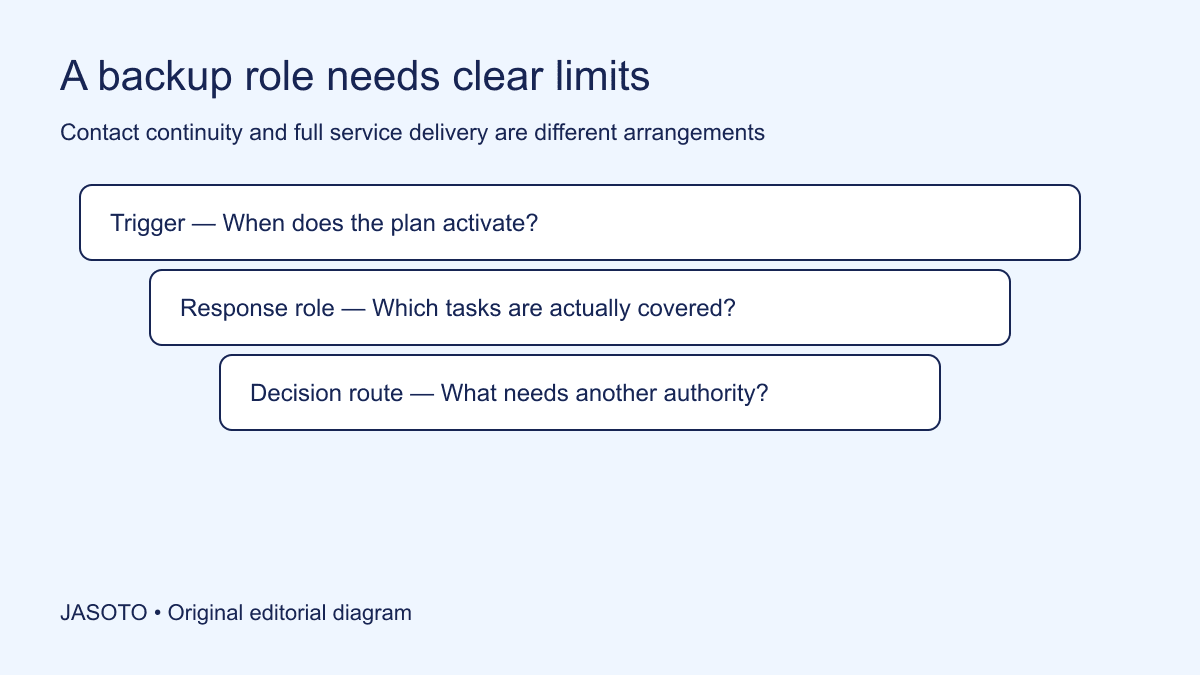
Original JASOTO editorial diagram. Its complete workflow is explained in the article; no actual customer outcome is depicted.
Prepare a backup contact plan for a one-person business by defining what someone else can do if you become unexpectedly unavailable. Agree the tasks, authority, activation trigger and actual availability before relying on the arrangement. Keep customer information accurate: a backup who can acknowledge a message is not automatically able to deliver the specialist service or make every decision on your behalf.
This guide is an original continuity worksheet for UK sole traders and other one-person operations. It focuses on contact and administrative handover. Legal authority, financial access, regulated work and personal emergencies can require separate professional arrangements. The example uses an invented independent design business with existing client commitments, without claiming that a document alone creates continuous cover.
The practical answer
- Define the limited tasks a backup can actually perform.
- Agree the role and trigger before relying on a person's name.
- Use appropriate access rather than sharing private credentials.
- Keep customer statements accurate about the cover available.
Identify what must happen during unavailability
List the essential communication tasks connected to existing work. A customer may need to know that a promised update cannot occur as expected, while a supplier may need an appropriate route for a scheduled delivery. Keep those tasks specific. Do not begin with a requirement that someone should run everything, which can hide the actual limited actions that would help.
Separate contact needs from service delivery. A backup may be able to identify a time-sensitive message and route it without completing design work or approving a contract change. If continued delivery is necessary, arrange it through an appropriately qualified and authorised provider. The contact plan should reveal that requirement rather than create an unsupported impression that a helpful person can replace every specialist role.
Choose a realistic backup arrangement
Consider who is appropriately placed to perform the defined tasks and discuss the role directly. Check actual availability, relevant competence and any business or confidentiality requirements. Do not assume a family member, friend or another trader has agreed to act simply because they know the business. The arrangement needs a real conversation and appropriate documentation or advice where warranted.
Record what the person can decline or cannot cover. If they are unavailable at particular times, preserve that limit and plan accordingly. Avoid describing the business as always monitored unless an actual suitable service provides that capability. Honest limits help the owner identify remaining gaps and make accurate commitments before a difficult situation arises.
Define the activation trigger
State how the backup knows the plan should begin. The trigger may involve an agreed instruction or another appropriate verified event. Choose an arrangement suitable to the business and obtain professional advice where it concerns consequential authority. Do not let an unanswered ordinary message automatically grant broad access or permission to act without a considered process.
Explain how the backup verifies the instruction and whom to contact for uncertainty. Keep the process practical without exposing sensitive details widely. A plan that depends entirely on the unavailable owner giving real-time explanations may not serve its purpose. At the same time, the plan should not authorise a person to infer unlimited powers from an ambiguous report or casual request.
Record the permitted tasks and authority
Write actions the backup may perform, such as acknowledging defined enquiries through an approved route or contacting a named provider about an existing booking. Keep scope and authority separate. Being allowed to send a factual status message does not necessarily permit accepting a new order, agreeing a refund or changing terms. Use the actual legal and commercial arrangements for those decisions.
Identify what must pause or be referred elsewhere. The backup should have a clear answer when asked for a decision beyond the role. Avoid leaving them to improvise authority because a customer is understandably anxious or a supplier wants an immediate answer. A limited plan can be useful precisely because it makes the boundary and next route explicit.
Prepare a concise reference for existing commitments
Keep a suitable current list of relevant cases, contacts, next commitments and authoritative record locations. Limit it to what the backup needs for the agreed role. An unfiltered export of the whole business can create privacy and security problems without making a response easier. Use appropriate access controls and retention arrangements for the contents.
The [government's continuity toolkit](https://assets.publishing.service.gov.uk/government/uploads/system/uploads/attachment_data/file/137994/Business_Continuity_Managment_Toolkit.pdf) includes roles and contact information within broader planning. It is older general guidance rather than a new rule for sole traders. The original plan here asks a specific practical question: can the agreed backup identify the next contact task without needing private memory or inventing the current status?
Arrange appropriate access before relying on it
Identify the systems the role actually requires and use an authorised method appropriate to each. A contact-only role may need less access than a delivery partner. Ask relevant providers or a suitable specialist how to configure delegation, recovery or another appropriate arrangement. Do not solve access by leaving passwords in a broadly shared handover file or circulating the owner's private login.
Test the authorised tasks while the owner is available to resolve problems. A link may work for the owner but not the backup, or a record may require a permission that was never granted. Keep the test proportionate and controlled. Access should support the defined role and its actual authority, not expand to every business resource simply because that is easier to configure.
Write customer messages around actual capability
Prepare appropriate factual wording for the limited cover. The backup can identify their role and the next communication route without pretending to be the unavailable owner. Avoid promising a response time or service continuation that the arrangement cannot support. Use the actual customer and commercial process for any affected commitment rather than a generic message that implies all work proceeds normally.
A writing structure might state that the usual contact is unavailable, explain which defined matter the backup can assist with and identify the actual next update arrangement. Adapt it to the circumstances and appropriate privacy considerations. Do not disclose unnecessary personal details about the owner. The customer needs useful service information, not a private account of the reason for unavailability.
Keep supplier and premises information proportionate
List relevant provider references and appropriate contact routes for the agreed tasks. A backup handling a delivery enquiry may need the booking reference without needing security credentials or authority to admit someone to premises. Keep those arrangements with the responsible people and proper access process. Possessing a contact list should not silently become permission to change site arrangements.
Review what information is shared with external parties. A provider may need to know the authorised temporary contact, while public customers do not need every internal number. Preserve the actual scope and availability in each communication. Avoid turning one person's limited willingness to help into a broadly advertised service that generates tasks they never agreed to accept.
Worked example: an independent design business
Imagine an independent designer arranging a backup who can acknowledge defined client messages and identify time-sensitive existing commitments. The backup cannot approve new design work or change commercial terms. The owner maintains an appropriately controlled reference, agrees an activation process and tests the limited communication access. A separate suitable route is identified for work that needs specialist delivery or consequential decisions.
The plan does not promise that every project continues unchanged. This invented example claims no legal authority or uninterrupted service. It shows how a narrow contact arrangement can still support useful communication while making the business's remaining needs visible, rather than hiding them behind the reassuring but undefined phrase backup person.
Test one ordinary case and one boundary
Include a scenario in which the backup receives a new request rather than an existing commitment. Can they explain the actual route without accepting specialist work outside their role? This is a different question from finding an old customer reference. A contact plan can be clear about existing cases while accidentally implying authority over new business. Record the appropriate response and any referral route agreed with the responsible people. If the business cannot support the new request during unavailability, the message should say what is actually possible rather than using a reassuring template that creates an unsupported service promise.
Ask the backup to use the plan for a fictional existing customer update and a request beyond their authority. Can they identify what to say, what record to consult and whom to contact? Avoid coaching from memory during the first review. The confusion they encounter identifies a missing instruction, access issue or unrealistic role assumption that can be resolved before reliance.
Record changes and confirm the person's agreement to the current role. Keep obsolete versions controlled so the wrong scope is not used later. A short test should not be presented as proof that every future circumstance is covered. Preserve limitations and obtain appropriate advice where the scenario reveals a consequential gap that an administrative worksheet cannot settle.
Review the plan as the business changes
Update relevant commitments, systems and contacts through a manageable routine. A new service, provider or legal arrangement may change what the backup can appropriately do. Check that the person remains willing and available. A plan can become inaccurate even when no emergency has occurred, simply because the business develops while the reference stays unchanged.
Use JASOTO businesses to discover defined cover services and verify capability and availability directly. If continuing support is needed, explore administrative roles within a realistic staffing review. For an agreed handover meeting, research travel after confirming its purpose. A useful backup contact plan offers a real limited response, with clear authority and an honest account of what still requires another arrangement.
Put the guide into practice
- Identify essential existing commitments and contact needs.
- Agree a backup role, authority and availability.
- Prepare a suitable controlled reference and activation process.
- Test the plan and review it when services or people change.
Frequently asked questions
Does a backup contact need to run the whole business?
Define a role the person can appropriately and realistically perform. They may acknowledge enquiries or route a time-sensitive matter without delivering the specialist service. Do not imply full operational cover if that has not been arranged.
Can a friend simply be listed as the backup?
Discuss the role, authority, availability and information handling first, and use suitable advice where the arrangement requires it. A person's name in a document does not establish consent, competence or continuous availability.
Should the plan include account passwords?
Use appropriate authorised access and administrative arrangements. Avoid placing private credentials in a general contact document. Ask the responsible provider or suitable specialist how access and recovery should be arranged for the actual business systems.
Explore JASOTO tools
Discuss limited tasks, availability and capability directly with potential providers.
Explore administrative support roles →Consider staffing where continuing cover needs require more than a contact plan.
Research a confirmed backup handover visit →Plan travel after the meeting and appropriate information handover are agreed.
Continue with JASOTO
Compare your next step
Discover UK businesses, compare services and request written quotes before making a decision.