
Business Growth · UK Guide 2026
Hand Over Product Enquiries Between Online and Shop Staff
JASOTO · Updated 5 November 2026 · 1,617 words
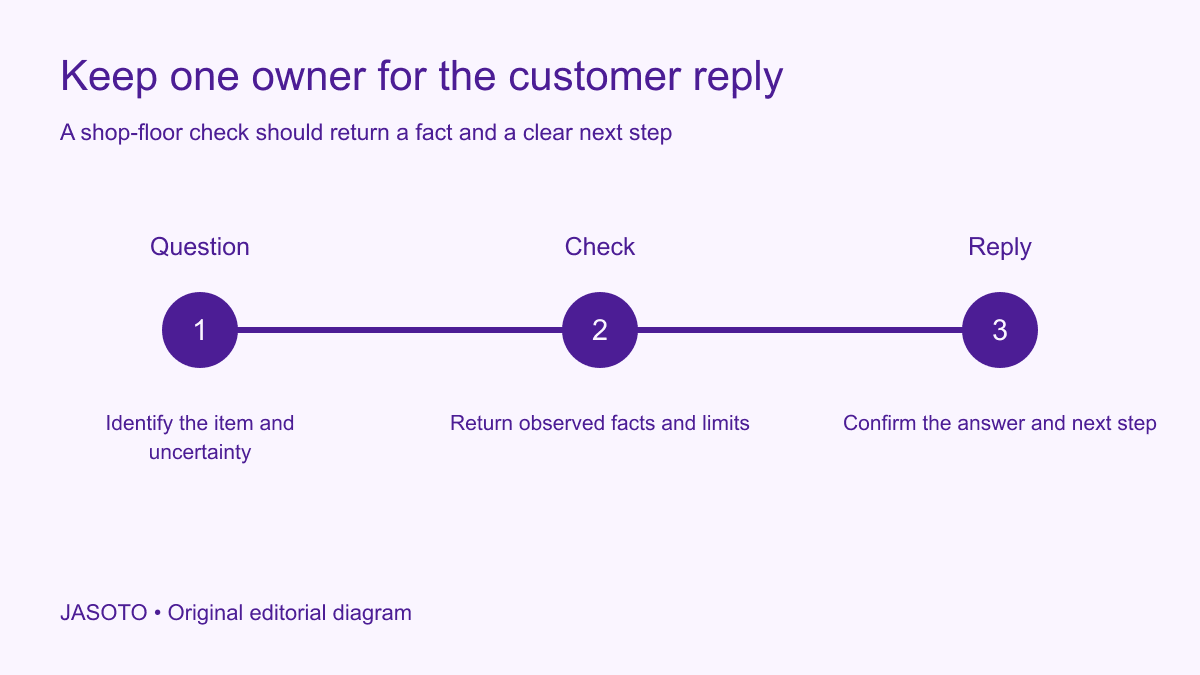
Original JASOTO editorial diagram. Its complete workflow is explained in the article; no actual customer outcome is depicted.
Plan the handover between online and shop-floor staff by transferring the exact product question, assigning a specific check and keeping one person responsible for the customer reply. Record what the store colleague actually confirmed and what remains unresolved. The customer should receive one coherent answer rather than being asked to repeat the enquiry across departments or receiving two incompatible promises.
This guide is an original workflow for UK retailers handling product questions before a purchase. It concentrates on the exchange between a customer-service inbox and colleagues who can inspect the shop's actual range. The example involves an invented furniture enquiry about a display cabinet. Order collection has its own handover requirements; here the immediate task is obtaining a reliable answer that supports the customer's choice.
The practical answer
- Transfer the customer's actual question with the exact product reference.
- Keep one person responsible for the final customer reply.
- Label checked observations and unresolved questions clearly.
- Return useful product facts to the shared catalogue record.
Transfer the question in the customer's terms
State what the customer needs to decide. A request asking whether a folder fits on a shelf is different from a general request for the cabinet's dimensions. Preserve the relevant wording so the store colleague understands the actual uncertainty. Avoid turning a specific question into check product, which leaves the recipient guessing what evidence would make the reply useful.
Include the exact product and variant reference, relevant page link and enquiry reference. If the customer's description is ambiguous, clarify the item before assigning a physical check. A photograph or screenshot can help when appropriately handled, but should not silently replace an uncertain identity with a guessed model. Keep the first question and any clarification connected in the shared record.
Identify what the online record already answers
Check the current catalogue information and relevant verified supplier records before involving the shop floor. The answer may already exist, while a contradiction between two records may be the actual issue. Send that context to the colleague performing the check. It prevents them repeating a general measurement when the business needs to resolve which published figure applies to the named variant.
Do not make the customer responsible for deciphering internal inconsistencies. Record the conflict and assign it appropriately. If the product information is incomplete, say which detail needs confirmation. Keep the question focused on a fact the store can appropriately establish, and seek suitable specialist advice when the enquiry concerns compatibility, safety or another matter beyond an ordinary product observation.
Assign the check to someone with the right access
Name the person or role responsible for checking the item and confirm they can do so through the shop's proper process. A colleague may know the range but be unable to access a packed item safely. Another may be serving customers continuously. Give the task a realistic place in the workload rather than assuming any shop employee can immediately investigate every online enquiry.
State the useful update point and the next step if the check cannot be completed. Do not invent a response commitment on a colleague's behalf. If a customer needs an answer before a planned journey, make that context visible without promising that the shop can always accommodate it. A clear pending status is more honest than a precise reply time nobody has accepted.
Keep the reply owner visible
Choose who will send the final answer and record that responsibility in the enquiry. The store colleague may provide facts to the online team, or may reply directly under an agreed process. Either arrangement needs clear ownership and access to relevant context. Avoid relying on copied messages as evidence that someone has accepted the action.
If the enquiry moves between shifts, preserve the current question, result and next action. A simple owner field can prevent both duplicate replies and silence. The owner should know who can approve commercial commitments, such as a reservation or special arrangement. Being responsible for responding does not automatically authorise changing the offer or promising stock outside the business's actual process.
Ask for an observation with context
For a physical check, identify what is being observed and how the result should be described. If a relevant dimension is needed, ask the appropriate person to record the reference points and unit through the business's suitable method. Do not present an approximate staff observation as a certified technical specification. State the limits so the customer can understand the basis of the answer.
If the colleague uses a display model, identify that fact. A display can help answer a practical question while differing from the supplied version or available stock. Check whether the observation applies to the actual item offered. Avoid extending one observation into a blanket claim about every variant or future batch without appropriate evidence.
Share relevant customer information appropriately
The store colleague usually needs the product question and relevant context, rather than the customer's full account history. [GOV.UK's business data-protection overview](https://www.gov.uk/data-protection-your-business) highlights secure, accurate handling of personal information. Use the business's appropriate system and access controls for the handover. A general staff chat or personal messaging account may not be the approved place for customer details.
If the question includes a private explanation, consider whether the practical requirement can be communicated without circulating that explanation. Do not remove context that is genuinely necessary, but keep the sharing proportionate to the task. Ask the responsible privacy or service contact where sensitive information requires particular handling. The handover should make the question answerable without turning every employee into a reader of unrelated personal material.
Separate a checked fact from a sales promise
A shop colleague can report that an item is visible on display or that a particular feature was observed. Availability, reservation and delivery commitments may require separate checks. Preserve that distinction in the reply record. Do not convert saw one in the shop into one reserved for you unless the actual reservation process has been completed.
Likewise, distinguish product facts from recommendations. A customer may ask whether the product is suitable for a particular use. The answer may need supplier information or specialist advice beyond the observation. Give the customer an accurate account of what has been confirmed and a useful route for the remaining question, rather than strengthening a limited check into unsupported assurance.
Return the result in a usable format
A concise result can state the exact item checked, the observation, its limits and any supporting reference. Ask the store colleague to identify a meaningful difference from the catalogue record. Avoid a reply such as yes fine, which may be impossible to interpret after the original conversation has moved on. The online owner should not need to infer which part of a multi-part question was answered.
Keep photographs connected to the enquiry and use an appropriate sharing route. A relevant image can support the answer, but it may not show scale or a hidden feature accurately. Explain what it demonstrates and avoid treating it as proof of broader technical suitability. Preserve the original evidence where appropriate so a later clarification does not depend on a screenshot detached from its context.
Worked example: a cabinet shelf enquiry
Imagine an online customer asking whether a particular folder can stand on a cabinet shelf. The online team identifies the exact cabinet variant and the relevant folder dimensions supplied by the customer. It asks a store colleague for an appropriate observation of the named display model and keeps responsibility for the final reply. The colleague records the reference points and notes that the observation concerns that display item.
The reply owner checks whether the product offered matches the observed model and communicates the verified information with its limits. Any stock reservation remains a separate action. This invented example claims no guaranteed fit or customer outcome. It shows why an exact question, a contextual result and one reply owner work better than forwarding a vague request to a group and hoping someone answers.
Close the enquiry and improve the shared record
Use a short reply checklist for enquiries that cross teams: the answer addresses the original question, names the relevant variant, preserves the observation's limits and identifies any separate next step. Ask whether a customer could mistake a product observation for a reservation or confirmed service. If so, clarify that sentence before sending. The checklist should be brief enough for ordinary work and should not require the reply owner to repeat an already verified physical check. Its purpose is to preserve meaning as information passes from the shop floor back into a customer-facing message.
Record that the customer reply was actually sent and preserve the relevant answer. An internal result received does not mean the customer has heard it. If further clarification is needed, keep the next action visible. Use the appropriate customer-service process for any disagreement or correction rather than silently changing an earlier statement without explaining the new information.
If the same product question recurs, consider a verified catalogue update. Assign a person to review and publish the fact through the actual process, and retain the evidence behind it. Do not copy every one-off observation into a permanent specification. The shared record should improve only where the information is appropriately supported and relevant to future customers.
Use JASOTO businesses to discover suitable retail support and verify capability directly. If online enquiries and store checks become continuing work, explore customer support roles within a staffing review. For an agreed viewing, research travel after confirming the exact item and appointment. A useful handover preserves the customer's question, the evidence and the person responsible for turning them into a clear answer.
Put the guide into practice
- Identify the enquiry, item and decision needed.
- Assign the shop-floor check and response owner.
- Share relevant information through the appropriate system.
- Confirm the customer reply and reusable product update.
Frequently asked questions
Should shop staff reply directly to every online customer?
Choose a clear ownership arrangement that fits the team and actual systems. Direct replies can work if responsibility, context and authority are understood. A handover can fail when both teams assume the other will answer, or when each sends conflicting information.
Can staff promise stock after seeing a display item?
Check the actual stock and reservation process before making a commitment. A visible display item may not represent saleable stock or a reserved order. Record what was observed and ask the appropriate person to confirm availability through the business's actual system.
What customer details should be shared?
Share what the authorised colleague needs to answer the relevant question through an appropriate channel. Avoid forwarding an entire account history or unrelated personal explanation. Use the business's privacy process and obtain appropriate advice where the information is sensitive or requirements are unclear.
Explore JASOTO tools
Discuss customer-enquiry routing and catalogue support with suitable providers.
Explore retail customer support roles →Consider staffing when enquiries and store checks become ongoing work.
Research a confirmed product viewing →Plan travel after the shop confirms the item and appointment details.
Continue with JASOTO
Compare your next step
Discover UK businesses, compare services and request written quotes before making a decision.