
Business Growth · UK Guide 2026
When to Pay for a Location Scout Before a Business Shoot
JASOTO · Updated November 5, 2026 · 1,629 words
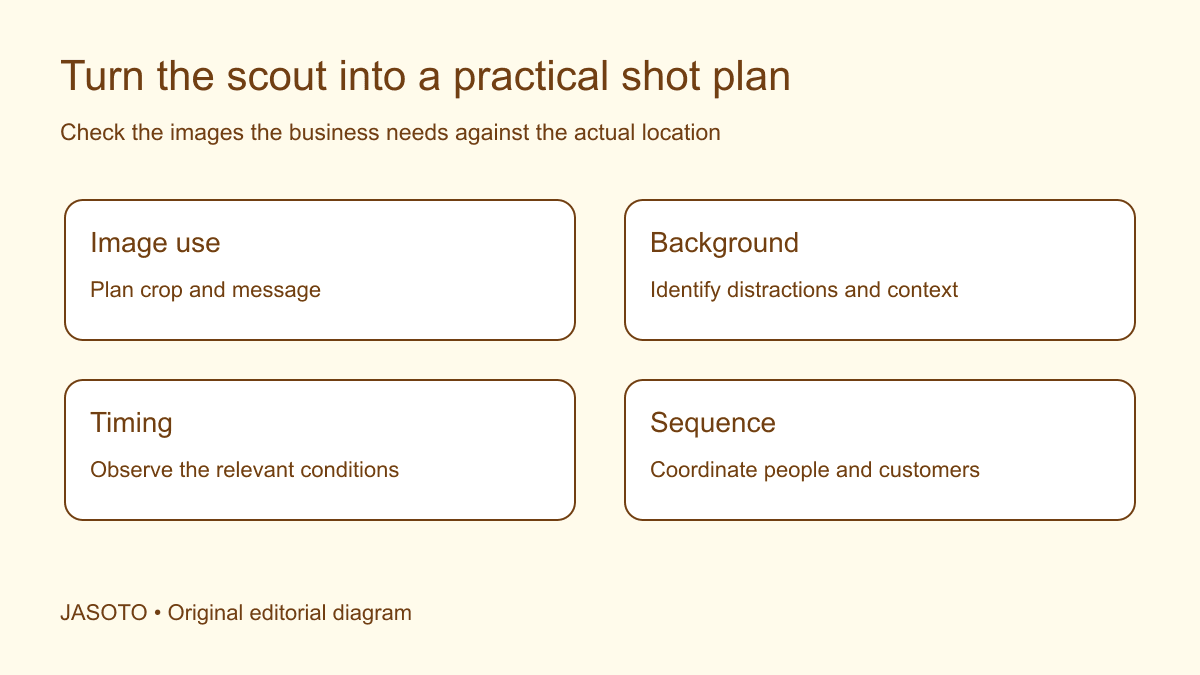
Original JASOTO editorial diagram. Its complete workflow is explained in the article; no actual customer outcome is depicted.
Pay for a photographer's location scout when an in-person visit can resolve specific uncertainties about the business photographs you need: usable backgrounds, changing light, access or how the shoot fits around customers. Ask for a practical shot-plan update as the output. A scout is preparation for the shoot, not a substitute for a clear image brief or a guarantee of finished results.
This guide is for small businesses in the United States commissioning commercial images at their own premises. The example is an invented café preparing website photographs. It offers original client-side questions and planning records, not lighting instruction or legal clearance. Discuss technical production with the photographer and obtain appropriate advice about permissions, people and image use where required.
The practical answer
- Connect the scout to specific photographs the business needs.
- Ask what existing photographs cannot show about the location.
- Use the scout to resolve backgrounds, access and customer scheduling.
- Keep scouting output separate from finished photographs and shoot approval.
Start with where the photographs will appear
List the actual uses: a wide website banner, a location page, a staff introduction or product detail. Describe the message each image should convey. A welcoming counter photograph and a close view of a product need different visual planning. If the website designer needs space for text, explain that before the photographer evaluates possible angles. Do not assume that a beautiful portrait-oriented image will fit a very wide layout.
Gather the current layout or approximate crop requirement without pretending the design is final if it is not. Ask the designer which constraints matter. The scout can then investigate a concrete question such as whether the main seating area offers a suitable wide composition. That is more useful than asking the photographer to find some nice shots while the business remains undecided about their purpose.
Identify what is unknown about the premises
Write the location questions that existing information does not answer. Perhaps the counter looks cluttered from the customer side, the preferred wall contains reflections, or the only suitable background is busy during opening hours. Keep these as questions rather than deciding the technical solution yourself. A photographer may see an alternative composition that preserves the business message with less disruption.
Share current ordinary photographs or an appropriate walkthrough before booking the scout. Ask which questions these can resolve and which need attendance. The business should not pay for a separate visit merely to repeat information the photographer already has. Equally, an online floor plan may not show visual distractions or the practical relationship between the intended image and the occupied space.
Ask why the observation time matters
If the photographer needs to evaluate conditions at a particular time, ask what they intend to learn. [Adobe's photoshoot planning guidance](https://www.adobe.com/learn/express/web/photoshoot-best-practices) notes the usefulness of visiting an outdoor location at the intended shooting time to understand light and traffic. For your premises, agree the relevant observation window rather than treating every available appointment as equivalent evidence.
Record the conditions actually observed. A quiet morning scout does not establish that the same space will be quiet during a lunchtime shoot. Nor does one visit guarantee future weather or identical lighting. Ask how the photographer will account for remaining variability. The business needs a realistic production plan with conditions and alternatives, not an assertion that scouting removes uncertainty entirely.
Inspect backgrounds through the business brief
Ask the photographer to identify potential backgrounds for each required image and explain relevant limitations. A shelf of unrelated packaging, a reflective menu surface or an exit behind a portrait position may affect the composition. Do not assume everything can simply be edited out later. Ask what can appropriately be changed before the shoot, what should remain truthful context and what is better handled by another angle.
Check that proposed staging represents the actual business honestly. A café can tidy its counter for photography without inventing facilities or customer experiences it does not offer. Keep private documents and unrelated customer information out of the preparation area through the appropriate process. Background review should support a useful commercial image, not create a false impression or expose information that never needed to be photographed.
Connect the shot list to people and objects
For each proposed image, identify the people, products or props required and who will prepare them. A staff portrait needs the person's agreed availability; a product scene needs the actual product in suitable condition. Avoid assuming the photographer supplies every prop or that any employee can substitute for a person already included in the brief. Ask what preparation belongs to the business.
[Adobe Stock's production guidance](https://stock.adobe.com/pages/artisthub/get-started/stock-content-production-tips-stock-contributor-guide-pt-2) discusses shot lists and shared preparation documents in its stock-content context. Your commissioned shoot has its own purpose and terms. Use a specific working list that connects an image to the business need, location and preparation owner, rather than copying a stock-production checklist as though every item applies.
Review access with the responsible site contact
Ask what the photographer and any crew need to bring and which access arrangements must be confirmed. The responsible site people should decide suitable routes, working areas and any safety arrangements. This guide does not instruct staff to move equipment, alter electrical supplies or create improvised shooting platforms. Keep production and handling decisions with the appropriately competent people.
Confirm who can authorise use of the space. A tenant, shared-building manager or landlord may have a role depending on the premises and agreement. The scout should reveal permission questions early, not be treated as permission itself. If a proposed image involves artwork, people or branding, identify the relevant clearance question and obtain appropriate advice rather than assuming location access settles every use.
Plan around customers without guessing their response
Ask whether the required images can be made before opening, during an agreed quiet period or in a controlled part of the premises. The business and photographer should discuss the actual operational constraints. Avoid promising that customers will stay out of frame or that a busy period will naturally provide usable participants. People and customer information need appropriate handling, and production should follow the agreed arrangements.
Give the business team a clear plan for ordinary service during the shoot. Which area remains available, who answers customer questions and whom should staff contact if the arrangement is not working? Do not leave every employee interpreting a photographer's setup independently. A scout can help identify these coordination needs before the production day, even where the final technical approach remains the photographer's responsibility.
Agree the scout's actual deliverable
Ask what you will receive: annotated reference images, a revised shot list, a location note or an updated production proposal. Clarify whether these are included in the fee and what further decisions remain. Scout photographs may be functional references rather than finished licensed assets. Do not use them in advertising without understanding the actual agreement and permission for that use.
Confirm who will review the output and by when. A photographer can produce a useful plan that the business never approves because the decision maker is unavailable. Keep the commercial shoot booking, licensing discussion and location preparation connected but distinct. Paying for the scout should not accidentally authorise a larger production or imply approval of every suggested image.
Worked example: a café website banner and team image
Imagine a café wanting a wide homepage banner showing the counter and a team image for its story page. Its existing photographs suggest the counter could work, but the proposed crop may include a distracting reflective panel. The photographer proposes a paid scout to review angles and the relationship between that composition, staff position and ordinary customer movement. The owner supplies the planned website crop and current opening schedule beforehand.
During the scout, the photographer identifies an alternative angle and a separate location for the team image. The business records which products must be ready and asks the designer to review the proposed banner composition. The final shoot timing remains conditional on the agreed access and people arrangements. This invented example claims no increased sales or perfect images; it shows how a scout can change specific production decisions rather than simply confirming that someone visited.
Compare the fee with the decisions it enables
Use the actual quoted scout fee, travel, output and cancellation terms. Ask whether the service is separate or credited under defined conditions, and what happens if the location is unsuitable. Include the business's preparation effort and whether the visit can meaningfully reduce a blocked decision. Do not invent a standard market price or promise that scouting always saves a reshoot.
A familiar small room with a simple product brief may need no separate scout. An occupied multi-area location with several people and constrained timing may justify more preparation. Ask the photographer to explain the difference for your brief. The decision should rest on unresolved production questions and their consequences, not on an assumption that either a free consultation or a paid visit is automatically better.
Turn the findings into the current shoot plan
After the scout, check the revised shot list against the required image uses. Identify what changed, which preparation the business owns and what remains conditional. Ask an authorised colleague to explain the plan without attending the original conversation. If they cannot identify which room, people or products are needed, clarify the record before the production booking becomes difficult to change.
Use JASOTO businesses to discover commercial photographers and review relevant work directly. If preparing locations and coordinating image use becomes regular work, explore marketing support roles within a staffing review. For an agreed scout, research travel after confirming access and timing. A worthwhile scout leaves concrete visual and operational decisions clearer, while preserving an honest account of what the actual shoot must still achieve.
Put the guide into practice
- List required image uses and unresolved location questions.
- Agree what the photographer will examine and deliver.
- Confirm access, business activity and appropriate permissions.
- Review the revised shot plan before booking production.
Frequently asked questions
Do all business shoots need a paid scout?
No. A familiar controlled space and a simple brief may need less preparation than an unfamiliar occupied location. Ask the photographer which unresolved location questions require attendance and what existing information can answer. Judge the proposed scout by its contribution to the specific shot plan.
Are scouting photographs the finished images?
Not unless the agreement specifically includes that deliverable. Scout images may be practical references showing angles, backgrounds or constraints. Ask how they may be used and do not assume they carry the same production quality, editing or licensing as the commissioned shoot.
Does a scout secure permission to photograph?
Do not assume it does. Confirm the relevant owner, manager and other appropriate permissions for both the scout and the actual shoot. A photographer seeing a location does not settle every issue involving people, artwork, trademarks or use of the premises.
Explore JASOTO tools
Discuss relevant portfolio work, scouting scope and the business image brief directly.
Explore marketing coordination roles →Consider support when preparing people, locations and image handovers becomes ongoing work.
Research a confirmed scout journey →Plan travel after access and the intended observation time are agreed.
Continue with JASOTO
Compare your next step
Discover UK businesses, compare services and request written quotes before making a decision.