
Travel & Local Guides · UK Guide 2026
Write Plain-Language Directions for International Visitors
JASOTO · Updated November 5, 2026 · 1,615 words
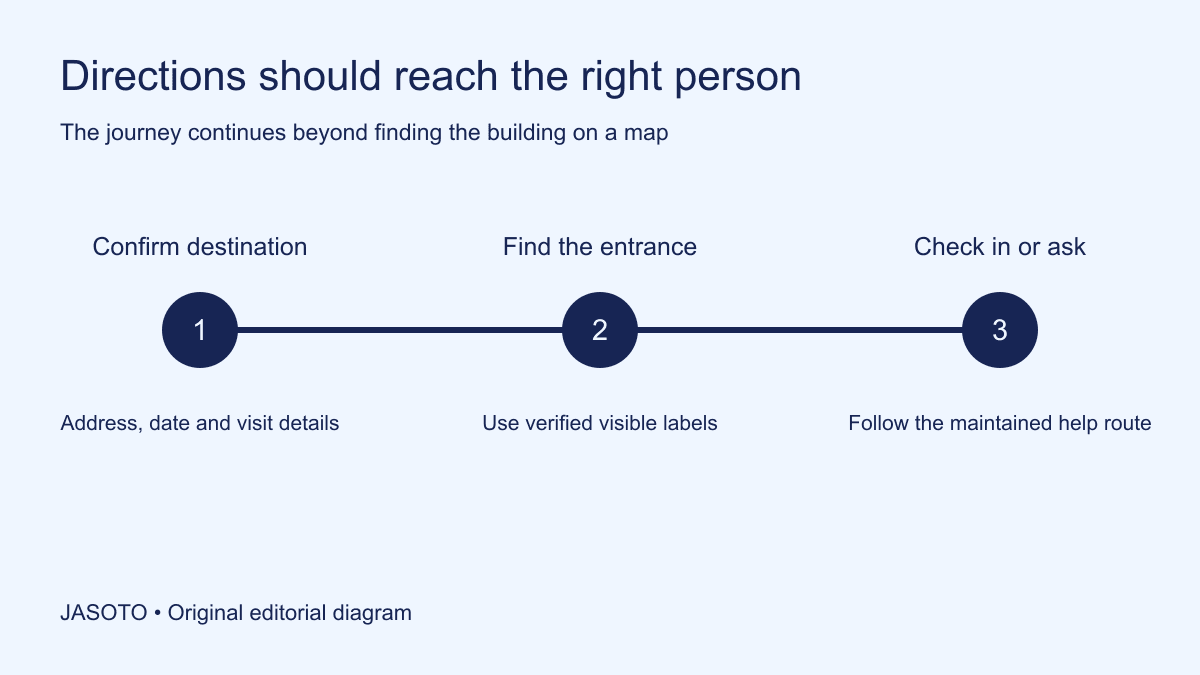
Original JASOTO editorial diagram. Its complete workflow is explained in the article; no actual customer outcome is depicted.
Write plain-language directions for international visitors by giving the confirmed address, the correct entrance and a short sequence of recognizable actions leading to check-in. Explain local labels that may be unfamiliar and provide a working route for help. Keep changing transport information separate from premises instructions so a visitor can distinguish journey planning from the business's actual arrival arrangement.
This guide uses a fictional United States business welcoming international visitors. It focuses on ordinary arrival information. Site safety, accessibility and restricted access arrangements need verification by the responsible people. Use current local evidence and appropriate language review rather than assuming that a familiar route or fluent translation makes every instruction suitable for the audience.
The practical answer
- Start with the confirmed destination and the visitor's actual arrival task.
- Use clear actions and recognizable local labels.
- Separate verified premises information from changing journey details.
- Test directions with someone unfamiliar with the site and maintain the help route.
Start with the agreed visit and destination
Confirm the location, date, local time and whether the visit requires an appointment. A business with several offices should identify the relevant branch clearly. Include the unit, suite or floor where it is part of the actual address or arrival instruction. Do not expect a visitor to infer the correct location from the company's name and a general city map.
Check the destination against the booking or meeting confirmation. If the location changes, update the visitor through the established process rather than relying on a new website address. An international visitor may have saved earlier directions or made travel plans long before arrival. Keep a clear version reference so staff can identify whether someone is using current or superseded information.
Choose the arrival task you are describing
Decide where the instructions begin: a confirmed building entrance, a nearby public arrival point or another appropriate location. Keep the scope explicit. Directions from an airport involve changing transport details that differ from instructions inside a business complex. Provide a useful link to current journey information where needed, while verifying the business-specific final approach separately.
Write the task from the visitor's perspective. They need to recognize the place, enter through the correct route and reach the host or reception. Avoid starting with internal parking terminology or a description of how employees usually arrive. Ask the premises owner which visitor route is authorized and what information can be shared publicly or in the confirmed visit message.
Use plain actions in the order they occur
Write short steps with one clear action or decision at a time. Use verbs such as enter, follow, turn and report where they accurately describe the approved route. Avoid idioms such as “pop round the back” or “head past the usual entrance.” These phrases depend on local familiarity and may translate poorly or leave several interpretations.
[Digital.gov's plain-language resources](https://digital.gov/guides/plain-language) focus on helping a specific audience understand content. Apply that audience-centered principle to directions and test the result. The federal guidance's legal context should not be generalized to every private business. The practical method here is to write observable actions and check whether unfamiliar readers can follow them.
Refer to signs visitors can actually see
Use the exact relevant entrance, desk or room label and explain its role. If a sign says “Visitor Check-In,” keep that recognizable phrase even when the surrounding explanation uses simpler language. A translation that replaces the sign's name entirely may make it harder to match the instruction to the physical environment.
Verify landmarks onsite or through the responsible local contact. A temporary display or parked vehicle is a poor permanent reference. If a landmark changes, the directions need an owner who will notice and update them. Avoid using another business as the only reference without checking that the description remains accurate and appropriate. Stable, visible identifiers make the route more dependable.
Clarify entrances, floors and building units
Shared buildings can contain several receptions or entrances. State which one applies and what a visitor does after entering. Use the building's actual floor labels and explain any ambiguity through the approved instructions. Do not assume that an international visitor interprets “first floor” or an abbreviated unit reference in the way a local employee expects.
Check whether elevators, stairs or other routes mentioned are available to the intended visitor through the relevant premises process. Do not invent an accessible alternative from a map or a photograph. Give a contact for discussing individual requirements and use verified information from the responsible team. The directions should support the arranged visit while respecting needs that require a more specific conversation.
Keep time and appointment statements unambiguous
Use full dates and a clear local-time context where needed. A visitor may read the confirmation while in another time zone or forward it to a travel coordinator. Distinguish the meeting start, reporting time and any separate reception hours. Do not imply that a visible building entrance is staffed whenever an online calendar accepts requests.
If the visitor arrives early or late, give the actual route for contacting the business and obtaining the next instruction. Use approved arrangements rather than inventing a waiting location or grace period. The message should describe what can be done, not guarantee an exception that the host or premises team has not agreed to provide.
Use maps and photographs as supporting information
Check that the map pin corresponds to the intended property and that the text identifies the correct entrance. A map may guide someone to a vehicle entrance unsuitable for visitors. Use an approved entrance image where it adds useful recognition, with an accurate caption and relevant text information. Keep image rights and privacy checks within the business's publication process.
Avoid putting essential instructions only inside a graphic. Provide readable text and appropriate alternatives through the site's accessibility approach. Check that a screenshot remains legible on the actual device or printed copy. A decorative map with tiny labels can appear helpful while leaving the visitor unable to use it at the moment they need to make a turn or identify a desk.
Separate current transport research from premises facts
Use JASOTO travel to research journey options and verify changing details with the relevant providers. Do not promise a transport frequency, fare or journey time without current evidence and a reason to maintain it. A link to current information may be more useful than copying a timetable into a notice the business rarely reviews.
Keep the final premises instructions under a local owner. Transport information can be current while the entrance arrangement is wrong, and the reverse is also possible. Label each part so visitors know what it represents. If the route depends on an event-specific closure or access window, obtain the responsible team's approved information and explain the effective date.
Provide a help route that works during arrival
Name the role or maintained contact that can assist an arriving visitor. Confirm coverage and a backup through the actual staffing plan. A general inbox reviewed later may be useful for preparation but unsuitable for a person standing outside at the appointment time. Explain which route to use for which question rather than publishing several contacts with no distinction.
Tell staff how to identify the visit without collecting unnecessary personal information in public. Keep restricted access details in the approved private channel. If the visitor needs language assistance, arrange appropriate support and explain the process. Explore language services where needed, avoiding assumptions about proficiency from the person's nationality or appearance.
Work through a fictional shared-building arrival
Imagine a visitor arriving at a business center whose map pin leads to a vehicle gate. The original directions say “come to reception on the first floor.” Review finds two receptions and different floor labels from those the visitor expects. The revised message identifies the approved pedestrian entrance, the visible desk label and the business's confirmed suite reference.
An approved photograph supports recognition, while text explains check-in and the working help contact. A reviewer unfamiliar with the site follows the route and flags a sign name that has changed. The team corrects it before sending the message. This fictional example shows why local verification and a practical test matter; it does not establish a route or access procedure for another building.
Test with someone who lacks local knowledge
Ask a colleague or appropriate reviewer unfamiliar with the site to explain each decision from the final instructions. Where practical and authorized, test the route without prompting. Record hesitation, missing references and contradictory labels. A person who already knows the destination may unconsciously fill gaps, so note that limitation if no unfamiliar reviewer is available.
Review translated versions through suitable readers and compare key facts separately. Find business support providers with a brief describing the actual route and audience. The result should be directions that preserve the same approved meaning across formats, rather than a set of fluent versions pointing to different entrances or contact arrangements.
Maintain the route and retire obsolete copies
Assign an owner for address, signage, check-in and contact changes. Keep the source message and its published or distributed versions linked. When a detail changes, identify active templates, downloaded sheets and appointment messages affected. An updated website does not automatically replace a PDF already attached to a future visit confirmation.
Consider visitor support roles when continuing coordination needs capacity. Keep earlier versions and a rollback path for publishing mistakes. Review real arrival questions to identify specific improvements without claiming that a simple wording change eliminates all difficulty. The useful outcome is a visitor who can identify the correct destination, follow verified local steps and reach appropriate help when their situation needs clarification.
Put the guide into practice
- Confirm the exact address, entrance and visit arrangement.
- Choose a realistic arrival point and write the route in order.
- Explain unfamiliar labels without relying on idioms.
- Check maps, images and contact information.
- Test the final instructions and assign updates.
Frequently asked questions
Is a map link enough for an international visitor?
It can help with journey planning, but may not identify the correct entrance, building unit or check-in process. Add verified premises instructions and a working contact for difficulties. Keep the address and map reference consistent, and avoid implying that a navigation result authorizes access through any visible gate.
Should all distances be converted into several units?
Choose information that helps the actual task and audience. A recognizable entrance or sign may be more useful than several approximate measurements. If a measurement matters, verify it and present it clearly. Do not invent walking times or distances to make the directions look more complete.
Can we reuse the same directions for deliveries and guests?
Only where the responsible site team confirms the route and procedure are the same. Suppliers and visitors may use different entrances, timing and check-in arrangements. Label each route clearly and avoid sending a delivery vehicle through guest directions simply because the business address is identical.
Explore JASOTO tools
Find suitable support for visitor information and site coordination.
Explore visitor support roles →Define who maintains directions and helps arriving guests.
Research the journey →Check current travel options separately from confirmed premises instructions.
Explore language support →Prepare appropriate versions for the intended visitor audience.
Continue with JASOTO
Compare your next step
Discover UK businesses, compare services and request written quotes before making a decision.