
Business Growth · UK Guide 2026
Prepare a Contact List for a Planned Business Closure
JASOTO · Updated 5 November 2026 · 1,616 words
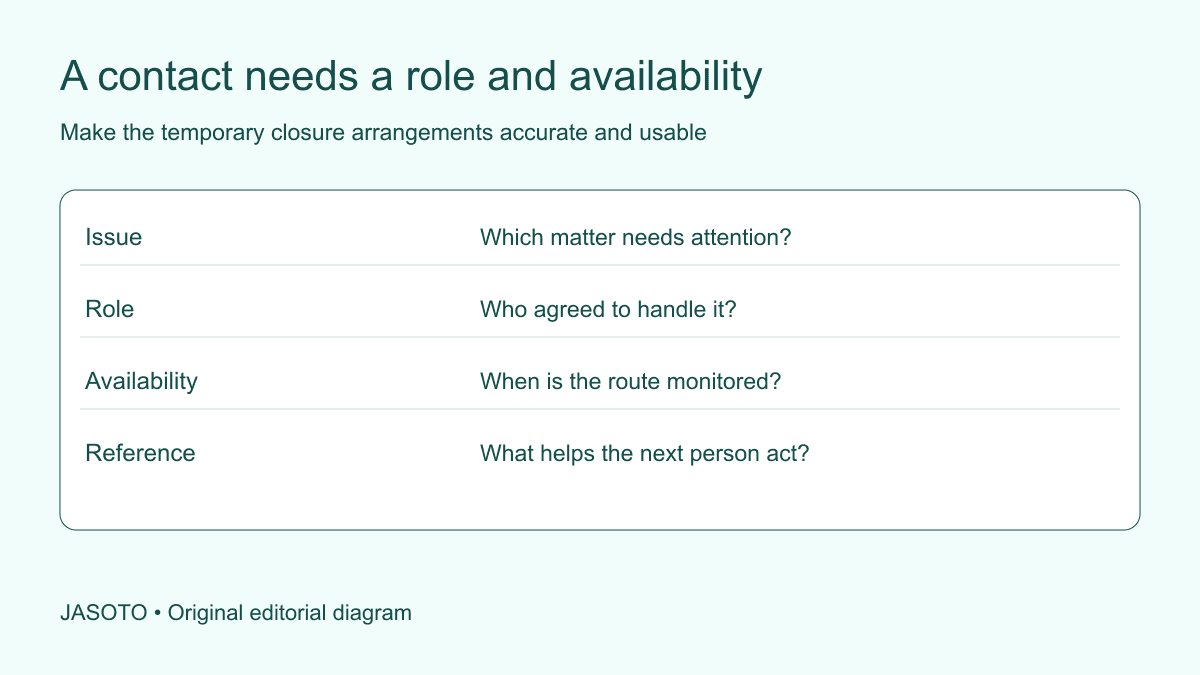
Original JASOTO editorial diagram. Its complete workflow is explained in the article; no actual customer outcome is depicted.
Prepare a planned-closure contact list by defining which matters still need attention, who has agreed to handle them and when the contact route is available. Include the authority and references needed to act. Keep public customer information separate from restricted operational details, and schedule a review when the business reopens so temporary arrangements do not remain active by accident.
This guide is an original administrative worksheet for a UK business temporarily closing its premises, such as a workshop pausing ordinary trading for planned maintenance. Permanent closure, employment matters and specialist shutdown procedures need their own appropriate advice. The contact list supports coordination; it does not create emergency cover or authorise technical work that the responsible people have not actually arranged.
The practical answer
- Define the closure period and services that remain active.
- Record roles, availability and authority alongside contact routes.
- Separate public customer information from restricted operational contacts.
- Check and retire temporary arrangements after reopening.
Define the closure before choosing contacts
Record the start, expected reopening point and affected services. A closed showroom may still have online orders, a booked contractor visit or scheduled deliveries. Identify what continues and what pauses through the actual business plan. Do not assume everyone understands the same meaning of closed. The contact roles depend on the real activities that remain during the period.
Mark provisional dates honestly. If reopening depends on work being completed and approved, preserve that condition rather than announcing a firm date unsupported by the plan. Use the appropriate customer communication and contractual processes for any existing commitment. The internal list should identify who owns the next update so uncertainty does not become an unmanaged gap.
List the matters that need a contact route
Start with actual dependencies: existing customer commitments, supplier deliveries, authorised site attendance and relevant service providers. Ask the responsible team which questions are likely and which require a response before reopening. Avoid copying the whole business address book into a special list. Too many unrelated entries can make the important route harder to locate.
Keep a concise purpose beside each contact. A maintenance coordinator, courier account contact and customer-enquiry owner serve different functions. Someone reading the list should know which route fits their issue without needing the original organiser's memory. If an item does not support a closure-period decision or necessary communication, consider whether it belongs in the normal directory instead.
Confirm that the named person accepts the role
Discuss the expected tasks and availability with each person. A colleague's name on last year's list does not prove they are covering this period. Record the agreed role and suitable business contact route. Do not assume an employee on leave will monitor messages simply because they usually handle that supplier or because their phone number is already known.
Explain what the role involves and what it excludes. A contact may receive information and route a question without authorising additional expenditure or access. Keep those boundaries clear. If another person must decide, identify the appropriate escalation route and actual availability. The list should help participants act within the plan rather than leaving them to improvise authority under pressure.
Record availability in practical terms
State when the route is monitored and any appropriate response expectation actually agreed. Avoid vague assurances such as someone will always respond unless a real arrangement supports them. A mailbox checked at defined intervals differs from a live telephone service. The person using the list needs to understand that difference before relying on it for a time-sensitive matter.
Use the business's proper urgent and emergency processes for those situations. Do not label an ordinary temporary contact as an emergency service or invent a parallel response arrangement. Where no routine cover is available for a period, make that clear to the relevant internal people and plan the appropriate handling of existing commitments through the responsible process.
Keep supplier references with the right contact
Include the account, job or appointment reference that helps the provider identify the matter, using the appropriate level of access. A phone number alone may not be enough when several sites or bookings exist. Check the current supplier information rather than relying on an old invoice if the service route has changed. Preserve the source and date checked where useful.
Avoid placing credentials or sensitive security details in the general contact list. Use the approved controlled system and authorised access arrangements. A provider may need a job reference without needing the full contract or unrelated customer information. Give people the information required for the task, and identify whom to contact where the request exceeds their access or responsibility.
Separate public notices from the operational list
A customer-facing closure message should explain the practical service status and appropriate contact route. It does not need the internal chain of staff contacts, personal numbers or detailed site arrangements. Keep the facts consistent across public channels while giving the internal team a more specific record suitable for their responsibilities. Shared accuracy does not require identical detail everywhere.
Check that published information reflects actual monitoring. A contact form that remains open can create an expectation of ordinary service if the page gives no relevant explanation. Use the business's appropriate communication process to set accurate expectations. Do not imply that submitting a form books an appointment or secures a response within a period the closure plan cannot support.
Prepare contact information for authorised substitutes
The [government's Business Continuity Management Toolkit](https://assets.publishing.service.gov.uk/government/uploads/system/uploads/attachment_data/file/137994/Business_Continuity_Managment_Toolkit.pdf) includes current contact information among planning considerations. It is older continuity guidance, not a new rule for this planned closure. The original worksheet here adds a practical test: can an authorised substitute find the right route and understand what the named person can do?
Make the list available through the appropriate business system and confirm access before closure. If a suitable fallback copy is part of the plan, manage it under the relevant security and privacy arrangements. Do not assume a document stored only on an unavailable premises computer will be accessible to the person expected to coordinate a problem elsewhere.
Worked example: a workshop's planned maintenance break
Imagine a workshop closing ordinary customer visits for a planned maintenance period. Existing collections are paused through the actual customer process, while an authorised provider still has a booked attendance. The owner creates a restricted operational list with the provider reference, site coordinator and agreed cover availability. Public information gives the actual trading status and the appropriate enquiry route without publishing private operational contacts.
The coordinator's role is to receive and route information within defined authority. Any additional work needs the separate approved decision process. This invented example claims no continuous monitoring or successful maintenance outcome. It shows how a temporary closure can have different public and internal information needs while preserving a clear connection between the real activity and the right contact.
Test a few likely contact situations
Ask an authorised colleague to use the list for a supplier delay, a customer question and an unavailable primary contact. Can they identify the correct route, relevant reference and next action? Use fictional or appropriately controlled details. If they need to know the organiser personally to interpret the entry, clarify the role or wording. The list should work for the people authorised to use it.
Check actual numbers, links and permissions through suitable non-disruptive verification. Do not make unnecessary calls to emergency services or send messages to third parties simply to test a document. Confirm the intended business routes appropriately with the participants. Keep the current version clear and withdraw or mark obsolete working copies so contradictory arrangements do not circulate during the closure.
Handle changes through one current record
Name the person responsible for updates while the closure is in progress. A provider may change its contact, a colleague may become unavailable or a visit may move. Record the new arrangement and tell affected participants through the agreed process. Updating one spreadsheet without informing the person who uses a printed copy can leave the practical problem unresolved.
Preserve important changes and their authority rather than overwriting the history without explanation. Keep the record proportionate to the period and responsibilities. If a proposed change exceeds the closure plan, route it to the responsible person instead of treating a new contact entry as approval of a new service, site visit or commercial commitment.
Reconcile the list at reopening
Check whether any external provider still holds an earlier contact instruction. A temporary redirect or visit note can persist outside the business's own directory. Assign the relevant update and confirm it through the actual provider process rather than assuming an internal reopening announcement changes every external record automatically.
Review outstanding enquiries and commitments before restoring ordinary customer expectations. Identify who resumes each task and which temporary contact routes should end. An out-of-office message, redirected call or cover instruction may need an authorised administrative update. Do not assume reopening the premises automatically restores every communication arrangement or transfers every open action back to its usual owner.
Retain appropriate records and remove obsolete personal information through the business's considered process. Review actual difficulties so the next planned closure can improve a specific gap, such as an unclear role or inaccessible reference. Keep the earlier template as a rollback and learning record where appropriate. A useful contact list has a clear ending as well as a clear start.
Use JASOTO businesses to discover defined cover services and verify availability directly. If closure coordination is recurring work, explore operations support roles within a staffing review. For a confirmed visit, research travel after checking the appointment and site status. A reliable closure list connects each necessary question to a real, agreed responsibility and an accurate contact route.
Put the guide into practice
- Identify who needs to contact whom during the closure.
- Confirm named people have agreed to their roles.
- Verify supplier references and appropriate communication routes.
- Test the list and record the reopening review.
Frequently asked questions
Should a closure notice include staff personal numbers?
Use an appropriate agreed business contact route and share personal details only where justified and properly handled. Public customer information and a restricted operational list have different purposes. Do not publish a private number merely because it appears in an internal record.
Does a named contact need to be continuously available?
State the actual agreed availability and response arrangement. Naming someone does not create constant monitoring or emergency cover. If a period is not covered, make that clear internally and use the appropriate established process for urgent situations.
Can we reuse last year's list?
Use it as a starting point only after checking roles, availability, numbers and supplier references. People, service arrangements and site responsibilities can change. A familiar document is not evidence that its contents remain current for this closure.
Explore JASOTO tools
Discuss actual closure-period tasks and availability directly with suitable providers.
Explore operations support roles →Consider staffing where recurring cover needs exceed the team's capacity.
Research a confirmed closure-period visit →Plan travel after checking access, appointment and the site's actual status.
Continue with JASOTO
Compare your next step
Discover UK businesses, compare services and request written quotes before making a decision.