
Jobs & Careers · UK Guide 2026
Prepare a Practical Hiring Task That Reflects the Role
JASOTO · Updated November 5, 2026 · 1,620 words
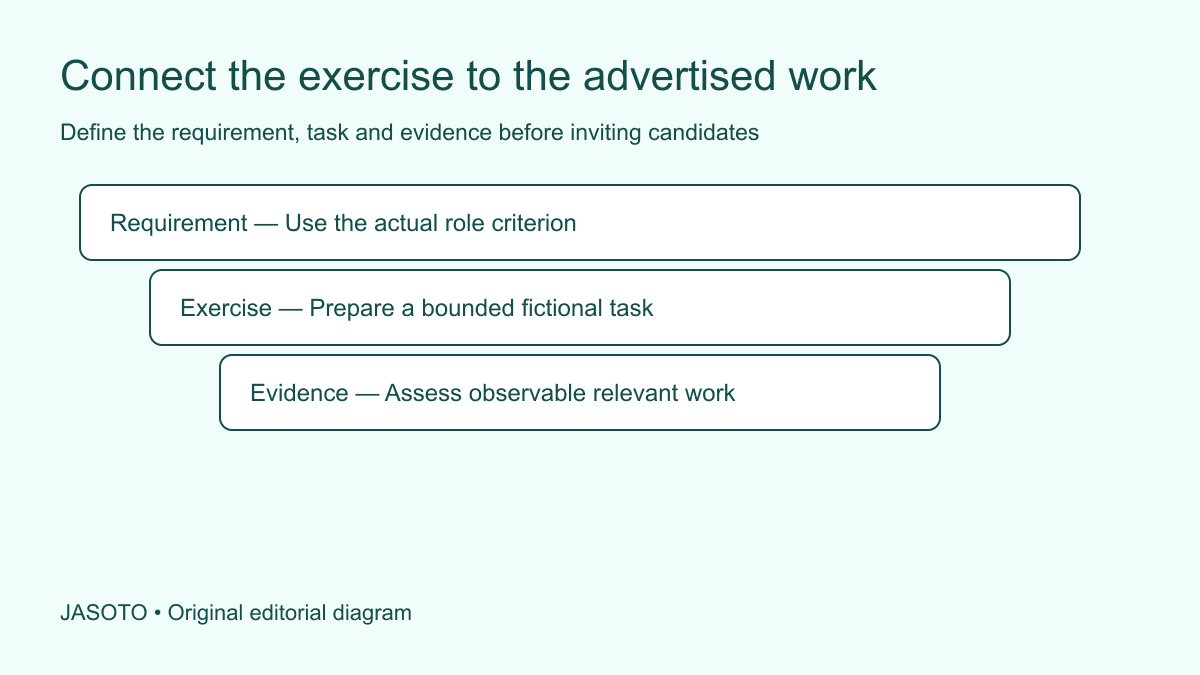
Original JASOTO editorial diagram. Its complete workflow is explained in the article; no actual customer outcome is depicted.
Prepare a practical hiring task by linking one advertised duty to a bounded exercise and defining the evidence reviewers will assess. Use clear fictional material, appropriate resources and consistent instructions. State the limits of the exercise. A candidate should understand what they are being asked to do, while the hiring team should be able to explain why that work is relevant to the role.
This guide is an original planning method for small employers in the United States. The example concerns an advertised appointment-coordination role and a fictional scheduling exercise. Employment testing, accommodations, compensation and discrimination questions need suitable current HR or legal guidance. The worksheet helps organise an assessment; it does not certify that a particular hiring process meets every applicable requirement.
The practical answer
- Start with the actual advertised requirement and observable work.
- Use a bounded fictional exercise rather than an undisclosed live assignment.
- Explain the task, resources and assessment criteria consistently.
- Review evidence against the role with appropriate hiring guidance.
Start with the advertised duty
Choose a real requirement from the role description, such as maintaining accurate appointment information or identifying conflicting requests. Ask what observable work would provide relevant evidence. Avoid designing a puzzle first and then searching for a job duty that seems to justify it. The assessment should help the team understand the candidate's ability to perform the advertised work.
Distinguish skills expected on entry from procedures the business intends to teach. A task that depends on private company terminology may test prior access to your office rather than the relevant capability. Explain necessary context or choose a different exercise. Keep the rationale with the assessment plan so reviewers do not add unadvertised expectations after seeing candidates' responses.
Define a narrow evidence question
Write what the exercise is intended to show. For appointment coordination, it might be whether the candidate preserves confirmed commitments and identifies a conflict requiring clarification. That is more specific than assessing common sense or culture fit. Keep the evidence question tied to the actual role and avoid claims that one short task predicts every aspect of future performance.
The [EEOC's guidance on employment tests](https://www.eeoc.gov/laws/guidance/employment-tests-and-selection-procedures) explains that selection procedures can raise discrimination issues under applicable federal laws. Use appropriate advice for the actual employer and process. The original method here makes the intended job-related evidence explicit so the hiring team can review relevance rather than relying on an exercise's familiarity or popularity.
Prepare fictional inputs with enough context
Create a realistic but bounded set of documents or messages. Use invented names, references and details rather than live customer records. Keep the information internally consistent except for deliberate ambiguities the exercise is designed to assess. Accidental contradictions can make the task harder without adding useful evidence, especially when reviewers later assume the candidate should have guessed the writer's intention.
Identify which facts are confirmed and which are provisional within the fictional scenario. If recognising uncertainty matters to the role, give the candidate a suitable way to record a question rather than forcing an invented answer. A practical task can reveal good judgment through a clear escalation note, not only through a completely filled table that hides unsupported assumptions.
Write the expected output plainly
State what the candidate should produce, the scope and the resources they may use. A request to review a schedule could mean correcting it, describing issues or proposing a new process. Choose the actual output and explain it. Avoid requiring candidates to infer the task from a vague instruction while reviewers assess them against an unstated private answer.
Give appropriate information about timing, format and submission through the actual assessment process. Keep estimates and limits clear, with a route for questions or relevant arrangements. Do not introduce an unexpected new test during the session because the team wants to see how candidates react under pressure. Any such assessment choice needs an appropriate rationale and suitable hiring review.
Make resources and conditions suitable
Check whether the exercise requires particular software, equipment, reading access or another resource. Use the actual role's relevant needs and the employer's appropriate accommodation process. Do not assume a candidate owns a licensed tool or can access a private system merely because staff use it every day. Provide or arrange what the assessment requires appropriately.
Explain what assistance is permitted, including reference material or other tools where relevant. Keep the instruction consistent and aligned with the evidence question. If the real job uses a reference guide, a memory-only test may assess something different. Conversely, an exercise intended to assess a particular unaided skill needs appropriate clear conditions rather than an ambiguous after-the-fact objection to the candidate's method.
Agree criteria before reviewing candidates
Describe observable indicators for the selected requirement. A scheduling task might consider whether confirmed entries remain accurate, conflicts are identified and the proposed next action is understandable. Avoid broad judgments such as polished or naturally organised unless the team can explain the role-related evidence behind them. Keep the criteria proportionate to the task and actual hiring process.
State how incomplete or alternative responses will be considered. A candidate may identify an important ambiguity and ask for clarification rather than fill every field. Review that against the intended evidence instead of rewarding confident guessing automatically. Use appropriate HR guidance for scoring and consistency, and preserve the basis of the assessment rather than inventing criteria after a preferred candidate emerges.
Pilot the instructions with a suitable reviewer
Ask someone familiar enough with the role but uninvolved in writing the task to work through it. Can they identify the output, resources and relevant uncertainty? Note where the instructions cause confusion. The pilot can reveal an accidental dependency on internal knowledge, an unrealistic amount of work or a missing document before candidates encounter the exercise.
Keep the pilot's purpose clear. A colleague completing the task does not prove it is fair, valid or suitable for every candidate. Use the appropriate broader assessment review and advice where required. Record changes and retain the current version so everyone involved knows which material and criteria apply to the recruitment stage.
Worked example: an appointment coordinator exercise
Imagine a role advertised as maintaining a clear appointment record and routing conflicts appropriately. The fictional exercise provides a small schedule, several short messages and definitions of confirmed and proposed bookings. One message requests a different time without confirming acceptance. The candidate is asked to identify the current position and write a concise next-action note, rather than invent a booking decision.
Reviewers consider whether the response preserves confirmed information, recognises the unresolved request and identifies an appropriate next step. This invented example claims no validated selection result or successful hire. It illustrates a direct link between the advertised duty, supplied context and observable evidence, with a clear limit on what the task can establish.
Keep candidate questions and clarifications controlled
Give candidates an appropriate route for questions and keep relevant procedural clarifications consistent through the hiring process. If a question exposes a material ambiguity in the task, decide how to handle it fairly with suitable advice. Do not quietly coach one candidate while leaving others with an unclear instruction, or circulate a private accommodation discussion as general assessment information.
Record the clarification and current task version appropriately. Distinguish a general correction from an individual arrangement that requires restricted handling. The hiring team should know the relevant assessment conditions without collecting unnecessary personal information. Use the actual privacy, retention and access processes for candidate records rather than storing everything in an unrestricted general project folder.
Review the evidence within the task's limits
Prepare a sample evidence note before the exercise is used: the response preserved confirmed bookings, identified the unresolved request and proposed an appropriate clarification. Keep that separate from broader inferences such as excellent under pressure, which the short task may not establish. A sample note helps reviewers understand the intended level of evidence without giving them a script that ignores the candidate's actual work.
Check the task's burden as well as its relevance. Ask the responsible hiring team whether the scope, preparation and conditions are proportionate, and obtain suitable advice on any compensation or work-trial implications. Do not treat a fictional scenario as automatically resolving every legal or fairness question. Record the actual review and remaining limits before candidates are invited.
Ask reviewers to record what the candidate actually produced and how it relates to the agreed criteria. Keep observation separate from inference. A concise correct note may demonstrate the selected administrative skill without supporting a claim about every communication setting. An error may need contextual consideration rather than a broad conclusion about the person's character or motivation.
Use the evidence alongside other appropriate role-related information. Do not let a visually impressive output override a missing essential requirement without an explained decision, or treat a single task as a complete substitute for the hiring process. Keep the actual decision and authority traceable, with suitable professional advice where consequential legal questions arise.
Maintain and retire the exercise appropriately
Review whether the role or workflow has changed before reusing the task. An old exercise can become detached from the advertised work as tools and responsibilities evolve. Preserve the rationale, current criteria and relevant version history. If the task is no longer suitable, retire it through the actual process rather than keeping it because staff already know the expected answer.
Use JASOTO businesses to discover appropriate recruitment specialists and verify capability directly. Use JASOTO jobs to present clear role requirements that support a relevant assessment. For a confirmed assessment visit, research travel after the practical arrangements are agreed. A useful hiring task produces bounded, role-related evidence through a process candidates and reviewers can understand.
Put the guide into practice
- Map the task to a relevant advertised duty.
- Prepare fictional inputs and a clear expected output.
- Confirm suitable assessment and accommodation arrangements.
- Pilot instructions and agree the evidence review method.
Frequently asked questions
Should the practical task cover the whole job?
Choose a relevant limited part that can provide useful evidence under suitable conditions. An exercise cannot establish every capability or future outcome. State what it assesses and use other appropriate evidence for requirements it does not cover.
Can candidates complete a real customer project?
Consider the actual employment, compensation, confidentiality and assessment implications with suitable advice. A fictional bounded exercise often makes the intended evidence easier to define without using customer material. Do not disguise productive work as a generic test or make unsupported claims about what is legally permitted.
Does the same exercise mean the process is automatically fair?
Review relevance, administration, access and any appropriate accommodations through the actual hiring process. Identical paperwork alone does not establish legal compliance or a fair assessment. Use suitable HR or legal advice for the circumstances.
Explore JASOTO tools
Discuss the actual role and assessment needs with suitable specialists.
Explore role requirements →Use clearly described duties and expectations when planning recruitment.
Research a confirmed assessment journey →Plan travel after the appointment, location and practical arrangements are confirmed.
Continue with JASOTO
Compare your next step
Discover UK businesses, compare services and request written quotes before making a decision.