
Business Growth · UK Guide 2026
Create a Practical Product Care Card
JASOTO · Updated 5 November 2026 · 1,601 words
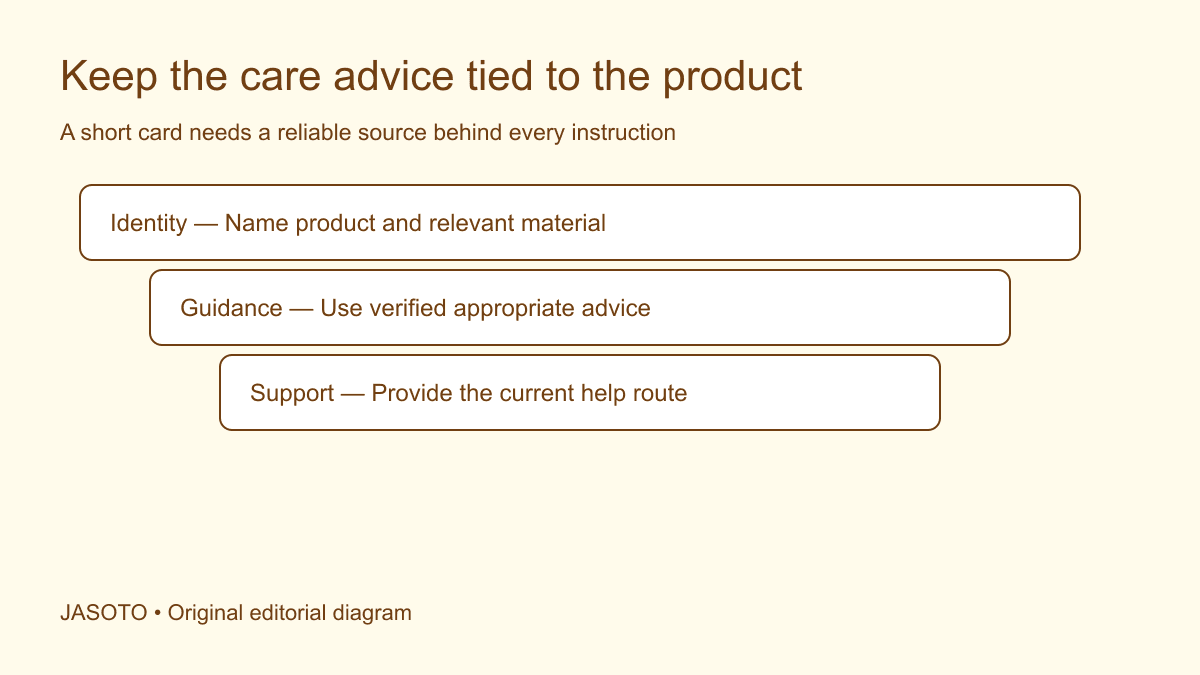
Original JASOTO editorial diagram. Its complete workflow is explained in the article; no actual customer outcome is depicted.
Create a practical product care card by identifying the exact item, selecting relevant verified guidance and giving the customer a usable route to the full instructions. Preserve important conditions when shortening the text. The card should help someone look after the actual product they bought, with clear support information if a question falls outside the summary.
For a UK small retailer, a care card can connect the handover to the product information customers need later. This original guide focuses on preparing and maintaining the card. It does not supply universal cleaning or repair methods. The worked example uses an invented range of decorative ceramic items, where material and finish information must be checked before any care instruction is printed.
The practical answer
- Connect the card to the exact product and material.
- Use verified manufacturer guidance and preserve important qualifications.
- Keep essential information readable and provide a usable source route.
- Review the card when the product or official guidance changes.
Identify the exact scope of the card
Record the products, materials and finishes the card covers. A shared brand or product family does not automatically mean every item has identical care requirements. A decorative coating, attached component or supplied accessory can change the relevant guidance. Ask the appropriate product specialist which distinctions matter and keep the scope visible in the internal record and customer wording.
Use a stable product reference alongside a readable name where appropriate. If the card is inserted into several packages, ensure dispatch can match it to the right item. Avoid a stack of nearly identical cards whose only difference is an unexplained internal code. A customer should be able to tell whether the card belongs to the product in front of them after packaging and receipts have been separated.
Find a suitable source before writing instructions
Use the manufacturer's current product guidance or an appropriate competent source. Preserve the reference and review date. As a specific example of product-dependent organisation, [Le Creuset UK's care page](https://www.lecreuset.co.uk/en_GB/care-and-use/cop002.html) separates guidance across cookware types. That does not make its instructions suitable for unrelated products; it illustrates why a retailer needs the actual material and item context.
If the available source is incomplete, ask a focused question before publishing. Do not fill the gap with a familiar household cleaning method simply because it sounds harmless. A product's intended use, surface treatment and components can matter. Keep the unresolved point with an owner and provide an appropriate customer support route while the authoritative answer is obtained.
Choose the customer tasks the card should support
Identify the relevant moments: before first use, ordinary care, storage and obtaining help. Not every product needs a paragraph for each. Select the tasks customers actually ask about and the information the source says matters. Avoid a decorative layout filled with generic advice that leaves the most important product-specific condition in small print or outside the card entirely.
Keep care, repair and safety information appropriately distinguished. A routine care card should not become an improvised repair guide. If damage or another condition requires a different process, use the appropriate verified instruction and support route. Ask the responsible specialist what must remain prominent. This planning step helps the retailer avoid shortening the text in a way that changes its practical meaning.
Shorten without removing qualifications
When summarising, preserve the conditions that make the guidance applicable. A statement suitable for one component should not become a statement about the whole product. A manufacturer instruction with an important limitation should not be reduced to an unconditional claim. Check the summary against the original source, ideally with the person responsible for product information rather than only the person designing the card.
Use plain language while retaining necessary precise terms. Explain an unfamiliar term where appropriate instead of replacing it with an inaccurate everyday synonym. Do not add unsupported promises such as keeps it perfect for years. The customer's useful outcome is understanding an appropriate action and its limits, not receiving a guarantee the business has no evidence to make.
Make the structure readable during ordinary use
Put product identity and the most relevant guidance where a person can find them easily. Use short sections with clear labels and an appropriately readable layout. Review the actual printed size, contrast and spacing rather than judging only an enlarged design preview. A card that looks attractive on a screen can become difficult to read when reduced to fit a small package.
Ask whether someone can locate the support route without reading every line. If the card uses symbols, explain or verify their meaning and use them appropriately. Do not invent a symbol that resembles a recognised instruction but means something different. The card should communicate accurately to the intended customers, with appropriate alternatives or assistance where the business's obligations and audience require them.
Provide a source route that survives the sale
Give a useful readable address or appropriate contact route alongside any QR code. Direct the customer to the relevant guidance, not merely the brand's home page if the exact information is difficult to find. Check that the destination is accessible without an employee login and identifies the correct product or range. The source link should help someone who encounters the card months later.
If the business controls a support page that links onward, assign ownership for keeping it current. Do not promise permanent access without an actual maintenance arrangement. Keep the product reference visible so support can identify the right guidance even if the URL changes. A convenient code is a route to information; it is not evidence that the information behind it remains accurate indefinitely.
Keep sales claims and warranty wording appropriate
Avoid turning the care card into an unsupported warranty summary or a blanket claim about customer rights. If warranty information is included, use the actual approved terms and an appropriate route to the complete document. A short care reminder should not imply that every customer issue is automatically their fault or that a particular phrase removes applicable rights.
Keep promotional material proportionate to the card's practical purpose. A large discount message can obscure the instruction the customer needs. If the business wants to include another communication, consider whether it belongs elsewhere in the package. The care card earns its place by remaining useful when the customer returns to it for guidance rather than being remembered only as another advertisement.
Worked example: decorative ceramics with different finishes
Imagine a shop selling two decorative ceramic ranges with different finishes. Staff initially propose one generic care card. The product-information owner checks the relevant manufacturer sources and determines that the ranges need separate verified guidance. The cards use clear product names, readable summaries and a support route. Dispatch receives an appropriate mapping so the correct card accompanies each item.
The shop does not invent a cleaning method or assume every ceramic product has the same intended use. This fictional example claims no reduced returns or improved product life. It shows how establishing scope before design can prevent an attractive generic card from carrying advice that has never been confirmed for the product actually supplied.
Test the card with a realistic question
Ask a colleague unfamiliar with the product to identify which item the card covers, find the relevant care information and explain where they would seek help. Use a question that the card is intended to answer. If they infer a broader instruction than the source supports, revise the wording. This is a communication check; technical accuracy still needs the appropriate product review.
Test the code or link in the final printed output and relevant customer context. A small code can become unreliable when printed poorly, while a long address may be mistyped or clipped. Verify the actual production version before ordering a large batch. Preserve the approved proof and source references so a later correction can be traced to the version customers received.
Plan updates before ordering more copies
If the card is offered in more than one language, keep each approved version tied to the same product and source revision. Use an appropriate translation and product-review process so qualifications remain accurate. A corrected English card should not leave another language silently carrying older guidance. Record which versions need review when the source changes and who confirms them. Do not infer technical accuracy from a fluent translation alone. The relevant product owner still needs to ensure the translated instruction describes the same applicable action and limits before it is supplied to customers.
Name the owner responsible for product changes, revised manufacturer guidance and recurring customer questions. Check the card at an appropriate point in the reordering process. Do not reprint an old file simply because it is already on the printer's system. If the source or product changes, review whether existing stock of cards remains suitable and manage any correction through the business's appropriate process.
Keep earlier versions identifiable rather than silently overwriting the only file. A customer enquiry may concern guidance supplied with an older purchase. Retain records according to the business's considered requirements and permissions. The current card should be easy to identify, while the history remains available where it serves a legitimate support or record purpose.
Use JASOTO businesses to discover suitable product-information or print support and verify capability directly. If maintaining customer guidance becomes recurring work, explore catalogue support roles within a staffing review. For an agreed support appointment, research travel after confirmation. A practical care card gives the customer a clear, product-specific starting point and preserves a reliable route to the guidance behind it.
Put the guide into practice
- Identify the product and authoritative care source.
- Choose the relevant customer tasks without inventing instructions.
- Check wording, layout and source access.
- Assign review ownership and preserve the current version.
Frequently asked questions
Can one care card cover every product in a shop?
Only where the guidance genuinely applies to every included item and the scope is clear. Different materials, finishes and components may need different care. Use verified product-specific information rather than assuming a generic cleaning instruction is universally suitable.
Is a QR code enough?
Provide a useful readable route as well as any code, and keep relevant essential information accessible. Check that the destination works for customers and identifies the correct product guidance. A code that leads to a homepage or obsolete document may not help someone caring for the item.
Should a shop invent instructions when none are available?
Ask the appropriate manufacturer or competent product specialist for guidance. Record the question and avoid presenting a plausible household method as verified care advice. A concise support route is more reliable than an unsupported instruction printed permanently on a card.
Explore JASOTO tools
Discuss the exact guidance, layout and production requirements with suitable providers.
Explore catalogue support roles →Consider support when maintaining customer product information is ongoing work.
Research a confirmed support visit →Plan travel after the shop or specialist confirms the appointment and relevant item.
Continue with JASOTO
Compare your next step
Discover UK businesses, compare services and request written quotes before making a decision.