
Global Business · UK Guide 2026
Prepare Product Instructions for a Translation Review
JASOTO · Updated 5 November 2026 · 1,593 words
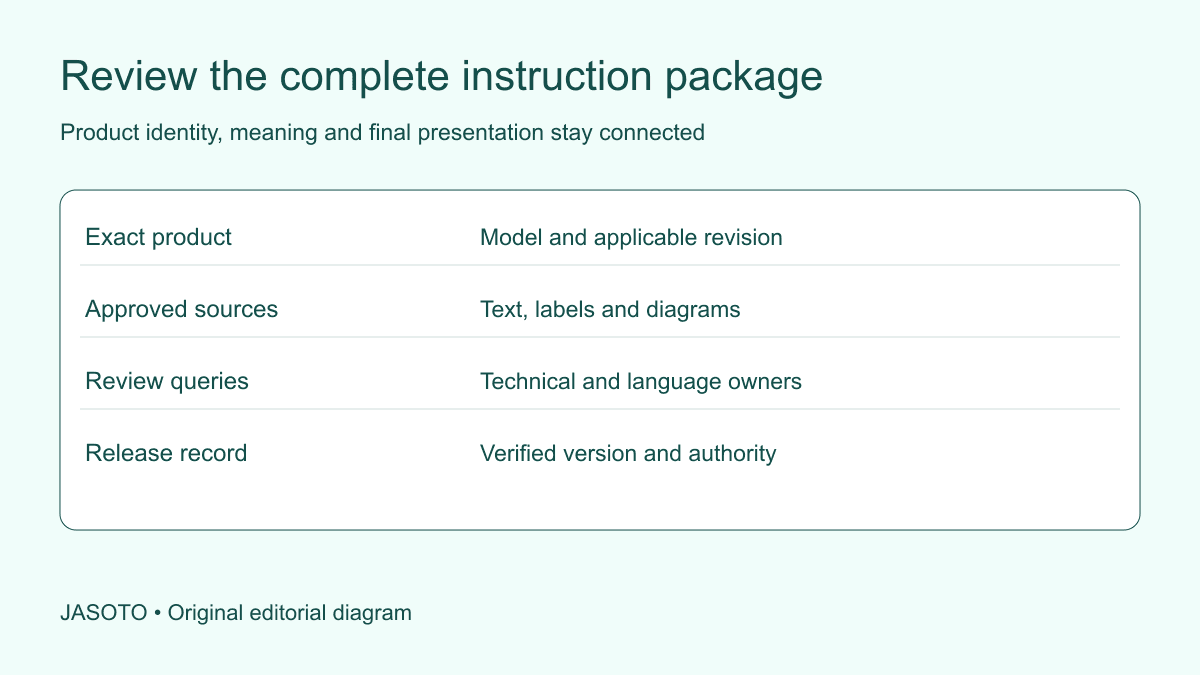
Original JASOTO editorial diagram. Its complete workflow is explained in the article; no actual customer outcome is depicted.
Prepare product instructions for translation review by confirming the exact product and source revision, gathering the complete instruction package and assigning technical and linguistic reviewers. Include diagrams, labels, warnings and linked material. Give unresolved questions a controlled route to the product owner, and define who authorizes release. A translated text file is only useful when it remains connected to the product and approved meaning it describes.
The workflow here concerns preparing a review pack for a UK business. It does not supply operating, repair or safety instructions for a particular product. Those must come from the authorized product information and competent responsible people. The fictional examples use document and component identifiers to explain editorial control without inventing technical steps.
The practical answer
- Match the instructions to the exact product and approved source version.
- Keep diagrams, labels, warnings and supporting files in scope.
- Assign technical and language reviewers with a clear query process.
- Release only the version approved through the product owner's process.
Confirm the exact product and applicability
Record the model, relevant variant and document revision using the product owner's approved reference. Identify any differences between versions that affect instructions. A manual for a similar-looking product may contain incompatible content. Do not select a source merely because its file name resembles the current item or it was used for a previous translation.
Ask who confirms applicability and where that decision is recorded. If the product identity or source status is unresolved, hold the review scope until the owner settles it. Translation cannot establish which instructions belong to the product. Preserving this boundary prevents a language reviewer from unknowingly approving material that is clear but intended for a different configuration.
Establish the authorized source package
Collect the current approved text, illustrations, labels, tables and referenced attachments. Include the editable files agreed with the provider and a rendered reference showing the intended relationships. Record the version of each file. If components come from different revisions, identify that explicitly rather than presenting the folder as one coherent approved manual.
Keep superseded and working drafts distinguishable from the review source. Use controlled access and a clear index. A provider should not have to choose between several files called final. The index can state document identifier, role, version, owner and open issues, giving every reviewer the same starting point without duplicating the entire product history.
Define the audience and use context
Explain who will use the instructions, in which language variety and for what approved purpose. Distinguish customer information from material intended for appropriately qualified service personnel where relevant. The product owner should decide the applicable scope and requirements. Do not merge several audiences into a single brief because they all use the same language.
Provide suitable context without exposing unnecessary confidential information. A reviewer may need to understand the product's terminology and intended setting, while not needing unrelated customer records. Explore language services for appropriate technical expertise and confirm suitability with the actual provider. General language fluency does not establish competence for every product or specialist subject.
Preserve the role of important information
Identify headings, notices, conditions and sequences whose relationships matter. Ask the responsible technical owner which content needs particular review. Do not prioritize solely by typography: a short condition may substantially change the meaning of the next step. The review pack should preserve the complete approved context rather than offer isolated sentences stripped of their dependencies.
[HSENI's user-instruction guidance](https://www.hseni.gov.uk/articles/user-instructions) describes the importance of information supplied with products and instruction content. Its regulatory context should be considered with appropriate specialist advice for the actual product and location. Use the authorized documentation as the reference; this preparation workflow does not determine compliance or replace the product owner's technical review.
Build terminology around product identifiers
Provide the approved names and identifiers for controls, components and functions referenced in the document. Link terms to the relevant diagram or description. Distinguish a branded name that stays unchanged from an explanatory term requiring translation. A bare word list may leave the reviewer unsure which physical item the term identifies.
Record approved target terminology where it exists and unresolved questions where it does not. Avoid inventing a preferred term because a machine translation consistently supplies it. Ask suitable reviewers to assess meaning in context. If the source uses several terms for one component, the technical owner should confirm whether that variation is intentional before the target text is standardized.
Keep diagrams and text linked during review
Give illustrations stable identifiers and keep their source files connected to the paragraphs and labels referring to them. Check that the target version points to the same visual element. A translation can preserve the words while an updated diagram changes the position or name of a component. The final review needs to catch that relationship.
Plan how text expansion will be handled. Small labels should not become unreadable because the translated wording is longer. Ask the responsible designer and reviewer to agree the presentation. Do not remove important wording to fit a box without approval. Any meaningful content change should follow the same controlled query and source-update process as a change in body text.
Give technical questions an explicit decision route
Use a query log with an identifier, source reference, question, proposed interpretation where useful and responsible owner. Distinguish a linguistic choice from an unresolved technical fact. The provider should know whom to contact and whether publication waits for the answer. Keep material questions visible instead of allowing an unanswered comment to disappear when the document is exported.
When the owner clarifies meaning, decide whether the source also needs correction. Update affected versions through the established process. A target translation should not become the only place a product instruction was corrected while the original remains misleading. Record the decision and authority so later reviewers can understand why the wording changed and which version now governs.
Separate review tasks and approval roles
Define who checks language meaning, technical accuracy, figures and units, visual relationships and final publication. The same person may perform several tasks when appropriately competent, but the responsibilities should remain explicit. A signature reading “checked” is weak if nobody knows whether it covers fluency, product applicability or only formatting.
Identify the release authority and the evidence they need. Do not treat the translation provider's delivery as permission to publish. The product owner's process may require additional specialist checks. Keep approval conditions visible and record any limited review scope. This lets the business obtain the missing expertise instead of assuming every participant has silently covered every risk.
Work through a fictional component-name query
Imagine instruction document P12 refers to a component as C4 in the diagram and uses two different names in body text. The language reviewer raises a query with both references. The technical owner confirms the intended component and approves a consistent source term. The source and target versions are updated together, and the diagram cross-reference is checked in the rendered document.
No operating action is invented during that process. The review resolves identity and wording through the authorized owner. This fictional example shows how a controlled query protects the relationship between text and product. It does not demonstrate that the rest of the manual is safe, complete or compliant, which requires the appropriate product-specific assessment.
Check the actual customer-facing package
Review the final rendered or printed output, including covers, revision labels, contents, page references and attachments. Check that no important text is clipped, detached or missing. Verify the intended language version and product applicability are clear. An accurate editing file does not establish that the final export contains the same information.
Ask the technical owner to test publication links and delivery channels through the actual process. If an onsite review is needed, research the journey and coordinate access with the responsible team. Do not ask reviewers to perform unapproved product operations simply to demonstrate the text. Keep practical tests within the authorized product-review arrangement and relevant competence.
Check review comments survive the handover
Before final approval, reconcile open comments against the query log. A comment marked resolved in a document may only mean that someone replied, not that the approved correction reached every affected file. Ask the owner to identify the implemented version and have the relevant reviewer verify the result. Keep material unresolved questions visible to the release authority.
Include cross-file changes in that reconciliation. A corrected component term may need an update in a diagram, a contents reference and a supporting attachment. This focused closure check prevents a coherent-looking export from concealing an unfinished decision. It also gives later reviewers a useful record of what was changed and which evidence supports the release, without requiring them to reconstruct the entire discussion.
Control release, replacement and later corrections
Record the approved source and target versions, reviewers, open conditions and release decision. Link the published package to its distribution locations so a correction can reach the right places. Research technical language providers with a brief stating the actual scope and approval expectations. For recurring work, consider documentation roles with defined technical escalation responsibilities.
Preserve earlier versions through the organization's process and prevent obsolete instructions becoming an accidental download. When the product or source changes, identify every affected language and visual file before release. The practical outcome is a review pack whose product identity, authorized meaning, questions and publication decision can be traced, allowing qualified reviewers to focus on the substantive checks their roles require.
Put the guide into practice
- Confirm product identity and document applicability.
- Collect approved editable sources and visual references.
- Map terminology and unresolved technical questions.
- Define review responsibilities and release authority.
- Check the final rendered package and version links.
Frequently asked questions
Can a translator correct an unclear technical step independently?
They should raise the ambiguity through the agreed query process. The authorized technical owner must settle the underlying meaning and any product instruction change. A language improvement should preserve approved content, while a technical correction needs its own review and controlled update to the source and affected versions.
Do labels inside diagrams need review too?
Include them in the scope. A body paragraph can be accurate while a diagram uses an old part name or points to a different component. Keep identifiers and source visual files linked, and verify the final rendered relationship between labels, illustrations and instructions through suitable technical and linguistic review.
Is a fluent translation enough to publish instructions?
Fluency is one part of review. Product applicability, technical meaning, important notices, figures, diagrams and final layout also need appropriate checks. Define approval and release with the responsible product owner and relevant specialists rather than treating a delivered translation file as automatically ready for customer use.
Explore JASOTO tools
Research qualified support for the actual product and review scope.
Explore documentation roles →Define ownership for technical queries and controlled publication.
Plan product review visits →Coordinate any approved onsite review through the responsible team.
Explore language services →Consider appropriate expertise for technical translation review.
Continue with JASOTO
Compare your next step
Discover UK businesses, compare services and request written quotes before making a decision.