
Jobs & Careers · UK Guide 2026
Write a Factual Project Summary for a Career Change
JASOTO · Updated 5 November 2026 · 1,640 words
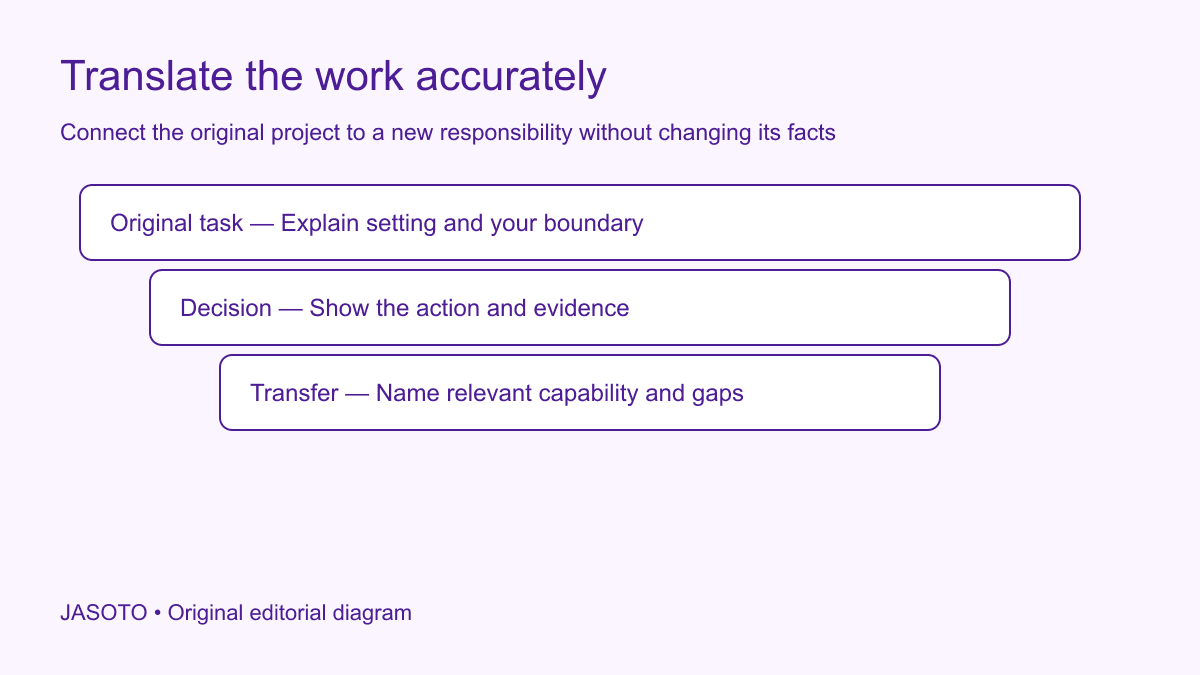
Original JASOTO editorial diagram. Its complete workflow is explained in the article; no actual customer outcome is depicted.
For a career change, write a project summary that explains the problem in plain language, your responsibility, the decisions you made and the output you can evidence. Then connect that work to one relevant capability in the new role. Keep the original setting visible. A useful summary helps a reader from another field understand your experience without renaming it as work you have never done.
This guide offers an original project-translation method for UK applicants. Careers Wales describes career-change CVs as highlighting relevant transferable skills and showing how those skills were used. The summary structure below turns that principle into a focused preparation document. Follow the employer's requested application format, use accurate evidence and distinguish transferable experience from a specialist qualification or sector requirement you still need to obtain.
The practical answer
- Keep the original project setting visible.
- Explain a decision you actually owned.
- Connect the capability to a specific new task.
- State specialist gaps honestly.
Choose a project with an understandable decision
Select a piece of work where you can explain the task and your contribution without relying on your former industry's reputation. A project does not need to be large or glamorous. It needs a clear problem, an action you owned and a useful output. A person moving from hospitality into administration might choose coordinating an event handover if that example genuinely shows accurate records and communication.
Write why the example is relevant to the new role. Keep the connection specific: managing information, organizing a sequence, checking an inconsistency or explaining options. Avoid choosing a project only because it contains a word from the target title. An event budget does not automatically demonstrate professional accounting competence, and a technical presentation does not establish experience in every related technical role. The summary should make the actual connection credible by describing the work at its proper scale.
State the original setting clearly
Give the reader enough context to understand where the work happened and what it was intended to achieve. Explain the audience, task and relevant constraint in plain language. Replace unexplained internal terms with a short description, while retaining any specialist term the reader genuinely needs. A person outside your former field should be able to follow the problem without first researching your old employer's processes.
Keep the setting accurate. A volunteer project should remain a volunteer project, and a course exercise should remain a course exercise. The candidate's ability can be meaningful in either context. Ambiguous wording that makes an independent sample sound like a paid client commission creates a different claim. A clear setting helps the reader evaluate the evidence fairly and gives you a reliable basis for answering follow-up questions about the resources, expectations and support available at the time.
Define your responsibility in one sentence
Describe the part you were responsible for before recounting every activity. Use verbs that identify the real boundary, such as prepared, compared, coordinated, checked or implemented. If another person approved the decision, say so. If the responsibility changed during the work, explain the relevant change rather than presenting the broadest later role as though you held it from the beginning.
For an invented event example, the candidate maintained the arrival schedule and gathered missing information for the venue manager. They did not own the event budget or approve supplier contracts. The summary can still show useful coordination skills. Stating the boundary early prevents a reader from assuming either too much or too little, and it lets the rest of the document focus on the decisions the candidate can discuss from direct experience.
Translate the task into a common work problem
Identify the underlying challenge in language relevant across fields. The project may involve incomplete information, conflicting deadlines, a handoff or choosing between options. Explain how that challenge affected the next step. This gives a new-field reader a familiar structure without pretending the industries are identical. The original context remains, while the reasoning becomes easier to inspect.
In the event example, the underlying problem is that several arrival times are unconfirmed while the venue needs a usable access plan. That can connect to administrative work involving incomplete records and follow-up. The candidate should not claim that an event schedule is identical to the employer's appointment system. Instead, the summary can show a method: distinguish confirmed facts, identify the missing owner and update the record after clarification. The reader can then evaluate the transferability rather than being asked to accept it as a slogan.
Explain the decision and its evidence
Choose the decision that best demonstrates the intended capability. Describe what information you had, what you checked and why you took the next action. Include an alternative where it helps explain judgement. A task list shows activity; a decision account explains how you used information. Keep the account grounded in what you actually knew at the time rather than rewriting the project through later hindsight.
For example, the candidate found that an exhibitor's proposed arrival conflicted with the venue's access window. They asked the venue manager which alternatives were possible before updating the schedule. The summary should identify that approval dependency. It should not claim a negotiated policy change if the manager made the agreement. A reader moving between sectors can understand the quality of the coordination through the sequence, even without knowing the event industry's terminology.
Show an output and name the limit
Describe what the work produced and what happened next. A checked schedule, an approved draft, a completed handover or a decision record can be an appropriate endpoint. Use a permitted example where it adds value, following actual sharing arrangements. If you cannot show the original, a factual account or clearly labelled independent illustration may be suitable through the employer's process.
Keep the result within the evidence. A schedule being used by reception does not prove it increased attendance or reduced costs. If a meaningful measure exists and can be disclosed, identify what it covers. Otherwise explain the observed output and intended benefit separately. Career-change applicants can feel pressure to produce exceptional claims to compensate for unfamiliarity with the new field. A precise account is more useful than a dramatic result that cannot survive a basic follow-up question.
Make the transfer explicit and bounded
Add a short sentence connecting the project to the target responsibility. “This example shows how I organized incomplete information into a handover for another team” is specific. Follow it with the relevant new-field gap where needed. You may understand handoffs while still needing to learn the employer's system, terminology or specialist rules. Both facts can be true in the same summary.
Do not translate a transferable skill into a qualification claim. If the new role requires a particular licence, certification or technical competence, research that requirement through the appropriate source and describe your actual status. A project summary can support your application by demonstrating relevant capability, but it cannot remove an entry requirement. Keeping the distinction visible helps you choose roles and development steps realistically rather than forcing every past task into the shape of a new profession.
Remove jargon that does not carry evidence
Read the summary as though you have never worked in the original field. Explain acronyms and replace internal shorthand that adds no useful precision. Keep a term when its exact meaning matters, then define it in context. The goal is to help the reader understand the work, not strip it of every detail until it becomes a generic story about communication and teamwork.
Ask a trusted person outside the field to identify the problem, your action and the result. If they cannot, note where the explanation failed. Perhaps the document assumes knowledge of an internal approval stage, or the personal contribution appears only after several paragraphs of background. Revise that specific point. This is a focused clarity check rather than proof that every recruiter will respond the same way or that the summary now guarantees an interview.
Adapt the summary to the requested format
Keep a factual master version, then select the relevant details for a CV bullet, application answer or interview account. Different formats need different lengths, but the setting, ownership and outcomes should remain consistent. Do not let the abbreviated version become more senior or more successful simply because there is less space to explain the boundary. A short accurate sentence can preserve the most important distinction.
Use job opportunities to identify responsibilities that genuinely connect to your evidence and where further learning is needed. If you ask a business service provider to review the wording, give them the factual boundary and check the edited claims. Confirm any assessment or interview arrangement before planning travel. The project summary should help you prepare for the actual opportunity, rather than become a generic document sent unchanged to every role with a similar title.
Review the summary as your direction becomes clearer
After useful feedback or a substantive conversation, revise the explanation where the connection was unclear. Separate feedback about writing from a genuine gap in experience. A clearer sentence may solve one problem, while another requires practice, training or choosing a different role. Keep both types of action visible instead of assuming stronger language can resolve every mismatch.
If the summary overstates the transfer, return to the original task and rebuild the connection at a narrower scale. Preserve what is accurate and remove the unsupported implication. The practical result is a project account that a reader in another field can understand and question. It shows useful experience without erasing where it came from, and it gives you a clear way to discuss what you can already contribute alongside what you still need to learn.
Put the guide into practice
- Choose an inspectable project example.
- Write the responsibility in one sentence.
- Check jargon with an outside reader.
- Preserve facts across application formats.
Frequently asked questions
Should I hide the industry I am leaving?
Keep the original setting clear and explain the task in language a reader from another field can understand. The aim is to show a relevant capability accurately. Renaming the work as experience in the target industry can create a claim you cannot support.
Can one project demonstrate several transferable skills?
It can, but choose the capability relevant to the actual question or role. Keep a factual master account and adapt the emphasis. Your contribution and the result should remain consistent even when one version focuses on information checking and another on coordination.
What if I lack a required qualification?
State your actual status and research the requirement through an appropriate source. A project summary can demonstrate related capability but does not replace a required licence, qualification or specialist competence. Use the gap to plan a suitable next step rather than implying equivalence through wording.
Explore JASOTO tools
Discover providers and check support for your specific task.
Explore roles and responsibilities →Consider the practical responsibilities involved when recruiting or joining a team.
Plan work-related travel →Research a journey when joining, training or meeting colleagues in person.
Continue with JASOTO
Compare your next step
Discover UK businesses, compare services and request written quotes before making a decision.