
Jobs & Careers · UK Guide 2026
Questions to Ask About a Role With Several Locations
JASOTO · Updated 5 November 2026 · 1,679 words
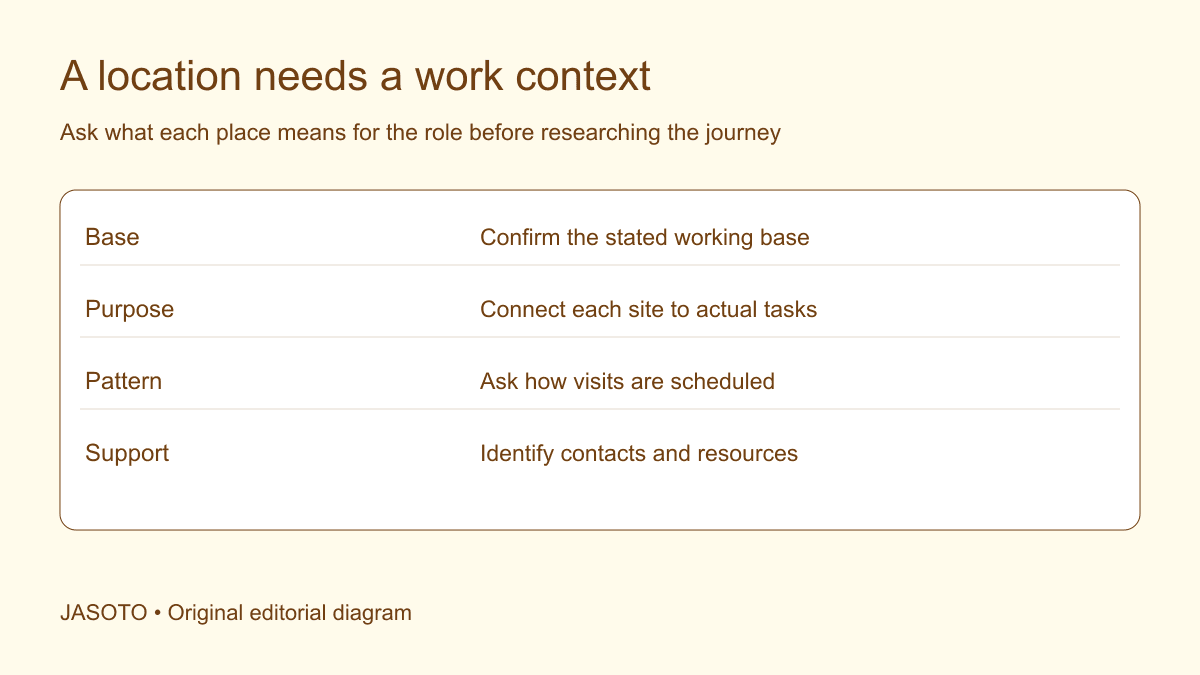
Original JASOTO editorial diagram. Its complete workflow is explained in the article; no actual customer outcome is depicted.
For a role with several locations, ask where the work is based, which sites you would attend, how visits are scheduled and who decides when plans change. A list of offices is not a usable description of the working pattern. Separate the interview venue from the eventual workplace, and distinguish occasional visits from responsibilities that regularly move between sites.
This original guide helps UK applicants prepare practical role questions. National Careers Service interview guidance encourages preparing your own questions and discussing work arrangements before accepting an offer. The location matrix and invented scenarios below are editorial tools for turning uncertainty into a focused conversation. Confirm the actual arrangements with the employer; do not assume that a familiar job title or a company's office map settles the requirements of an individual vacancy.
The practical answer
- Separate interview, training and work locations.
- Ask for a representative working pattern.
- Clarify who resolves site priorities.
- Record current facts separately from possibilities.
Identify the different meanings of location
Read the posting and separate the stated base, potential work sites, customer locations, training venues and interview address. These may be different places. An interview at head office does not establish that the role is based there, and a company with many branches does not establish that you would visit all of them. Keep the exact wording beside each location so your notes do not silently strengthen a vague statement.
List the missing facts that affect your decision. “Regional travel” might leave the region, frequency and notice period unclear. Ask which locations are currently relevant to the role and whether any described locations are only possible future additions. The purpose is to understand the working arrangement, not require the employer to predict every journey throughout your employment. Distinguishing the current pattern from possible change makes the answer useful without demanding unrealistic certainty.
Ask for an ordinary working example
Invite the manager to describe a representative week or working cycle. Which location would the person start from, what activity brings them to another site and what determines the next move? An example can reveal how the role works more clearly than asking whether travel is “frequent”. Different people use that word for very different patterns, so replace the label with a concrete description.
Ask the manager to separate ordinary work from an unusually busy period. For an invented service supervisor role, routine branch visits might be planned, while a new-site opening creates a different temporary pattern. Record both without treating the exceptional period as either irrelevant or permanent. You need enough information to assess the practical reality and choose appropriate evidence for the interview, rather than a fictional weekly timetable that nobody can actually promise.
Clarify the base and reporting relationship
Ask how the employer describes the role's base and where the manager and immediate team work. A role can have an assigned site while collaborating mainly with people elsewhere. That affects how questions are answered, how decisions are approved and where support comes from. Do not assume that the person sitting nearest you at a branch is the person responsible for your priorities or supervision.
Ask what happens when site needs conflict. Who decides which location takes priority, and how is that decision communicated? A multi-location role can become difficult when every site treats the same person as permanently available. The candidate does not need to design the employer's management structure during the interview, but should understand the existing route for resolving competing requests. An unclear answer is an uncertainty to record and follow up, rather than an invitation to make assumptions about informal authority.
Understand the purpose of each visit
Map locations to tasks. A training site may be relevant during induction, a warehouse may be visited for inventory work and a customer site may be part of service delivery. Ask what must be done physically at each place and which activities happen elsewhere. This helps distinguish necessary attendance from a general statement about being flexible, while avoiding an unsupported assumption that every task can be done remotely.
Prepare evidence that matches those tasks. If the role involves site handovers, a factual example of coordinating information between teams may be useful. If it involves operating specific equipment, a general travel anecdote will not demonstrate that capability. The location question is connected to the work, rather than simply a list of personal preferences about towns. You can assess practical fit and explain relevant skills without claiming experience of the employer's exact sites.
Ask how the schedule is made and changed
Find out who plans visits, how much notice is usual and what can trigger a change. Separate planned attendance from unexpected calls to another site. Ask how the person learns of a revised plan and which contact can resolve a conflict. A calendar published in advance is only helpful if the role's ordinary change process is also understood.
Use a neutral scenario rather than a challenge. “If two sites need support on the same day, how is the priority agreed?” invites an explanation of the work. Avoid presenting an extreme hypothetical as though it is an established problem at the employer. The answer may identify a central scheduler, a manager or a different arrangement. Note whether the process is current or still being designed, especially when the vacancy is part of an expansion or a newly created team.
Separate travel arrangements from assumptions
Ask what travel the role requires and where to find the employer's actual arrangements for booking, expenses, equipment and authorization. Do not assume a particular reimbursement or transport method merely because another employer used it. If a vehicle requirement appears in the posting, clarify what it means for the task rather than drawing conclusions from a generic phrase. Any individual legal or contractual question should go through the appropriate adviser or employer contact.
If travel is material to your decision, ask early enough to understand it before committing to the role. A candidate can explain a practical constraint without disclosing unnecessary private detail. Keep confirmed employer information distinct from your own route research and budget estimates. A map can help you explore distances, but it cannot tell you whether the business expects a journey on a particular day or which costs it will approve.
Check induction and equipment across sites
Ask where initial training happens and which location-specific introductions are provided. Knowing one building does not establish familiarity with another site's access, local procedures or equipment. Find out who receives a new colleague at each location and how site-specific questions are handled. The answer helps you understand the support offered without turning the interview into a request for an exhaustive operational manual.
Clarify how equipment moves between sites and whether different workspaces provide different resources. For an invented coordinator role, one branch might provide a workstation while another expects the colleague to use a supplied device. Do not infer those arrangements from office photographs. Ask which setup is actually planned for the position and what the employee needs to bring. Keep safety, access and suitability questions with the responsible employer contacts rather than improvising solutions based on convenience.
Plan questions in a useful order
Prioritize what changes your decision. First establish the base and ordinary pattern, then explore scheduling and support. Ask detailed route questions after the relevant locations are confirmed. This avoids spending an interview discussing an address that turns out to be only a training venue. A concise sequence is easier for the interviewer to answer than a long list mixing commute, expenses, reporting relationships and speculative expansion plans.
Assign questions to appropriate contacts. The recruiter may confirm the written location description and process, while the manager can explain representative tasks and changing priorities. If a question cannot be answered immediately, ask who can provide the information and when. Do not treat an uncertain first response as a settled promise, and do not ask several people independently in the hope of finding the answer you prefer. Resolve inconsistent information through the established recruitment route.
Record the answer with its scope
After the conversation, note the location, purpose, ordinary pattern, decision owner and any remaining uncertainty. Date the note and identify whether it records a verbal explanation or written confirmation. A phrase such as “usually at the main branch” should remain qualified in your record. Turning it into “main branch only” makes the application decision appear simpler while discarding the information you actually received.
Use job opportunities to compare roles with similar titles, keeping each employer's arrangements separate. For providers or local services researched through JASOTO businesses, confirm suitability directly when planning a potential visit. Travel research becomes useful once the relevant workplace and attendance pattern are understood. Keep research in proportion: there is little value in producing detailed journey plans to ten branches if the hiring manager confirms that only two are part of this role.
Revisit unresolved points before accepting a location
If the process reaches an offer, review the points that still affect your decision and ask for the appropriate confirmation. Compare the formal information with the understanding developed during interviews. Raise a material discrepancy neutrally and seek clarification before assuming which version controls. This guide does not interpret an individual contract; it helps you identify what needs a clear answer from the employer or a suitable adviser.
If the role's pattern is different from your initial assumption, revise your decision rather than forcing the facts into the application you hoped to make. The rollback is simple: return to the confirmed base, tasks and visit pattern, remove unsupported expectations and ask the remaining decision-critical question. A multi-location job can be appealing and workable, but its practical meaning comes from the actual responsibilities and arrangements. A well-prepared candidate explores those details through clear examples instead of relying on an office list or a reassuring adjective.
Put the guide into practice
- Identify the actual sites in scope.
- Ask how schedules change.
- Check training and equipment arrangements.
- Confirm material unresolved points before deciding.
Frequently asked questions
Should I ask about every company location?
Start with the locations relevant to the vacancy and ask how the employer defines the role’s coverage. A company-wide office list may include sites you would never attend. Once the actual scope is clear, ask detailed questions about the locations and working pattern that affect your decision.
Is the interview venue normally the workplace?
Do not assume that it is. Employers may interview at head office, a recruitment venue or another site. Ask the recruiter to distinguish the interview address, initial training location and intended workplace before planning a commute or deciding whether the role’s location is suitable.
What if different interviewers describe the travel differently?
Record the exact difference and ask the recruitment contact or responsible manager to clarify the current arrangement. Distinguish an ordinary pattern from an exceptional period or possible future change. Do not quietly select the most convenient answer and treat it as confirmed.
Explore JASOTO tools
Discover providers and check support for your specific task.
Explore roles and responsibilities →Consider the practical responsibilities involved when recruiting or joining a team.
Plan work-related travel →Research a journey when joining, training or meeting colleagues in person.
Continue with JASOTO
Compare your next step
Discover UK businesses, compare services and request written quotes before making a decision.