
Jobs & Careers · UK Guide 2026
Organise Questions Before a Recruitment Agency Call
JASOTO · Updated 5 November 2026 · 1,660 words
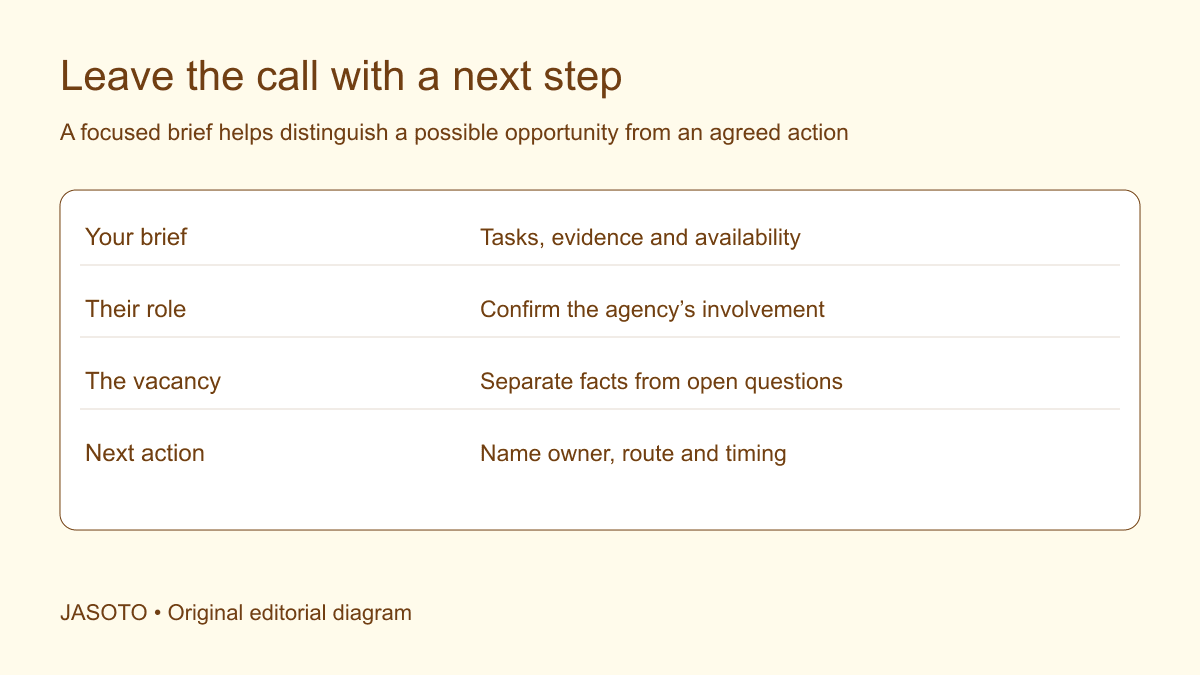
Original JASOTO editorial diagram. Its complete workflow is explained in the article; no actual customer outcome is depicted.
Prepare for a recruitment agency call by writing a short factual brief about the work you want, the experience you can demonstrate and the practical arrangements you can accept. Then list the questions needed to understand the agency's role, any vacancy being discussed and the next action. Leave the conversation knowing what the consultant will do and what you have agreed to provide.
This original guide is for UK work-seekers organizing a first or follow-up agency conversation. GOV.UK provides guidance on employment agencies and businesses, including their rules and required arrangements. Use that current guidance and appropriate advice for a specific rights or contract question. The call sheet below focuses on obtaining clear information; it does not assume every agency, assignment or employment arrangement works in the same way.
The practical answer
- Prepare a factual task-based work brief.
- Clarify the agency’s role in this opportunity.
- Ask for relevant written information.
- End with named actions and contact timing.
Establish the purpose of the call
Check whether the conversation concerns a specific vacancy, general registration, an existing application or an offered assignment. Ask for a role reference or agenda if that distinction is unclear. A general conversation about your search needs different preparation from discussing a confirmed interview. Record who arranged the call and through which established route so you can connect later instructions to the correct consultant.
Do a proportionate check of the agency's own information. Identify the types of work it says it handles and the contact route you are using. Avoid sending extensive personal documents before understanding the process and recipient. If an unexpected message changes the arrangement, verify it through an established contact. The immediate goal is a useful conversation with the right person, rather than a large speculative dossier assembled before you know whether the agency deals with relevant work.
Write a concise work brief
Summarize the responsibilities you are seeking and the evidence you bring. Use task language alongside job titles, because titles can vary across employers. An applicant might want work involving scheduling, accurate records and customer follow-up, rather than describing every acceptable position as “administration”. Include relevant qualifications or experience factually and leave room for the consultant to explain which vacancies match.
Prepare a brief opening statement you can say naturally. For an invented coordinator applicant, it might be: “I have experience maintaining service records and arranging appointments. I am looking for work where those responsibilities are a substantial part of the role.” Add the actual location and schedule facts that matter. Avoid claiming a broad skill solely because a previous title sounded related. The consultant needs a reliable starting point for matching, and you need an account you can support in a later interview.
Separate preferences from firm constraints
List the practical arrangements that matter: location, working pattern, start availability, travel and the type of engagement you are considering. Distinguish requirements from preferences. If you can consider several arrangements, state the real range without saying you are available for anything. An overly broad answer can lead to repeated unsuitable conversations, while a precise boundary helps the consultant understand where a vacancy needs clarification.
Use dates for changing availability and explain how contact can be arranged around current work. Keep private reasons out of the general brief unless you choose to raise something through an appropriate support route. You can say that a particular arrival time is unworkable without providing an unnecessary personal history. If a question relates to an individual legal or employment issue, ask for the relevant written information and seek suitable advice instead of relying on a hurried general answer during the call.
Ask how the agency is involved
Clarify whether the agency is introducing candidates to an employer, arranging temporary assignments or performing another defined service. Ask who would be your contact at each stage and which organization supplies the relevant written terms. Keep the explanation specific to the opportunity being discussed. A consultant's description of one vacancy should not become an assumption about every other role the agency may later mention.
Ask what the agency intends to do with your application information and how you can keep it current. If the consultant proposes sending your details for a role, clarify which role and what material is being represented. Record the agreement in your own notes and ask for confirmation through the normal process where appropriate. This is useful coordination: you should know which opportunity is active, rather than discover several unexplained submissions when another employer contacts you.
Explore a vacancy through its actual tasks
For a specific role, ask about the main responsibilities, reporting relationship, location and working pattern. Identify which details are confirmed by the employer and which the consultant still needs to establish. If a phrase such as “fast-paced office” appears, ask what work pattern it describes. A practical example is more useful than another adjective about the employer's culture.
Connect your questions to the role's requirements. “Would the person prepare the schedule or approve changes to it?” clarifies authority. “Which system is used, and what training is planned?” clarifies a preparation need. Avoid expecting the consultant to know every technical detail immediately. Ask who owns the answer and how it will be obtained. A good call can end with a specific information request rather than an invented answer designed to keep the conversation moving.
Ask about documents through the proper process
Find out which documents or information are required, why they are needed at that stage and how to provide them through the approved route. Keep identity, bank and other sensitive details out of an ordinary email summary unless the established process appropriately requires that channel. Do not infer that every document requested by an unfamiliar contact is necessary merely because the message uses recruitment language.
GOV.UK's agency guidance provides a route to the applicable rules and written arrangements. Check the current relevant page if you need to understand a particular requirement. This call plan does not provide an exhaustive list of documents for every engagement. Record what the consultant has requested and any question you need clarified before sending it. Accuracy includes acknowledging when you do not yet understand the process, rather than producing a guessed document or an incomplete answer to avoid asking.
Keep commercial and pay questions specific
For an opportunity you may pursue, ask for the actual written information about pay, deductions, expenses and the relevant terms through the agency's proper process. Clarify what an advertised figure represents instead of comparing unlike amounts from different arrangements. Do not treat an informal headline as a complete explanation of what you would receive or what conditions apply.
If a charge or optional service is mentioned, ask what it is for and whether it is separate from finding work. Check current official guidance and obtain appropriate advice where needed. Avoid agreeing to a poorly understood service simply because you feel the conversation is moving quickly. A useful question is “Where is that explained in the written information?” This gives you something concrete to review and distinguishes a factual clarification from an attempt to negotiate an arrangement you have not yet understood.
Agree the next contact and action
Before ending, summarize the next step aloud. Name who will obtain the missing role information, who will send the current CV and when an update is expected. Confirm the best contact route and what happens if nothing is heard by that point. “We will keep in touch” can be friendly but gives neither person a practical action to follow.
For the invented coordinator applicant, the consultant will check the ordinary branch schedule, while the applicant will send a revised factual CV through the agreed route. They arrange a follow-up after the consultant has the employer's answer. The applicant records that the location remains unconfirmed and does not plan a commute as though it were settled. This turns an exploratory conversation into two bounded actions without pretending that an interview or placement has already been secured.
Send a concise factual follow-up
Where useful, send a short message confirming the material requested, key availability and agreed next action. Do not repeat the whole conversation or attach sensitive records that were not requested. If your notes contain an uncertainty, identify it as a question rather than presenting your interpretation as the consultant's promise. Correct a material misunderstanding promptly while the conversation is still easy to trace.
Keep separate records for different agencies and vacancies. Use job opportunities to compare actual responsibilities and maintain the relevant reference for each application. An agency discovered through business listings still needs direct confirmation of its services and suitability. If an employer visit is proposed, confirm the venue and purpose before planning travel. Your own record should show which step is agreed, which is proposed and which still requires information.
Review whether the conversation was useful
After the call, ask what you learned about the work and whether the agency deals with suitable opportunities. Revise your brief if repeated misunderstandings arise from your own wording. If the consultant mostly handles work outside your scope, make a deliberate decision about further contact rather than repeatedly preparing for irrelevant calls. Keep that assessment factual and avoid drawing a broad conclusion from one delayed reply.
When the process becomes confused, return to the vacancy reference, the current written information and one accountable contact. Ask for the specific unresolved fact before making another commitment. The rollback is to narrow the active conversation and restore an accurate work brief. A productive agency call leaves you with a clearer understanding of the opportunity and a manageable next step, while preserving your ability to review the relevant documents and make an informed decision before proceeding.
Put the guide into practice
- Confirm the purpose and contact route.
- Separate constraints from preferences.
- List decision-critical vacancy questions.
- Record and confirm the agreed next step.
Frequently asked questions
What should I prepare before a first agency call?
Have a factual work brief, current availability, relevant experience and a short list of practical constraints. Check whether the call concerns a specific vacancy or general registration. Keep the current CV accessible, but ask which documents are needed and how to supply them through the appropriate process.
Should I agree to every role the consultant mentions?
Ask about the responsibilities and practical arrangements before deciding whether to pursue an opportunity. Explain firm constraints and genuine preferences clearly. If important facts remain unknown, agree who will obtain them rather than treating a tentative suggestion as a confirmed match.
What if I do not understand a pay or document requirement?
Ask for the relevant written information and a clear explanation of what applies to the opportunity. Check current official guidance and seek appropriate advice for a specific rights or contract question. Avoid guessing or agreeing merely because you feel pressure to finish the call quickly.
Explore JASOTO tools
Discover providers and check support for your specific task.
Explore roles and responsibilities →Consider the practical responsibilities involved when recruiting or joining a team.
Plan work-related travel →Research a journey when joining, training or meeting colleagues in person.
Continue with JASOTO
Compare your next step
Discover UK businesses, compare services and request written quotes before making a decision.