
Jobs & Careers · UK Guide 2026
Prepare a Reception Brief for Visiting Job Candidates
JASOTO · Updated 5 November 2026 · 1,606 words
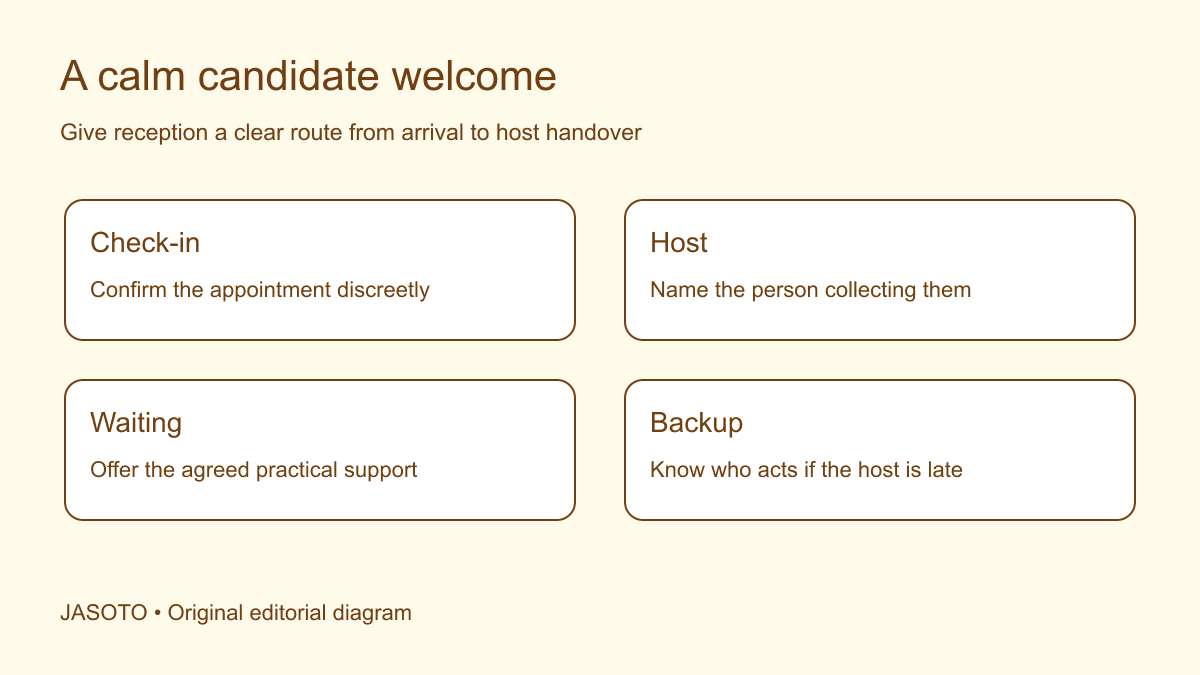
Original JASOTO editorial diagram. Its complete workflow is explained in the article; no actual customer outcome is depicted.
A candidate reception brief should tell the front desk how to confirm the appointment discreetly, contact the right host, provide agreed practical help and resolve a delayed handover. It should be short enough to use while someone is standing at the desk.
For a UK employer, this brief fills the gap between the invitation and the interview room. The invitation explains where the candidate should go; the reception brief explains what staff will do when the candidate gets there. Building that handover around real responsibilities makes the visit easier for the candidate, receptionist and hiring team.
The practical answer
- Give reception only the information needed to welcome and route the candidate.
- Name a host and an available backup for each appointment.
- Keep practical arrival observations separate from hiring assessment.
- Plan a discreet response to delays, waiting and requested assistance.
Define reception's job for the visit
Write the intended outcome in one sentence: welcome the named visitor and connect them with the appointed host. That gives reception a clear operational purpose without making them responsible for interpreting the vacancy or conducting an informal interview.
Identify where reception's responsibility starts and ends. It may include confirming the appointment, notifying the host, explaining the waiting arrangement and recording that the host collected the candidate. The interview team owns the assessment and substantive questions about the role.
Make the boundary practical. If a candidate asks who will interview them, reception can use the confirmed appointment information. If they ask about salary flexibility or the manager's expectations, reception should direct the question to the hiring contact. Guessing an answer to sound helpful can create a misleading impression before the formal conversation begins.
Use a minimal appointment record
Include the candidate's expected name, appointment time, host, host contact and backup. Add the relevant entrance or meeting location where the building has several reception points. A simple visit reference can help distinguish two appointments with similar names.
Decide how staff will confirm the appointment without announcing unnecessary information across a busy lobby. A discreet question at the desk is often more useful than a large public list of candidates and job titles. Follow the organisation's actual visitor arrangements for any identity or sign-in step; avoid inventing extra requirements on the day.
The receptionist needs a current record. Show who supplied it and how late changes reach the desk. A perfect brief printed yesterday will still fail if the hiring team moves the interview and tells only the candidate. Put appointment changes into the same operational channel used for other host updates.
Give staff a natural welcome script
Use a short model that staff can adapt: “Hello, welcome. Are you here for an appointment? Thank you; I will let your host know you have arrived.” The point is a predictable, respectful start rather than a performance that reception must recite word for word.
Add the next action. For example, the receptionist might explain where the candidate can sit and say the host will collect them there. If the building uses visitor badges, describe the normal process clearly and explain what happens to the badge at departure.
Avoid unnecessary questions about where the candidate currently works, why they are leaving or what salary they expect. Those conversations are outside a routine welcome brief. Staff can remain warm and conversational while allowing the visitor to wait without feeling that every casual remark has become part of an undisclosed interview.
Make the host contact operational
List a contact method that the host can actually monitor during the arrival period. An extension that rings in the empty interview room is an apparent solution rather than a usable one. Check how the host expects to receive the arrival notification and what acknowledgement reception should see.
Name a backup with authority to resolve a delayed collection. That person might collect the candidate, find the host or explain a revised waiting time. Give reception a sensible point at which to contact them, based on the building's actual arrangements and the appointment schedule.
Do not leave “contact HR” as the entire backup instruction where several people share that label. Include the role and available route. If the host changes during the day, update the brief and tell the desk who now owns the handover. The candidate should not have to coordinate the employer's internal search for their interviewer.
Translate agreed assistance into actions
[Acas discusses reasonable adjustments for interview attendance](https://www.acas.org.uk/recruitment/interviewing-job-applicants). Reception's part is to deliver the practical arrangement assigned to it, with the information and support necessary to do that reliably.
For example, the brief might state that the host will meet the candidate at a particular accessible entrance, or that the waiting location has been changed. Describe the action, contact and location without adding unnecessary personal or medical detail. Questions about new or changed arrangements should go to the appropriate hiring contact promptly.
Check the route in practice. A clear instruction to use a side entrance achieves little if nobody knows who can open it. Reception should know where to request help if the planned arrangement is unavailable. Keep the candidate informed while the responsible person resolves the practical issue, rather than expecting them to explain their circumstances repeatedly to different staff.
Plan waiting updates and privacy
Choose a waiting location appropriate to the actual workplace. Consider whether private conversations, candidate documents or other interviews can be overheard. Reception may need an alternative when the usual seats are beside a busy customer queue.
Give staff an update route for a delay. A helpful message states what is known and when another update will follow: “Your host has been contacted. I will check again shortly and keep you informed.” Do not promise an immediate start unless someone has confirmed it.
Avoid discussing the other candidates, interview scores or the reason a previous interview is running late. The visitor needs practical information about their own appointment. If the candidate must leave or has a fixed onward commitment, reception should pass that information to the host promptly and let the hiring team agree the next arrangement.
Handle early and late arrivals consistently
The brief should cover an early arrival without assuming the interview can start early. Confirm the appointment, contact the host through the agreed route and explain the available waiting arrangement. Reception can be helpful without committing an interviewer who is still preparing or meeting someone else.
For a late arrival, record the arrival time as a practical fact and notify the host. The hiring lead decides whether and how the interview can proceed within the recruitment process. Reception should not improvise a cancellation rule or make promises about a shortened assessment.
If a visitor goes to the wrong entrance, provide the confirmed route or seek help from the host. Use the problem to improve the instructions afterwards. Treating every location mistake as evidence of poor candidate organisation risks obscuring a genuine weakness in the employer's directions or building signage.
Work through a shared-building example
Imagine a fictional design agency interviewing in a building with a shared lobby. The candidate reaches the main reception, while the agency's interviewer expects a notification from its own upstairs desk. Without a brief, both desks can reasonably assume the other is managing the arrival.
The agency assigns the ground-floor receptionist to confirm the appointment and notify one named host. The host acknowledges the message and collects the candidate from the agreed seats. If there is no response through the agreed route, a named colleague handles the collection.
The brief also explains that the upstairs door is controlled and that candidates should be accompanied from the lobby. This example resolves a handover gap between two desks. It does not require either receptionist to know the candidate's CV, judge their suitability or answer detailed questions about the agency's employment terms.
Keep operational facts out of hidden assessment
Ask reception to report problems through the appropriate route, using specific facts. “Host did not acknowledge arrival notification” is an operational issue. “Candidate seemed nervous” is an interpretation with little value for managing the handover.
A candidate may reasonably ask for directions, a quieter place to wait or an update after a delay. The reception brief should support those requests rather than turn them into informal character scores. Where a serious incident occurs, follow the organisation's normal incident process and record the relevant facts carefully.
If the hiring team wants to assess a particular job-related interaction, it needs to design and review that activity openly through its recruitment arrangements. The routine front-desk welcome is a poor place to conceal an extra assessment. Keep the receptionist's instructions focused on a clear, respectful visit and a completed host handover.
Close the loop after the visit
Tell reception how the visit ends: whether the host escorts the candidate out, where badges are returned and who confirms that no further collection is needed. This prevents staff waiting for an appointment that has already finished or retaining an unresolved arrival alert.
After the recruitment day, review one practical question with reception: where did staff have to guess? An unclear host contact, changed entrance or missing waiting update can be corrected in the next brief. Remove superseded appointment material through the organisation's appropriate record arrangements.
Use business listings to explore visitor support where coverage is needed, connect the formal process with accurate job information, and use confirmed visit details for travel planning. A useful reception brief ends with the candidate in the right person's care and the desk certain that its handover is complete.
Put the guide into practice
- Confirm appointment name, time and host contact.
- Prepare a neutral welcome and private waiting route.
- Check how agreed practical assistance will be delivered.
- Give reception a clear escalation and end-of-visit process.
Frequently asked questions
Does reception need the candidate's application or CV?
A routine welcome brief usually needs appointment and routing information rather than the application file. Identify the specific information reception must use, then give access through appropriate arrangements. Avoid circulating assessment material simply because reception helps with the appointment.
Should reception score how a candidate behaves while waiting?
Do not create an informal assessment system through the welcome brief. A practical issue such as a missed host handover needs a factual operational response. Any planned selection activity should have a clear role-related purpose and be managed through the organisation's proper hiring process.
What if the candidate arrives before the interview room is ready?
Welcome them, confirm their appointment discreetly and contact the host. Offer the agreed waiting arrangement and give a realistic update. Reception should have a backup contact if the host cannot respond, without having to guess which manager can take over.
Explore JASOTO tools
Discuss candidate reception coverage and host handovers with suitable service providers.
Keep candidate visits connected to the vacancy →Use clear advertised role information alongside the formal recruitment process.
Research confirmed interview travel →Plan a journey using the employer's confirmed entrance and appointment details.
Continue with JASOTO
Compare your next step
Discover UK businesses, compare services and request written quotes before making a decision.