
Business Growth · UK Guide 2026
Record an Agreed Change During a Booked Job
JASOTO · Updated 5 November 2026 · 1,637 words
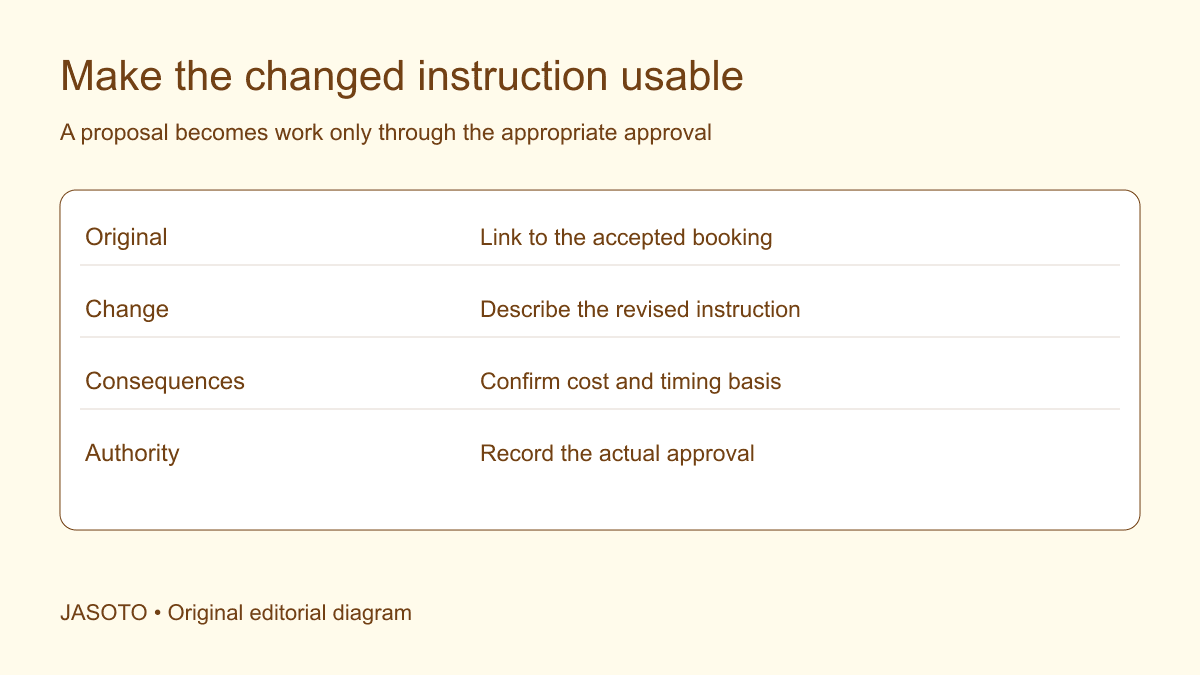
Original JASOTO editorial diagram. Its complete workflow is explained in the article; no actual customer outcome is depicted.
When a booked service job changes, record the original booking, the revised instruction, its confirmed consequences and the person authorising it. Use the approval process that applies to the agreement. Keep an idea, a quotation and an approved change visibly different, then make sure the people carrying out and receiving the work have the same current instruction.
This guide addresses a small change during an active UK service appointment, such as revising a collection list or adding a defined task. It is an original communication framework, not contract drafting or technical advice. For consequential work, follow the actual contract and obtain appropriate advice. A tidy note cannot create authority or settle rights that the parties have not established.
The practical answer
- Describe the changed instruction against the original booking.
- Confirm who can approve it and use the applicable contract process.
- Record confirmed consequences and unresolved dependencies separately.
- Send the current instruction to the people doing and receiving the work.
Anchor the change to the existing booking
Start with the provider, appointment date, job reference and accepted scope. Identify the exact item or task affected. “Add another one” is unusable when a substitute colleague reads the record later. “Add one named cabinet to the collection list for job [reference]” gives the discussion a stable object. Keep the original list available so the provider can distinguish addition, removal and replacement.
Record who raised the change and when. This helps explain the sequence without implying that the person raising it could approve it. A staff member may notice a practical need while another person controls purchasing. If the suggestion comes from the provider, ask for its reason in ordinary language and distinguish a recommendation from something essential to complete the original work.
Describe what will be different after approval
Write the revised instruction as an action that can be understood and checked. Include relevant quantities, locations and references. Avoid wording that simply says “as discussed”, because the discussion may have included several options. If the parties considered moving two items but approved only one, the record needs to state the one item. Preserve a sketch or list where it meaningfully explains the agreed detail.
State whether the change adds work, removes work, substitutes an item or alters the order. Those differences can have different practical consequences. Ask the provider to clarify anything it cannot identify from the request. A brief pause to resolve an ambiguous item reference is often more useful than a fast approval that leaves the attending team deciding which interpretation the customer intended.
Confirm the person with authority
Name the person authorised to approve this category of change. Financial, property, technical and operational decisions may have different owners. A visitor should not be expected to work out the internal hierarchy from whoever is standing nearby. Give the provider the correct contact and a backup arrangement before a likely decision point, especially if the normal approver will be in meetings or away from the site.
Record approval through the actual agreed method. A colleague acknowledging a message or helping carry an item does not automatically answer the approval question. If a formal variation or specific document is required, use it and link the practical record to it. The note should make the authority traceable rather than treating every friendly conversation as a purchasing instruction.
Establish the charge basis before assuming a total
Ask the provider how the change affects the price or calculation basis. It may be a defined additional charge, a revised quantity or work charged by an agreed method. Record what is confirmed and any limit or assumption that matters. Do not write a guessed final total where the provider has only supplied a rate and still needs to establish the amount of work.
Keep consumer and business contexts distinct. [Business Companion's supplying-services guidance](https://www.businesscompanion.info/en/quick-guides/services/supplying-services) addresses consumer services in England and Wales; its framework should not simply be assumed to determine every business purchase. For either audience, an explicit price discussion supports practical clarity, but the applicable legal and contractual position needs appropriate advice where it is in doubt.
Ask how the change affects timing and dependencies
Check whether the extra task changes the end time, requires another visit or depends on materials or access. Ask which consequences are confirmed and which remain estimates. If the provider says an extra visit may be necessary, record it as a possibility until booked. Avoid telling colleagues the job will finish today simply because that was the plan before the change was proposed.
Consider what other people need to know. An extended visit may affect the receiving contact, room availability or another appointment. The authorised coordinator should update the relevant arrangements. A commercial approval does not automatically mean that access or safety arrangements are suitable for the revised work. Keep those questions with the competent people responsible for them rather than allowing the change note to imply they are settled.
Make unresolved conditions visible
Sometimes approval is conditional: proceed only with a named option, within an agreed limit or after a particular confirmation. Record the condition plainly and identify who checks it. A conditional instruction should not look identical to unrestricted approval. If the condition cannot be verified, ask what happens next rather than allowing someone to interpret silence as permission to continue.
Avoid combining an approved task and an unapproved suggestion in the same sentence. Use separate entries or clear wording. For example, adding one item to an agreed collection can be approved while a second location remains under discussion. The provider should be able to act on the first without guessing whether it also covers the second. Clarity reduces the burden on everyone reading the working instruction.
Send the instruction to the people who will use it
After approval, confirm who needs the updated information: the attending worker, provider's office, receiving colleague and internal approver may all have different records. Use a clear reference and mark the current list or instruction. Do not assume a change agreed with the office has reached the person already travelling to the appointment. Ask for appropriate acknowledgement where it affects what they will do.
Preserve the original booking while making the current instruction prominent. If printed lists are used, tell the authorised team which version applies and withdraw obsolete working copies through the normal process. A perfect digital change record is of limited help if the worker is following yesterday's paper list. The record should connect to the actual method by which work is assigned.
Worked example: adding an item to an office collection
Imagine an office that has booked collection of four named storage units. During preparation, a colleague asks whether a fifth can be included. The coordinator records the exact additional unit and asks the provider about capacity, the revised charge and any timing effect. The provider's response is reviewed by the person authorised to approve the purchase before the collection list is changed.
The updated list names five units and retains the original reference. A separate suggestion about collecting items from another floor remains unapproved. This invented example does not claim that any particular provider would accept the change or charge a particular amount. It shows how one modest addition can be made explicit without accidentally expanding the job into every related idea discussed on the day.
Check completion against the revised scope
If the original approver is absent at handover, give the substitute the current approved record and explain their role. They should not need to decide from memory whether an extra task was discussed, quoted or accepted. Record questions for the authorised person rather than inviting an improvised retrospective approval.
At the end, compare the work record with the approved current instruction. Record completed items, outstanding questions and any agreed follow-up. Do not judge the job against an abandoned proposal or the untouched original list alone. If an item was not completed, ask for the factual reason and next action. Keep attendance, completion and acceptance distinct where the agreement treats them differently.
When the invoice arrives, link it to the original booking and the approved change. If the description does not match, ask a focused question rather than rewriting the history to make the numbers fit. Preserve any clarification. A future colleague should be able to see why the final commercial record differs from the first quote without searching through an unstructured sequence of messages.
Improve the next booking from the actual problem
Test a change record by asking a colleague to identify the approved task without reading the full message chain. They should be able to explain the item, current instruction, approver, charge basis and outstanding conditions. If they confuse a quotation with approval, change the labels or layout. This small administrative check evaluates whether the record communicates the decision; it does not validate the technical work or contractual effect. Use a real anonymised example internally where appropriate, and preserve the original documents behind the summary so the simplified record can always be checked.
Review why the change arose. Was the original inventory incomplete, did the need genuinely emerge later, or did the booking form make an important option hard to describe? Improve the relevant step rather than banning all changes or adding irrelevant fields. Keep a previous version of any template so confusing wording can be corrected. Measure repeated problems before claiming that the process saves time or money.
Use JASOTO businesses to discover providers and discuss their change process directly. If approvals and job coordination become continuing work, explore operations support roles as part of a staffing decision. If the revised job requires an agreed follow-up journey, research travel after confirming the appointment. A useful change record ends with a clear current instruction, a traceable approval and an honest account of what remains unresolved.
Put the guide into practice
- Identify the original booking and proposed change.
- Confirm scope, authority, charge basis and timing.
- Record approval through the agreed method.
- Update the working instruction and check the final outcome.
Frequently asked questions
Is an email always enough to approve a change?
Use the approval method required by the actual agreement and circumstances. An email may support the record, but this guide cannot establish its contractual effect. Ask the responsible person or an appropriate adviser where authority, formality or consequences are uncertain.
What if the provider needs an answer while on site?
Use the agreed escalation contact and ask what can sensibly pause pending the decision. Do not let time pressure turn an unauthorised person's comment into approval. Record the confirmed instruction and any limits, including work that remains outside the approved scope.
Should the original quotation be overwritten?
Preserve the original and link the change record to it. Make the current instruction easy to find, but retain the history explaining how it differs. Overwriting the first document can remove evidence needed to understand the price, timing and completion discussion later.
Explore JASOTO tools
Discuss a defined scope and change process with potential providers.
Explore operations support roles →Consider staffing when managing service approvals is a recurring responsibility.
Research a confirmed follow-up journey →Plan travel after any revised appointment and destination are agreed.
Continue with JASOTO
Compare your next step
Discover UK businesses, compare services and request written quotes before making a decision.