
Business Operations · UK Guide 2026
Review the Time Spent Preparing Recurring Reports
JASOTO · Updated 5 November 2026 · 1,520 words
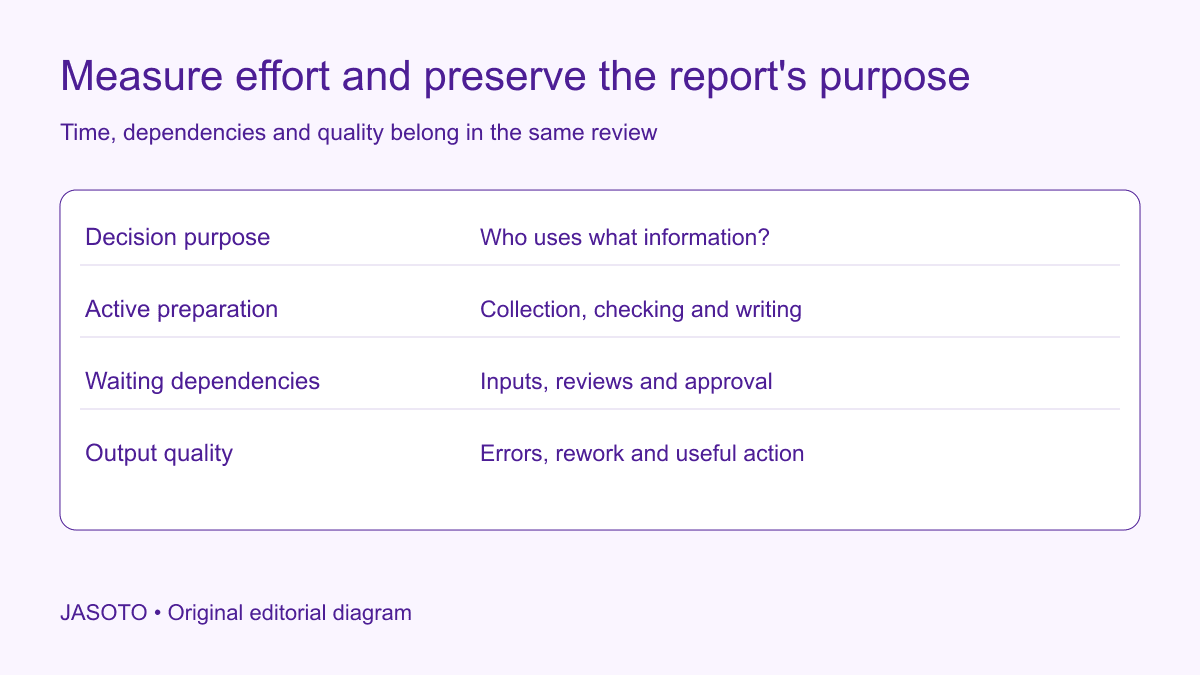
Original JASOTO editorial diagram. Its complete workflow is explained in the article; no actual customer outcome is depicted.
Review recurring-report preparation by defining the report's purpose, observing complete production cycles and recording active effort separately from waiting time. Include checking, rework and reader clarification. Then investigate a specific bottleneck and test whether a simpler process still produces useful reliable information. A faster export is not necessarily an improvement if staff or readers must repair the result later.
Start with one report and the decision it supports. This workflow uses fictional UK business examples and no invented time savings. Keep personal or confidential information within the organization's process. The aim is a proportionate evidence record that helps the team decide what to retain, simplify or investigate, rather than a permanent minute-by-minute surveillance exercise.
The practical answer
- Define the report's decision purpose before timing its production.
- Record complete cycles with active effort and waiting time distinct.
- Keep quality, rework and downstream clarification visible.
- Test a focused simplification and verify the report remains useful.
Establish who uses the report and why
Ask the intended readers which decision or action the report supports. Identify the relevant sections and timing. A recurring document can survive long after its original purpose changes, so do not assume every field remains necessary because it has always appeared. Record what is known and what requires confirmation from the owner.
Separate a report's decision value from its distribution list. Being emailed to many people does not establish that every page is used. Ask suitable questions through an appropriate review process without making unsupported claims about reader behavior. The effort review needs a useful output definition before it can judge whether simplification preserves the right information.
Define the production cycle and boundary
Record the report version, frequency, source period and delivery point. Decide where preparation begins and ends. Include relevant collection, reconciliation, analysis, writing, review and publication tasks. A measure starting after data cleaning may hide the largest source of work, while one ending at first export may omit repeated corrections.
Write the boundary explicitly so another colleague can apply it. [GOV.UK's cost-per-transaction guidance](https://www.gov.uk/service-manual/measuring-success/measuring-cost-per-transaction) illustrates defining service cost relative to completed output. Use a suitable local effort boundary rather than importing its government calculation as a requirement. Time measurement alone should not automatically become a monetary savings claim.
Break the work into observable activities
Use categories that match actual preparation: obtaining inputs, checking data, resolving differences, producing analysis, writing commentary, formatting and approval. Keep the list small enough to use. Avoid broad labels such as reporting work when the purpose is to locate a bottleneck. The categories should make a practical next action identifiable.
Record rework separately where useful. A repeated formatting fix differs from a new question that legitimately changes analysis. Do not assume every revision is waste. Some checks protect the report's reliability. The review should identify unnecessary repetition without encouraging staff to omit important scrutiny merely to reduce a measured category.
Separate active effort from elapsed delay
Record time spent working and time waiting for inputs or decisions in distinct fields when relevant. A report can require modest active effort while missing its useful deadline because a source arrives late. Another can be delivered promptly only because several people perform extensive manual reconciliation. Those situations need different remedies.
Keep the waiting reason and owner visible. Do not erase a dependency because it lies outside the preparer's team. Equally, do not treat every elapsed hour as active staff effort. Define the units and collection method accurately so the summary does not overstate resource use or hide the reader's experience of delayed information.
Choose a proportionate observation method
Use suitable direct notes, existing task records or other approved evidence. Ask staff to record enough detail to identify the issue without interrupting work excessively. If estimates are used, label them and explain their basis. Do not invent precision from recalled activity or treat a tool's open-window duration as proof of continuous work.
Agree the purpose and access with the responsible owner. The review should support process improvement and handle personal information appropriately. A shared task worksheet may be sufficient for a small report. Avoid introducing intrusive monitoring when a simple cycle-level record can answer the actual question more effectively.
Observe comparable cycles and exceptions
Choose periods representing relevant ordinary work and note unusual conditions. A first production cycle, system migration or absent reviewer may differ materially from routine reporting. Record those factors instead of averaging them away. The baseline should remain interpretable to someone who did not observe the work.
Keep the report's scope and frequency visible. A more detailed month-end edition should not be compared casually with a short weekly summary. If the report changes during observation, identify the version and effect on comparability. A useful review can describe variation without claiming every cycle should take the same amount of effort.
Check the sources of repeated work
Inspect where staff copy, reconcile or correct the same information. Ask why the repetition exists and what evidence shows it is unnecessary. A manual check may compensate for an unreliable source or missing definition. Removing it without fixing the dependency can make the output faster and less trustworthy.
Record source ownership and unresolved data questions. A reporting tool cannot settle a disputed business definition automatically. Assign the underlying decision to the appropriate owner and keep it separate from formatting or automation work. The improvement should address the actual cause of effort rather than merely move it to another colleague.
Include output quality and later clarification
Review errors, corrections, reader questions and whether the report arrived in time for its intended task. Use actual records and appropriate feedback. A clean-looking document can still use outdated definitions or unsupported commentary. Keep factual reliability separate from presentation preference so the team does not simplify the wrong thing.
Track meaningful downstream work where it belongs within the review boundary. If readers repeatedly ask the preparer to explain a table, the report may need clearer labels or context. Avoid assuming every question is a defect; some reflect legitimate analysis. Record what decision was blocked and what information would have helped.
Work through a fictional monthly report
Imagine a business assembles a monthly inquiry report by copying several source lists, reconciling duplicate cases and formatting a summary. Observation shows that inconsistent category definitions create repeated discussion each cycle. The team first agrees the definitions and checks the source records, rather than immediately buying a tool to automate the copy step.
A later cycle reviews effort and report reliability under the revised process. This fictional example supplies no time reduction or financial return. It shows how timing evidence can reveal a decision dependency and why an improvement should preserve the output's meaning, not merely reduce the visible preparation stage.
Prioritize a focused simplification
Choose an action supported by the observed bottleneck, such as removing an unused section, standardizing an input or clarifying a review step. Identify the expected benefit, owner and evidence needed to verify it. Keep consequential technical changes with appropriate reviewers. Do not redesign the entire reporting system solely because one cycle was awkward.
Research reporting support using the actual task and records when outside help is needed. A provider should understand what the report must enable and which checks remain essential. The brief should not promise savings before the current effort and proposed change are understood.
Test the revised cycle and reader task
Run the approved change through a suitable cycle or controlled test. Verify the output and relevant reader decision, not just the export time. Record shifted effort, new dependencies and unresolved issues. If a check was removed, confirm through appropriate review that reliability remains supported.
Compare with the baseline definitions and context. Do not interpret a smaller report or different input volume as a pure efficiency improvement without explanation. A provisional decision can be useful while evidence remains limited. Keep earlier templates and a rollback path for misleading or broken output.
Keep ownership and absence cover explicit
Name who provides inputs, prepares, reviews and publishes the report. Arrange handover during absences and business travel. A recurring process that works only when one person is present has a maintenance dependency worth recording. Check whether another colleague can locate definitions and source references without private help.
If recurring work needs capacity, define the responsibilities before exploring reporting roles. The required role may involve data review, subject analysis or coordination rather than formatting alone. Evidence about actual activities helps the business choose appropriate support and avoid assigning a vague reporting task to someone without the needed authority.
Retain a concise decision record
Summarize the purpose, cycle boundary, observations, quality findings, chosen change and remaining uncertainty. Keep actual measured values distinct from estimates and proposed benefits. Follow appropriate retention arrangements for working records. Remove collection effort that no longer informs a decision once the process is stable.
Review when the report's purpose, sources or audience changes. The practical result is an understandable account of where preparation effort goes and which improvement preserves useful information. That gives the business a sound basis for changing recurring work without manufacturing savings or rewarding speed at the expense of reliable decisions.
Put the guide into practice
- Identify the report, audience and current version.
- Define preparation tasks and measurement boundaries.
- Observe comparable cycles without invented time estimates.
- Review output quality and actual reader use.
- Choose a reversible improvement supported by evidence.
Frequently asked questions
Is the fastest report always the best one?
Check whether it still supports the intended decision and contains reliable information. A shorter preparation time can conceal omitted checks or work shifted to readers. Review quality, rework and clarification alongside effort before deciding a change improved the process.
Should waiting for data count as preparation time?
Record active effort and elapsed waiting separately when both matter. They answer different questions about staffing and delivery. Define the boundary consistently, preserve important dependencies and avoid silently excluding delay from a report meant to describe the full production experience.
Can we estimate time from memory?
Use a clearly labelled estimate when necessary and record its limitations. Direct observations or suitable existing records may provide a stronger baseline. Do not present recalled figures as precise measured effort or calculate confident savings from evidence that cannot support that level of accuracy.
Explore JASOTO tools
Continue with JASOTO
Compare your next step
Discover UK businesses, compare services and request written quotes before making a decision.