
Jobs & Careers · UK Guide 2026
Plan a Remote Interview That Can Survive a Connection Failure
JASOTO · Updated 5 November 2026 · 1,618 words
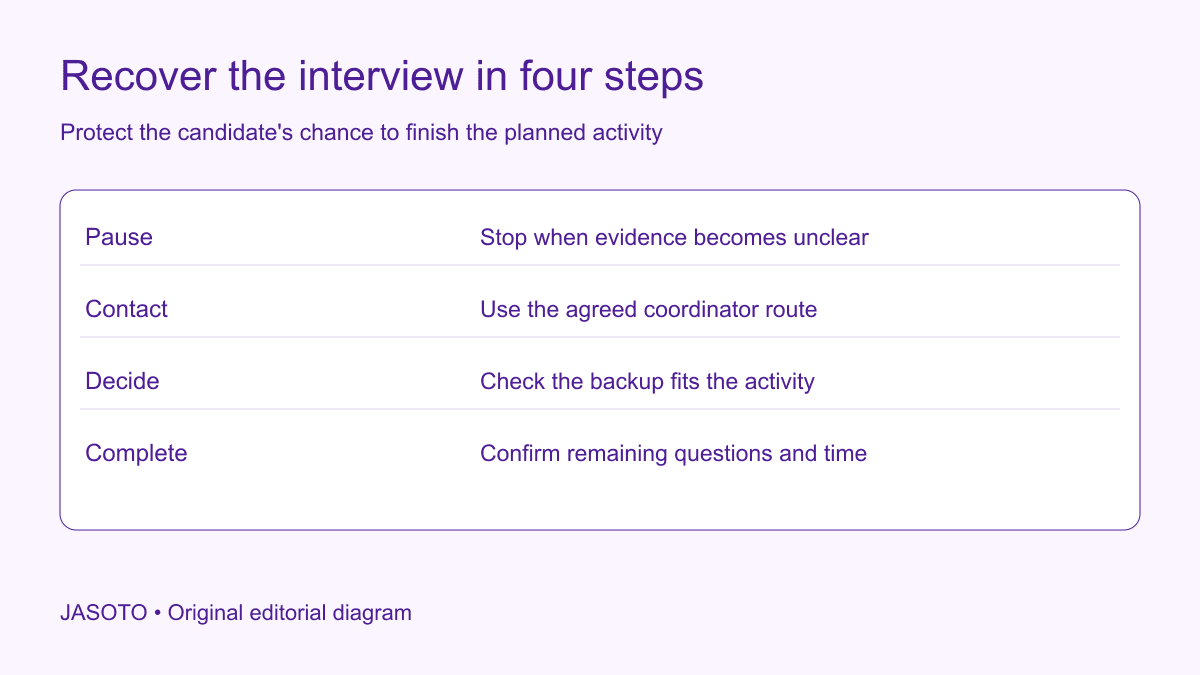
Original JASOTO editorial diagram. Its complete workflow is explained in the article; no actual customer outcome is depicted.
A remote interview needs a written recovery sequence: pause when communication fails, use an agreed contact route, decide whether a suitable backup can support the activity, and confirm how unfinished assessment will be completed. That sequence gives both sides a useful next action while the screen is frozen.
For a small UK hiring team, the difficult moment is often the decision after the first failed retry. The candidate is waiting, one interviewer has another appointment, and a practical demonstration is only partly visible. Plan for that decision before the interview starts, with responsibilities that a colleague can actually follow.
The practical answer
- Agree who contacts whom when the meeting disconnects.
- Pause assessment when the answer cannot be heard reliably.
- Check whether a backup channel can support the actual interview activity.
- Record what needs completing and confirm the next appointment.
Give the interruption to one coordinator
Choose the person who will manage the disruption, rather than leaving every interviewer to send separate instructions. The coordinator might be the interview chair or an administrator who remains available during the appointment. Give that person the authority to call a pause and arrange the next process step.
Record which contact route is available to the candidate and which route the coordinator will use. An email address is little help if nobody monitors it during the interview. A telephone number needs a named recipient and sensible availability. Share these practical details in the appointment information, with a short instruction for a complete disconnection.
Also identify cover. If the coordinator's own connection fails, another panel member should know that they now own contact. A plan stored only in the missing person's private notes recreates the original problem at the moment it matters.
Define when the conversation pauses
A useful pause rule is based on communication quality: stop when the panel or candidate cannot reliably hear, see or understand the material needed for the current activity. Continuing through repeated missing words produces uncertain evidence and makes recovery harder.
Tell the candidate plainly that the interview is paused. State the last point heard clearly, then stop asking substantive questions while the problem is investigated. The panel can note the interrupted question and relevant time without interpreting the interruption as an answer.
Avoid talking over a frozen connection in the hope that some audio is still arriving. The candidate may hear only fragments while several interviewers discuss different remedies. One calm instruction from the coordinator makes the sequence easier to understand. When communication returns, check that everyone knows the current stage before resuming assessment.
Prepare a short recovery sequence
[Acas advises employers to have a backup plan for connectivity issues in online interviews](https://www.acas.org.uk/recruitment/interviewing-job-applicants). Turn that narrow principle into an operational sequence for your appointment, rather than a vague promise to be flexible.
For example, the team might pause, attempt one agreed reconnection, then use the coordinator's contact route to decide the next step. Choose the timing around your actual interview structure and candidate needs. A complex software task and a short introductory conversation need different recovery arrangements.
Write who initiates each action. If the candidate is told to wait for a call, the coordinator must know they are making that call. If the candidate should rejoin the original meeting, say whether the panel remains there. Several people repeatedly leaving and creating new meeting links can make a recoverable interruption more confusing.
Include a route for silence after the failed retry. State which message the coordinator will send, where the candidate should look for it and what they should do if it does not arrive. This closes a common gap: each side waits politely because both believe the other person is arranging the replacement connection.
Test the backup against the activity
List the interview's actual components before choosing alternatives. A verbal example, a shared document review and a live visual demonstration have different communication needs. Moving the whole appointment to audio may preserve one component while making another impossible.
Ask what evidence the panel needs and whether the proposed channel can provide it clearly. If a candidate is explaining how they prioritise requests, a telephone discussion may work. If they must review a visual layout, the panel needs a reliable way for everyone to view the same material.
Check the candidate can use the alternative and that agreed participation arrangements still work. Offer a clear choice where practical. Avoid asking them to improvise an unfamiliar account, application or device under time pressure simply because an interviewer already uses it. A later appointment can be the more workable completion route.
Preserve the boundary of the interrupted answer
Before restarting, establish the last complete answer segment that was reliably received. Ask the panel to distinguish words they heard from conclusions they guessed during distorted audio. This small check prevents an uncertain fragment becoming a settled assessment note.
Use a neutral restart prompt such as: “We heard your explanation through the point where you checked the booking reference. Please continue from there.” If the panel missed a larger portion, explain that clearly and allow the candidate to give the relevant explanation again.
Do not make the candidate choose between contradictory interviewer recollections. The chair should settle the process question and create a clear opportunity to respond. If a repeated question creates a materially different assessment condition, record the issue for the hiring lead to resolve using the recruitment process. Keep the interruption record separate from unsupported judgments about performance.
Decide what can finish in the available time
After a successful reconnection, review the remaining appointment honestly. Ten minutes left on the calendar does not create time for twenty minutes of planned questions. Identify the activities still needed and whether the panel and candidate can remain available.
Avoid quietly shortening one candidate's opportunity to explain because the next appointment is approaching. Equally, do not assume the candidate can extend indefinitely. Explain the remaining work and offer a definite completion arrangement where the original slot cannot support it.
The coordinator should confirm who will attend, the expected length and whether any preparation changes. If the original panel cannot return together, the hiring lead needs to decide how evidence will be reviewed consistently. Solve the assessment process explicitly; a diary invitation alone cannot resolve missing evidence or inconsistent interview conditions.
Work through a scheduling-coordinator example
Consider a fictional employer interviewing for a scheduling coordinator. The candidate has answered two experience questions and is explaining how they would resolve a duplicate room booking. Their audio disappears just before they describe the proposed customer message.
The chair pauses the exercise and notes the last clear point. One reconnection attempt fails, so the named coordinator contacts the candidate through the agreed route. Audio works, but the shared booking worksheet cannot be viewed reliably. The panel decides to finish the spoken experience question and schedule the worksheet component separately.
The follow-up states exactly which activity remains, how long it should take and who will attend. It does not describe the candidate as unprepared or mark the unfinished customer message as a weak answer. The example demonstrates a recovery decision, without claiming any particular hiring outcome.
Give the panel a usable incident note
Keep a short process note containing the appointment reference, interrupted component, last reliable evidence, recovery action and remaining work. These fields help the hiring lead understand what happened without replaying a long technical narrative.
A useful entry might read: “Booking exercise paused after the duplicate-slot explanation. Proposed customer message not heard. Reconnection unsuccessful. Spoken discussion completed by agreed telephone call; worksheet component awaiting a replacement appointment.” That is specific enough to guide the next action.
Restrict access through the organisation's appropriate recruitment record arrangements. Avoid collecting unnecessary diagnostic screenshots, private home details or broad commentary about the candidate's circumstances. The purpose of this note is to explain an assessment gap and its resolution. If the organisation needs technical incident information as well, use the proper support route and keep the purpose clear.
Send a definite completion message
The candidate should leave the interruption with a clear status, even if the next appointment time is still being arranged. State what finished, what remains, who will follow up and when they should expect that contact. Explain what to do if the message does not arrive.
Use plain language: “Your experience discussion is complete. We still need the shared worksheet activity. Our coordinator will send appointment options tomorrow; the same preparation material applies.” Adjust the timing to a commitment the team can meet.
Check that the candidate has received the practical details and understands any new joining arrangements. Where the interruption affects the decision timetable, update that information too. A recovery message should reduce uncertainty, rather than repeat a general thank-you while leaving the candidate to infer whether the interview counted.
Review whether the plan worked
Afterwards, ask the coordinator and chair which decision was difficult and why. The most useful improvement may be clearer ownership, a better method of sharing the exercise or more space between appointments. Count specific process problems rather than blaming a particular network connection without evidence.
Rehearse one disruption with the panel before the next recruitment round: the candidate disappears halfway through a shared-document answer. Ask each person what they would do next. Any conflicting instructions reveal a gap that can be fixed in the short plan.
Use business support listings when coordination help is needed, keep assessment linked to the actual job requirements, and confirm the appointment before researching an in-person travel alternative. The plan is complete when another coordinator can follow it and the candidate can understand their next step.
Put the guide into practice
- Name the interruption coordinator and contact route.
- Define a practical pause and retry sequence.
- Prepare a decision for activities that cannot move to audio.
- Confirm unfinished questions and the next step in writing.
Frequently asked questions
Should every failed video interview continue by telephone?
Use telephone only when it supports the planned activity and the candidate can participate appropriately. A spoken discussion may transfer easily; a visual demonstration or an agreed communication arrangement may require another solution. The coordinator should confirm the workable format rather than treating audio as an automatic substitute.
Should the candidate repeat their whole answer after reconnecting?
First identify the last complete point that interviewers reliably heard. Explain what was missed and provide a clear opportunity to complete the answer. Avoid requiring an unnecessary full restart simply because different panel members remember different fragments.
What should the panel record about the interruption?
Record the relevant process facts: the interrupted question or activity, the point of reliable evidence, the recovery decision and any remaining assessment. Keep speculation about the candidate's equipment, personal circumstances or commitment out of the assessment.
Explore JASOTO tools
Discuss meeting administration and candidate communication needs with relevant providers.
Keep the interview connected to the role →Use the advertised requirements when deciding what evidence still needs collecting.
Plan any confirmed in-person alternative →Research travel only after the employer confirms a suitable replacement appointment.
Continue with JASOTO
Compare your next step
Discover UK businesses, compare services and request written quotes before making a decision.