
Business Growth · UK Guide 2026
Turn Repeated Customer Questions Into a Service Update
JASOTO · Updated 5 November 2026 · 1,613 words
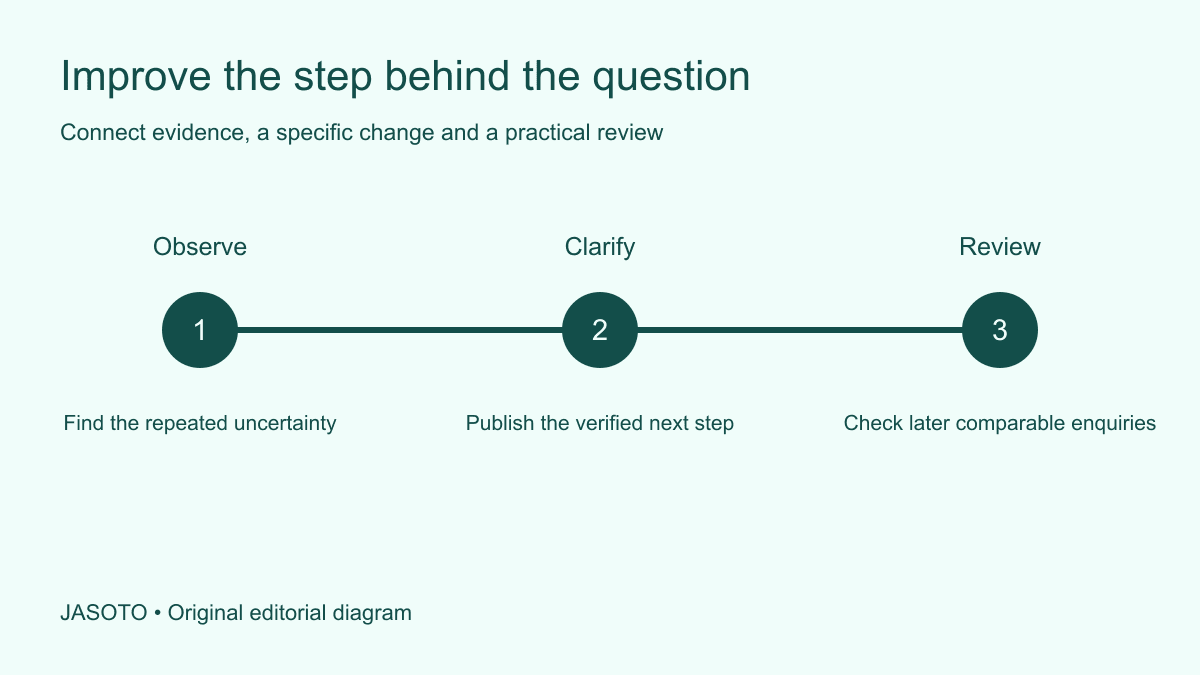
Original JASOTO editorial diagram. Its complete workflow is explained in the article; no actual customer outcome is depicted.
Turn repeated customer questions into a service update by identifying the task people are trying to complete, verifying the missing information and placing a clear answer at the relevant step. Then review later comparable enquiries and customer actions. The useful change may be one sentence in a booking form or confirmation rather than a larger collection of answers elsewhere on the website.
This guide is an original improvement method for UK small service businesses. The worked example uses an invented print shop where customers repeatedly ask when a production deadline begins. It focuses on evidence, service information and a reversible change. Use the actual agreed commercial process when communicating prices, timings and commitments, with appropriate specialist advice where needed.
The practical answer
- Look for the task behind the repeated question.
- Verify the actual service rule before writing an answer.
- Place the clarification where the customer needs it.
- Review later comparable enquiries before claiming an improvement.
Capture the question with its context
Record the actual question, the service stage and the page or message the customer had seen. A question asked before booking may have a different cause from the same words asked after payment. Preserve relevant context without collecting unnecessary personal information. The aim is to understand the information gap, not create a detailed profile of every person who contacted the business.
Use a small evidence register with references to appropriate original records. Avoid rewriting several different questions into one broad theme before checking whether they concern the same problem. A customer asking when an estimate arrives is not necessarily asking when production starts. Keep those distinctions so the eventual update answers the actual task rather than a convenient summary invented by the team.
Look for the action the customer wants to take
Ask what the question prevents the person from doing. They may need to decide whether the service fits their deadline, prepare suitable information or understand the next approval step. Write that need in ordinary language. This gives the team a clearer target than a goal such as reduce enquiries, which could be achieved by making contact harder without helping the customer.
The [GOV.UK Service Manual](https://www.gov.uk/service-manual/user-research/start-by-learning-user-needs) discusses learning what users are trying to do and reviewing existing evidence in its government-service context. The original small-business method here uses a similar modest question: which uncertainty is stopping the customer from making an informed next step? Keep assumptions labelled until appropriate evidence supports them.
Check whether the existing information is missing or misunderstood
Review the actual page, form, confirmation and staff response connected to the question. The answer may be absent, hidden at another stage or phrased in language customers interpret differently. Do not assume the problem is that people failed to read. A statement can be technically present while appearing too late to support the decision for which it matters.
Ask staff what explanation they usually give and compare the answers. Different replies may reveal an unclear service process rather than a writing problem alone. If the business itself has not agreed when a deadline begins, publishing a polished sentence will not resolve the underlying decision. Assign that question to the appropriate owner before changing the customer-facing information.
Verify the actual rule or arrangement
Identify who can confirm the answer and what evidence supports it. For the print-shop example, production may depend on the approved file and another actual condition. Use the real service agreement rather than an employee's memory of one order. Preserve the relevant qualifications and avoid turning a typical practice into a guarantee for every customer.
If the service arrangement needs changing, treat that as a separate authorised decision. A content update should not quietly introduce a new obligation or promise. Record what was approved, who approved it and which customers or orders it affects. Obtain appropriate advice where the change has contractual consequences. Clear information depends on a real current process behind the wording.
Choose the place where the answer is useful
Put the clarification where the customer reaches the relevant decision. A deadline condition may belong beside a timing estimate and again in an appropriate confirmation. A document-preparation answer may belong before the upload field. Do not automatically add everything to a general FAQ page that customers may never visit during the task.
Keep relevant channels consistent. A staff script, quotation template and website can all create expectations about the same service. Identify which need updating and who owns each. Avoid copying a sentence into every channel without considering its context. The customer should receive the same factual meaning while each format gives the right level of detail for that stage.
Write the clarification as a usable next step
Use direct language that answers the question early and explains what the customer should do. Replace internal abbreviations with understandable terms, while retaining precise references where needed. If an action depends on another event, state that relationship clearly. A sentence such as contact us for details may preserve uncertainty rather than resolving it, unless the service genuinely needs an individual assessment.
For the invented print shop, a draft could say: We confirm the production schedule after the required artwork approval and other agreed order conditions are complete. If you have a fixed event date, tell us before ordering so we can check the actual service option. The business must adapt this to its real arrangement; the template is a writing example, not a universal timing rule.
Keep examples accurate and clearly bounded
A short example can explain a dependency that abstract wording hides. Use fictional dates or a plainly described scenario, and avoid implying a real customer result. State what the example demonstrates and what remains subject to the actual order. Do not create a sample promise that is stronger than the service statement it is meant to clarify.
Check whether the example survives being read alone. Customers may scan the boldest sentence or a shared screenshot rather than the full page. If an important qualification appears only elsewhere, revise the layout or wording. The goal is to make the condition understandable, not to hide it in supporting text while the headline creates a different expectation.
Test the update before broad publication
Ask a colleague unfamiliar with the change to answer a representative customer question using the draft. Can they identify the next step and the condition that matters? If practical, obtain appropriate feedback from actual or likely customers through the business's normal process. Keep personal information and permissions suitable to the research activity.
Record where interpretation differs from the intended meaning. A term that staff find familiar may still be unclear to customers. Change the relevant wording and repeat the useful check. Avoid asking only whether the text sounds professional; that invites general preferences rather than evidence about the task. A concise test should reveal whether the answer supports the decision it was written to help.
Worked example: when a print schedule starts
Imagine a print shop receiving repeated questions about whether an advertised turnaround begins at enquiry, payment or artwork approval. The team reviews the actual enquiries and discovers that customers encounter the timing statement before its relevant conditions. The service owner confirms the real arrangement, and the content owner adds a concise explanation beside the timing information and in the appropriate quotation template.
Staff receive the current wording and know where individual deadline questions go. This invented example claims no measured reduction in calls or improved delivery performance. It shows how a repeated question can reveal a specific information placement problem, and how the business can change that step without pretending a new FAQ alone settles every customer's scheduling needs.
Review later comparable enquiries
Keep the observation method small enough to maintain consistently. For the print-shop example, the team might tag the specific timing question and note the service stage, while preserving access to relevant original records. Explain any change in the tagging method before comparing periods. If staff previously used one broad category and now use several precise ones, an apparent decrease may reflect classification rather than clearer information. Report that limit openly. The evidence can still identify useful examples without supporting a numerical improvement claim, and a cautious conclusion is preferable to assigning success to a change the data cannot isolate.
Define what you will observe after the update: the relevant question type, customer misunderstanding or completion of the intended next step. Keep the comparison proportionate and acknowledge other changes in demand, staffing or service. A lower raw enquiry count may reflect fewer customers rather than clearer information. Use an appropriate denominator where a rate is claimed, or report the narrower observation honestly.
Look for new confusion too. The update may answer one question while introducing another. Keep examples and dates so the team can identify what changed. Do not declare success solely because the page was published. The practical question is whether customers can better understand the relevant service step, with actual evidence and limitations recorded.
Preserve ownership and a rollback path
Save the earlier wording, approved change and relevant source. Name the person responsible for future service changes and the review trigger. If the new wording causes a problem, revise or restore it through the proper process. Keep staff informed so an obsolete script does not continue creating expectations after the website has been corrected.
Use JASOTO businesses to discover suitable service-information support and verify capability directly. If reviewing enquiries becomes continuing work, explore customer experience support roles within a staffing review. For a confirmed appointment, research travel after checking current preparation information. A useful service update connects a real customer uncertainty to a verified answer and a practical review of whether it helps.
Put the guide into practice
- Collect relevant examples without unnecessary personal detail.
- Define the specific uncertainty and affected customer task.
- Approve the factual answer and publish it consistently.
- Measure useful observations and retain the previous version.
Frequently asked questions
Should every repeated question become an FAQ?
Choose the format and location that help the customer at the relevant step. A repeated question may need a clearer field label, booking confirmation or service description rather than another FAQ entry. Investigate the task and information gap before deciding the solution.
How many questions prove a problem?
There is no universal count. Consider the context, available evidence and consequences. A few similar enquiries can justify a proportionate investigation, but should not be presented as a measured failure rate without a suitable denominator and comparison.
Can staff publish the answer immediately?
Confirm the actual service arrangement and appropriate authority first. A helpful-sounding answer can accidentally change a promise or conflict with another channel. Use the business's review process and make unresolved points visible instead of filling them with assumptions.
Explore JASOTO tools
Discuss the actual customer task and evidence with suitable providers.
Explore customer experience support roles →Consider support where enquiries and service updates become ongoing work.
Research a confirmed service visit →Plan travel after checking current appointment and preparation information.
Continue with JASOTO
Compare your next step
Discover UK businesses, compare services and request written quotes before making a decision.