
Business Growth · UK Guide 2026
Replacement Parts When the Model Number Is Missing
JASOTO · Updated 5 November 2026 · 1,608 words
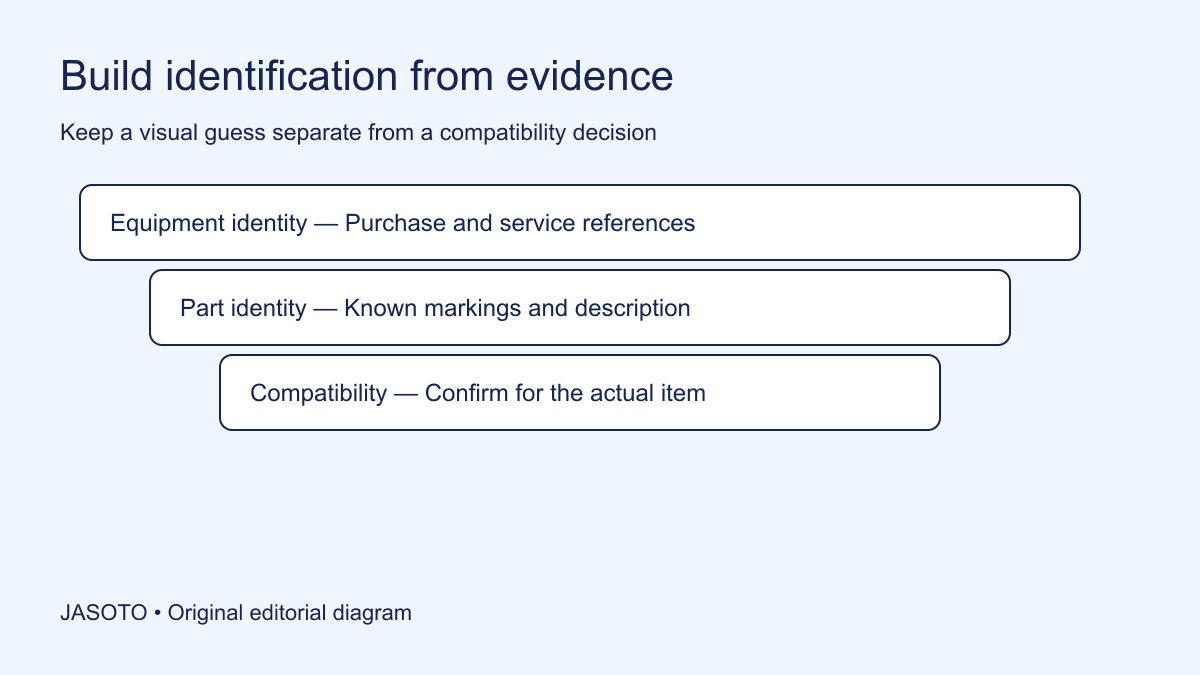
Original JASOTO editorial diagram. Its complete workflow is explained in the article; no actual customer outcome is depicted.
When a model number is missing, build an identification enquiry before buying the replacement part. Trace purchase and service records, record the information you can safely obtain and ask the manufacturer or suitable specialist to confirm the next step. A part that looks right in a photograph is not automatically compatible with the equipment in front of you.
This guide is for UK small businesses organising a parts purchase. It covers records, communication and approval, not dismantling or fitting. Keep technical decisions with the appropriate competent provider. The practical goal is to prevent an uncertain equipment identity from becoming a confident order simply because a website requires a model field or a familiar-looking search result appears near the top.
The practical answer
- A similar photograph is a lead, not proof of compatibility.
- Trace existing purchase and service records before guessing a model.
- Keep equipment identity separate from the part's own markings.
- Obtain an appropriate compatibility answer and fitting plan before ordering.
Separate the missing information into distinct questions
Write down whether you are missing the equipment model, the individual part reference, a production variant or all three. These are different gaps. A clearly marked component can still belong to several equipment versions, while a known equipment model may contain different components depending on its configuration. Ask the relevant source which identifiers matter for this particular enquiry rather than assuming every product uses the same numbering system.
Keep an evidence note with two columns: known and unconfirmed. A brand name copied from a visible label belongs under known. A model guessed from an online picture belongs under unconfirmed, with the reason for the guess. Do not merge the columns as the enquiry progresses. A later colleague needs to know which detail was verified and which remains a possible lead.
Search the records you already own
Start with the original invoice, order confirmation, asset register, installation paperwork and earlier service records. Search for the supplier as well as the equipment name, since the order description may use an unfamiliar catalogue reference. Check whether the paperwork refers to the actual item at the current location. A manual stored nearby could belong to an earlier unit or another branch of the business.
If a supplier account contains an old order history, save the relevant order reference through the authorised account process. Do not assume that an order proves the item currently in use is unchanged. Equipment may have been replaced, moved or modified. Record that history where known, and ask the responsible person if the documents and physical item cannot be linked confidently.
Use manufacturer identification help appropriately
Manufacturers may provide product-specific identification tools. For example, [Bosch UK's spare-parts page](https://www.bosch-home.co.uk/products/spare-parts) uses an appliance model number, called an E-Nr, for its search. That is an example of a particular manufacturer's system, not a universal rule for every brand. Follow the relevant manufacturer's guidance for the actual product and ask its support team what to do if the expected label is unreadable.
Do not select the nearest valid model merely to pass a website's form validation. If the tool rejects the information, check the transcription and contact the appropriate support channel. A successful search result only means that the number entered exists in that system. It does not prove that the number was copied from your equipment or that the listed part matches a modified configuration.
Collect useful photographs without creating a repair task
Where it is appropriate and safe, photograph the whole item, any visible branding and the relevant externally accessible label or component. Include context so a recipient can tell which item is being discussed. Avoid sending a close-up with no explanation of where the part belongs. Keep file names tied to the enquiry, and do not claim a photograph shows a dimension or marking that cannot actually be read.
Do not move heavy equipment, remove covers or reach into inaccessible spaces just to complete the record. [HSE's maintenance guidance](https://www.hse.gov.uk/work-equipment-machinery/maintenance.htm) emphasises competent maintenance work. If identification needs technical access, ask a suitable provider to handle it. A purchasing checklist is not a reason to attempt work beyond your competence or the business's authorised arrangements.
Describe the part without guessing its function
Use the location and visible characteristics you genuinely know: “removable tray from the lower compartment” may be better than an incorrect technical name. Copy markings exactly, including punctuation and any suffix. Label a partially readable character as uncertain instead of silently choosing the most plausible letter. A wrong character can lead a recipient to an entirely different reference while appearing precise.
Keep the equipment description and component markings in separate fields. A moulded number may identify a casting or manufacturing detail rather than the orderable replacement. Ask the specialist how to interpret it. If you provide dimensions, state how and where they were obtained and whether they are approximate. Do not turn a rough measurement into a claim that a safety-critical or functional fit has been established.
Write an enquiry that invites an honest answer
A useful message says: “We need help identifying a replacement for [description]. The equipment model is unconfirmed. Attached are [records]. Please tell us what further information you need and whether you can confirm an orderable part for this actual item.” Add the business location and relevant reference. This gives the recipient permission to ask a necessary question instead of responding to an apparently confident but incorrect part request.
Ask whether the reply is a possible match or a confirmed recommendation, and what information supports it. If several options remain, request an explanation of how they are distinguished. Keep the reply with the enquiry. An internal note saying “supplier thinks this is it” loses the qualification and may later be read as a firm compatibility confirmation. Preserve the source's actual wording.
Check the purchasing terms separately from compatibility
Once a part is identified, confirm the order reference, quantity, what is supplied and any additional items the provider says are required. Ask about availability, delivery and return conditions before placing the order. Do not assume that every component can be returned after opening or attempted fitting. Equally, do not let a shop's return policy substitute for an answer about whether the component is suitable.
Compare offers on the same basis. One may include a kit, another a single component; one may include a fitting service, another only delivery. Record the difference before comparing totals. Use actual quotations rather than inventing typical prices. If the cheaper offer depends on an unconfirmed variant, the sensible next step may be clarification rather than immediate purchase.
Worked example: an unidentified office appliance shelf
Imagine an office with a damaged removable shelf in an older appliance. The model label is unreadable, and a colleague finds a similar-looking shelf online. Instead of ordering it, the office checks the old purchase record and a previous service invoice. The documents contain different references, so the office sends both to the manufacturer's support channel and explains that the equipment identity is uncertain.
The enquiry includes an appropriate photograph and a description of the shelf's position. The office waits for an identification answer before approving a purchase. This invented scenario does not claim the manufacturer can always identify an old product, or that a part will remain available. It shows how conflicting evidence can be made explicit instead of being hidden behind a plausible-looking online match.
Plan receipt and fitting before the parcel arrives
Name the person who will receive the part and compare the delivered reference with the confirmed order. If packaging or labels differ, ask the supplier to explain before treating the difference as harmless. Preserve the documentation and record any discrepancy. The receiving colleague should not be expected to decide technical equivalence from appearance, especially when the original purchase depended on specialist identification.
Confirm who is authorised and competent to fit or assess the part, and what happens if it is unsuitable. Do not assume the availability of an employee, technician or workshop after ordering. If an appointment is needed, connect the part reference and delivery status to that booking. A confirmed part with no appropriate installation plan can still leave the business unable to complete the task.
Leave a better record for the next enquiry
If the business keeps spares, distinguish a verified spare from an unidentified item left in a drawer. Record the intended equipment reference and the source of the match where it has been confirmed. Do not label a loose component “universal” because it resembles several items. Ask the appropriate specialist whether an existing spare is suitable before treating it as an alternative to a new purchase. A well-stocked cupboard is useful only when the records allow the right person to understand what each component is and which uncertainty remains.
After the matter is resolved, update the asset history with the verified equipment identifier, confirmed part reference, source of confirmation and related order or service record. Preserve uncertainty if identification remains incomplete. Avoid adding an unverified number to the asset register as if it were a permanent fact. The point of the exercise is to improve the evidence available next time, not merely to fill every blank.
Use JASOTO businesses to discover appropriate parts or repair specialists, then verify their suitability directly. If record maintenance becomes recurring work, explore purchasing support roles as part of a staffing review. For a confirmed workshop assessment, research travel arrangements after checking that the workshop can accept the item. Keep the final decision grounded in the actual product and an appropriate compatibility answer.
Put the guide into practice
- Record known facts and label uncertainty.
- Check invoices, manuals and earlier service records.
- Send a focused enquiry through the manufacturer's or supplier's channel.
- Confirm the part reference, compatibility basis and installation arrangements.
Frequently asked questions
Can I order a part because it looks identical?
Appearance alone is not a reliable compatibility decision. Ask the manufacturer or appropriate specialist which identifying information is needed and obtain a clear answer for the actual item. Dimensions and photographs can support an enquiry, but should not be presented as proof that an unverified component is suitable.
Should I remove the old part to find a number?
Do not dismantle equipment or expose hazards merely to improve an enquiry. Use information that can be obtained appropriately and safely, and ask a competent provider to handle identification that requires technical access. This guide concerns purchasing records, not repair instructions.
What if no one can identify the equipment?
Record that the identity remains unconfirmed and ask an appropriate specialist what assessment is possible. Compare that next step with other sensible options for the item. Do not turn an uncertain online match into a confirmed model simply because you need to complete an order form.
Explore JASOTO tools
Ask suitable providers about identifying and supporting the particular item.
Explore purchasing support roles →Consider staffing when maintaining asset and parts records becomes regular work.
Research a workshop journey →Plan travel only after confirming a workshop can assess or accept the item.
Continue with JASOTO
Compare your next step
Discover UK businesses, compare services and request written quotes before making a decision.