
Customer Communication · UK Guide 2026
How to Respond to Negative Reviews
Updated 9 September 2026 · 2,452 words
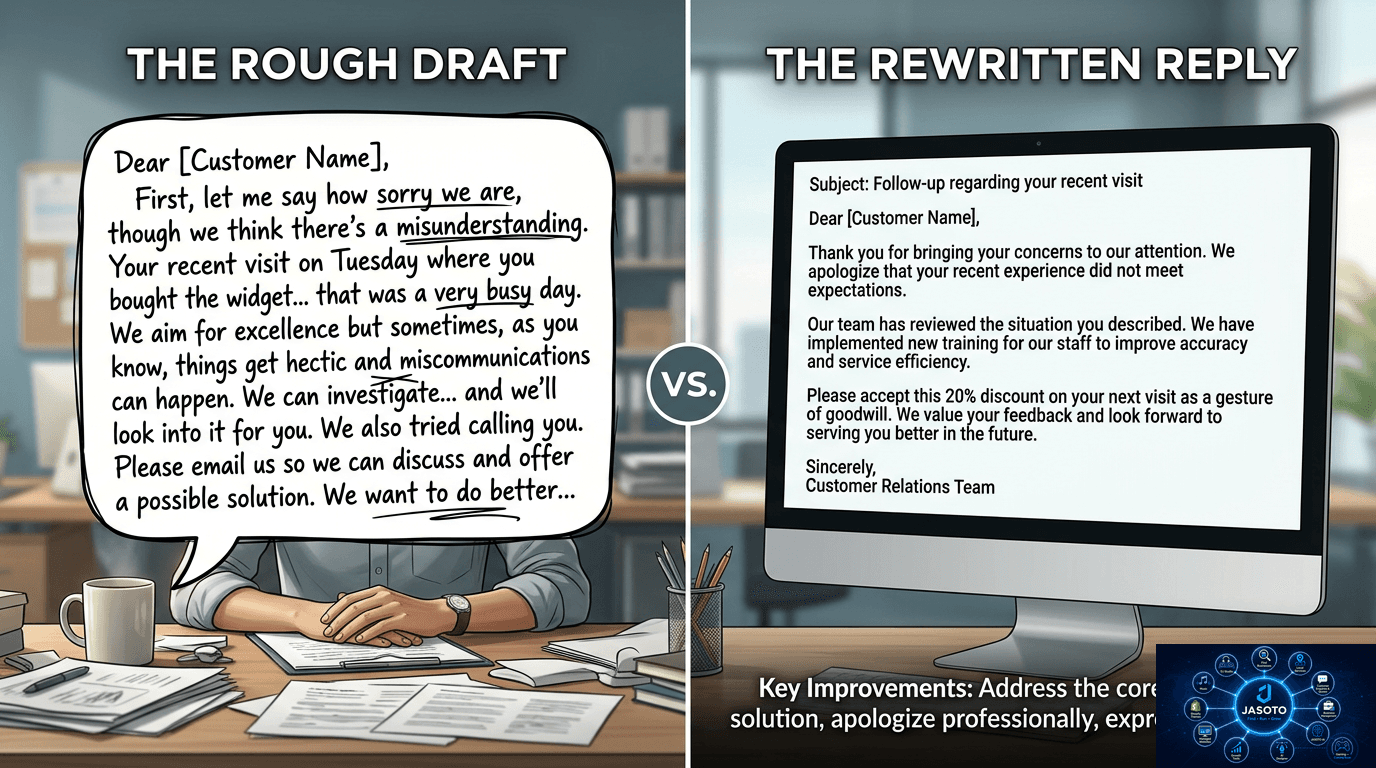
AI-generated illustrative image. It does not depict an actual customer project or a tested product.
A negative review can feel personal, especially when the comments are incomplete, emotional or plainly unfair. Even so, the public reply is not just for the reviewer. It is also read by future customers, who are often deciding whether the business is calm, organised and willing to deal with problems properly.
That is why the best response is usually measured rather than defensive. Check the facts first, acknowledge the concern clearly and explain a practical next step. Where private details are involved, move the conversation away from the public review space and into a direct channel. A good reply does not pretend the issue never happened; it shows that the business can handle feedback in a professional way.
This guide focuses on constructive responses that stay within the facts you have, protect privacy and avoid turning a review into a public argument. It also shows how to keep the process consistent inside the business so that a single difficult review does not become a wider communications problem.
At a glance
- Check the facts first and assign one person to handle the response.
- Acknowledge the specific concern, then point to a practical next step.
- Keep private details out of public replies and use direct contact for follow-up.
- Treat recurring complaints as process clues, not just one-off criticism.
Start by checking what you actually know
Before writing anything, find the relevant booking, job record or customer interaction internally. The aim is to separate confirmed information from assumptions. A review may sound clear, but the details might be incomplete, especially if the customer name is missing or the complaint refers to a different visit than the one you first expect. If you reply too quickly, you risk correcting the wrong point and creating a second problem on top of the first.
It also helps to decide who will handle the response. If several staff members reply independently, the result can be inconsistent or argumentative. One person should normally own the public reply and any follow-up, even if they need input from others to confirm the facts. That keeps the tone coherent and reduces the chance of a public back-and-forth. The purpose is not to produce a polished defence, but an accurate and professional response that can be supported internally.
Acknowledge the concern without overstating it
Once the facts are clear enough, name the issue directly. If the customer is complaining about a delay, missed communication or a similar service problem, the reply should reflect that specific concern rather than offering a generic apology. A specific acknowledgement reads as more credible because it shows that you have actually read the review and understood what the person is unhappy about.
A useful structure is to thank the reviewer for raising the matter, acknowledge the concern and then point to the next step. For example, a reply to a confirmed delay might say that you are sorry the communication left the customer uncertain and invite them to contact a named business contact so the relevant person can review the booking and discuss what happens next. The important point is that the response stays tied to what is known. If you cannot support a statement, leave it out. A public reply should not reach beyond the evidence you have in front of you.
Use wording that stays within confirmed facts
One of the easiest mistakes to make is to over-explain. In a stressful moment, it is tempting to list every detail of the business side of the story, but a public reply is not the place to build a case. Keep the wording short, clear and supportable. If the issue is confirmed, say so plainly. If it is not yet confirmed, avoid speaking as if it has been established.
This is especially important where the response could imply an outcome that has not yet been agreed. Do not promise a refund, replacement or investigation result before the appropriate person has assessed the matter. Even when you feel confident that the business will want to put things right, the public reply should not get ahead of the internal decision-making process. A careful response is more useful than one that sounds generous but later has to be corrected. The review thread should not become a place where the business commits to something it cannot yet verify or deliver.
Handle missing or unclear information carefully
Sometimes a review cannot be matched to a booking or job record. That does not mean you should ignore it, but it does mean the response needs to be especially careful. A suitable reply can say that you would like to understand the feedback, but cannot match the details available to a booking, and invite the reviewer to contact the business with the information needed to look into it. This keeps the door open without pretending you know who the customer is or what happened.
It is also important not to publish private material in the hope of proving your point. Addresses, payment information and private correspondence should stay out of a public reply. Google’s response guidance stresses privacy and constructive communication, which is a useful reminder that the purpose of the reply is not to win an argument. If a review may breach platform rules, use the platform’s reporting process rather than assuming that criticism alone makes a review removable. That distinction matters: a negative review and a removable review are not automatically the same thing.
Why privacy should shape every public reply
A review response is part of your public presence, even when it only covers a few lines. Future customers may read it long after the original issue has faded from memory. For that reason, the reply should protect both the business and the reviewer by avoiding unnecessary detail. Publicly listing private correspondence, account details or payment information can make a difficult situation worse, even if you believe it supports your account of events.
A privacy-aware reply also prevents the conversation from drifting into a dispute about facts that should be handled elsewhere. The review box is not a secure case file or an internal note. It is a public-facing space, so the most useful reply is often the one that says enough to show you are listening and then moves the discussion into a direct conversation. If there is a real issue to resolve, the direct channel is where it can be handled properly. If there is no identifiable booking, that too is best explained briefly and privately where appropriate.
This approach is not about being evasive. It is about matching the format to the purpose. Public replies should reassure readers that the business is serious about feedback, while private contact allows the details to be checked without oversharing.
Turn a calm public reply into a useful next step
A good negative review response should do more than acknowledge feelings. It should point to a practical action that makes sense from the business side. That might mean inviting the reviewer to contact a named person, asking for enough information to find the record, or confirming that the matter has been logged internally. The exact next step depends on what you know, but it should always be specific enough to be useful.
This matters because a short apology on its own can feel incomplete. Future readers often want to see that the business knows what to do next when something goes wrong. A useful reply therefore combines three elements: recognition of the concern, a clear route for follow-up and a tone that remains professional. If those three are present, the response can be brief without seeming careless.
It is also worth remembering that the public reply is only one part of the communication. If the customer then responds privately, that conversation should be handled consistently with the same care. The goal is not to produce separate messages that all say slightly different things. The goal is to make the next step easy to understand and straightforward to complete.
Follow through internally, not just in the review thread
A polite public message with no operational follow-through does not solve the underlying cause. Once the issue has been confirmed, record it, identify the owner of the next action and decide what should change in the process. This might be a booking step, a communication routine or some other part of the service flow. The important point is that the review should trigger learning, not just a response.
Recurring themes are especially valuable because they show where customers repeatedly misunderstand or encounter the same difficulty. If the same complaint appears more than once, the fix may not be limited to review replies. You may need to improve how the service is described on the website, in a profile listing or in booking confirmation messages so that expectations are clearer before the job starts. In that sense, the review is useful data, not just criticism. It can reveal where the business needs better explanations rather than better wording alone.
This is also where internal records matter. If you keep a simple note of the complaint, who is responsible and what was done next, it becomes easier to spot patterns later. That record can help you avoid repeating the same response without ever adjusting the process behind it.
Keep the tone professional even when the review is unfair
Some negative reviews are fair and specific, while others are vague, exaggerated or written in a highly emotional tone. The temptation in those situations is to respond in kind, but that usually weakens the business’s position rather than strengthening it. A calm tone shows restraint. It also makes the reply easier for future customers to trust because it does not read as if the business is trying to punish the reviewer for speaking up.
Professional tone does not mean sounding cold. It means staying respectful, avoiding sarcasm and resisting the urge to correct every emotional phrase in the review. If you can identify the practical issue, focus on that. If you cannot, say that you would like to understand the feedback and invite a direct conversation. That approach leaves space for resolution without making claims you cannot support.
It may help to imagine that the public reply is being read out of context, because that is often how it will be seen. Many readers will not know the job, the staff involved or the back-and-forth that led to the complaint. They will judge the business mainly by whether the reply sounds responsible and measured.
Use adaptable example wording, not a rigid script
Template responses are useful because they reduce the pressure of replying in the moment, but they still need adapting. A complaint about a delay is not the same as a review that cannot be matched to a record, and neither should be answered with identical wording. The point of an adaptable example is to preserve the structure while changing the detail. Thank the reviewer, acknowledge the specific issue, point them to the right contact and keep private matters off the page.
For instance, if the issue is a confirmed delay, the core reply can say that the business is sorry the communication left the customer uncertain and invite direct contact with the responsible person. If the issue cannot be matched to a booking, the core reply can say that the business would like to understand the feedback but needs more information to look into it. Both responses do the same job in different circumstances. They show that you are listening without pretending that every complaint can be handled in the same way.
The mistake to avoid is copying a template so closely that it sounds mechanical. A short reply can still sound human if it is tied to the actual concern. That means choosing the most relevant sentence and trimming anything that does not help the reader understand what happens next.
Avoid common missteps that make the situation worse
A few errors repeatedly undermine otherwise sensible responses. One is replying before checking the facts, which can lock the business into a statement that later proves inaccurate. Another is becoming defensive and treating the review as a personal attack rather than a customer communication. A third is oversharing private information in the hope of proving a point. None of those approaches improves the public impression, and each can make the issue harder to resolve.
Another common mistake is focusing only on the review itself and forgetting the wider customer experience. If the same type of confusion appears across the website, a profile listing or booking messages, then the reply alone will not solve the problem. Clearer service descriptions and more precise confirmations can prevent the same complaint from appearing again. The review thread may be the last place to show that improvement, but it should not be the only place where action happens.
Finally, avoid the assumption that a difficult review must be publicly dismantled. In many cases, the strongest response is a brief acknowledgement and a direct invitation to continue the conversation elsewhere. That is often enough to reassure readers that the business is organised, without escalating the dispute.
Your practical checklist
- Find the relevant booking or job record before drafting the reply.
- Separate confirmed facts from assumptions and keep the tone professional.
- Acknowledge the specific issue rather than replying with a generic apology.
- Use only wording you can support and do not promise an outcome too early.
- Keep addresses, payment details and private correspondence out of the public thread.
- If the issue is confirmed, record it and assign the next internal action.
- Review whether the same confusion appears in your website, profile or confirmations.
Frequently asked questions
Should I reply to every negative review straight away?
Reply in a reasonable time, but check the facts first. A short accurate response is usually better than a rushed one that later needs correcting.
What if I cannot identify the customer from the review?
Say that you would like to understand the feedback but cannot match the details to a booking, then ask the reviewer to contact you with the information needed to look into it.
Is it a good idea to post private evidence to prove my side?
No. Keep private details out of public replies. Use a direct conversation if more information is needed, and rely on the platform’s reporting process where a review may breach its rules.
Can I ask the reviewer to delete the negative review?
Focus on resolving the issue rather than pressuring the reviewer. Do not offer a benefit in exchange for changing or removing a review.
Organise your business with Jasoto
Explore a Jasoto business account and check the listing and management tools available for your work.
Explore a business account