
Jobs & Careers · UK Guide 2026
Return to a Project After a Gap: Write a Useful Briefing
JASOTO · Updated 5 November 2026 · 1,666 words
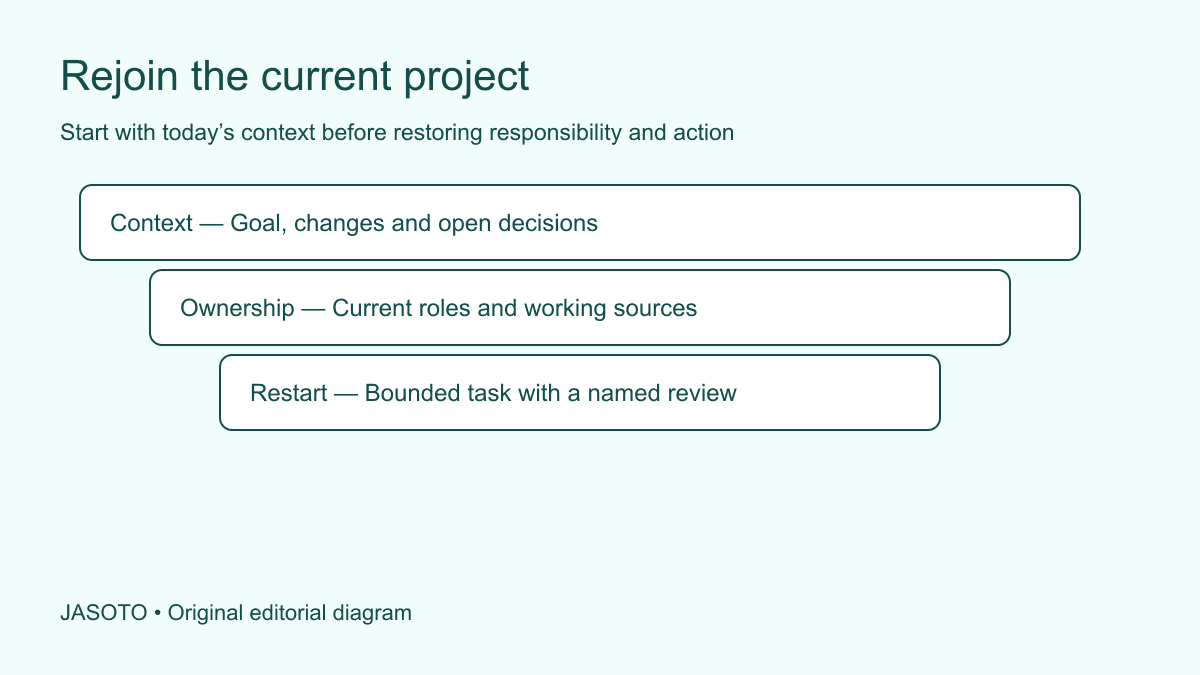
Original JASOTO editorial diagram. Its complete workflow is explained in the article; no actual customer outcome is depicted.
A return-to-project briefing should explain the current goal, the important changes since the person last worked on it and the first decision or task they now own. Show what still stands as well as what changed. Link to the current records and name someone who can answer questions. Do not make returning colleagues reconstruct months of history from an inbox before they can understand today's work.
This original guide is for a UK small team bringing someone back after an extended assignment elsewhere, a paused project or another gap. It is not guidance on personal absence or medical return arrangements. The Government Project Delivery Teal Book addresses project-specific induction and reporting in government. Its focus on context and working practices is relevant background; the concise briefing structure and examples below are editorial tools for a smaller team's coordination problem.
The practical answer
- Compare today with a known earlier reference.
- Separate changed, unchanged and unresolved.
- Reconfirm roles and current sources.
- Restart with a bounded reviewed task.
Define the point the person is returning from
Confirm when they last had an accurate view of the project and what responsibilities they held then. Use an approximate period if that is all anyone can establish. A person who attended one update during their time away may have heard a headline without knowing the detail. Do not assume that being copied into messages means they absorbed every change or could access the documents.
Ask what they remember as the project's goal, next milestone and decision structure. This is a way to identify the starting point for the briefing, rather than test their memory. Record the last reliable reference, such as an approved plan or a previous handover. That makes the change summary specific: it compares today's position with a known earlier state. Avoid including personal explanations for the gap in the shared project document unless there is an appropriate and necessary reason.
State the current goal before recounting events
Open the briefing with what the project is now trying to deliver and why that remains useful. Keep the description concrete. For an invented office relocation project, the current goal might be making a smaller workspace ready for a particular team, rather than the larger move originally planned. The returning person needs to know that change before reviewing supplier conversations or layouts produced for the old scope.
Name any important constraint that shapes the current work, such as an agreed sequence or a dependency on another team. Distinguish an approved change from a proposal still being considered. “The sponsor approved the smaller scope” and “we are discussing a smaller scope” lead to different decisions. The opening should give the reader a stable frame for the details that follow, without turning uncertain information into a confident summary merely for brevity.
Separate changed, unchanged and unresolved
Use three short groups for the main comparison. Changed items explain what is different and identify the decision or event behind it. Unchanged items confirm earlier assumptions that remain valid. Unresolved items show where the team still needs a decision or information. This structure prevents the returning colleague from assuming that every older decision has expired or that every recent discussion became policy.
For each material change, link to its current record and name its owner. Do not reproduce the entire conversation that led to it unless that history is needed for the person's work. A concise entry can say “supplier selection reopened after the scope changed; procurement owner is reviewing options”. Add what this means for the returning role. A change summary becomes actionable when it explains its effect, rather than simply listing events in chronological order.
Identify the current source of truth
Link to the approved plan, active task board, latest decision record and relevant working documents. Check that the returning person's account can open them. Explain which location replaces an older folder or template. The project may have accumulated several plausible copies during the gap, and a person familiar with the earlier structure is especially likely to find an obsolete one first.
Show the status of each key document in plain language. A draft layout should not sit in the briefing as though it were the approved design. Keep historical material available through the appropriate archive, but do not make it compete with the current instructions. If the project lacks a reliable maintained source, name that problem and assign an owner. A briefing cannot resolve inconsistent records by choosing one privately and presenting it as authoritative without agreement.
Rebuild the responsibility map
Name who now owns the main decisions, who performs the work and who needs to be consulted. Explain changes in responsibilities, not just changes in personnel. The same colleague may still be present but no longer have approval authority. Conversely, a new team member may maintain a critical record without being the person who can approve the underlying commitment.
Give the returning person a clear role statement. Specify what they are expected to take back, what remains with a colleague and which decisions require a handover. Avoid telling them to “resume as before” when the team has reorganised around the gap. If responsibility is still being negotiated, mark it as unresolved and arrange a decision before dependent work begins. A friendly welcome is valuable, but it does not substitute for a usable boundary around the work.
Explain open issues and decisions needed soon
Choose the open items that affect the returning person's next work. For each, state the observed problem, current impact, action owner and next decision point. Separate an issue that has occurred from a risk that might occur, using the team's established terminology where it exists. The reader should not need to infer urgency from the length of an email chain.
For the invented relocation project, an open issue might be that the proposed meeting-room equipment does not fit the revised space. The briefing should say what is confirmed, which measurement or decision remains outstanding and who will act. It should not casually diagnose a supplier failure when the cause has not been established. Keep proposed solutions visibly separate from approved ones, so the returning person does not unknowingly implement the most recent suggestion rather than the current decision.
Confirm access, tools and working practices
Check whether the person's accounts, folders and relevant permissions still match their role. Use supported individual access arrangements and the accountable approver. Do not assume that everything should be restored to an earlier state: some previous permissions may no longer be necessary, while new tools may require fresh setup or instruction. Record outstanding dependencies before assigning work that relies on them.
Explain changes to ordinary working practices, including how decisions are recorded, where updates are posted and how an urgent question is escalated. A returning person may understand the project technically while missing a new coordination convention. Give one representative example rather than a tour of every feature. If a new process needs practice or specific training, arrange it explicitly. Familiarity with the old project should not be treated as evidence of readiness for a substantially changed task.
Choose a bounded first piece of work
Assign a first task that helps the person reconnect with the current project without requiring every unresolved question to be settled beforehand. State the intended output, supporting sources, authority boundary and reviewer. For an office move, the task might be reviewing the latest equipment inventory against an approved room plan, rather than negotiating a supplier change immediately after reading the briefing.
Reserve time for review and allow the person to surface conflicting information. They may notice an older constraint the current team has overlooked. Evaluate that contribution against the records instead of dismissing it as outdated or accepting it solely because the person has historical knowledge. A bounded restart creates a practical way to test shared understanding. It also limits the cost of a misunderstanding before the person resumes wider responsibilities or makes commitments on behalf of the project.
Hold a conversation around the briefing
Send the concise pack before the discussion where appropriate, then use the meeting to check assumptions and answer questions. Ask the person to describe the current goal and the first task in their own words. This reveals where the document needs clarification. Avoid reading every section aloud while leaving no time to discuss the decisions the person now needs to make.
Invite them to distinguish historical concerns from current blockers. An old unresolved question may now have an approved answer, or it may remain important despite falling out of recent updates. Link any correction to the proper record and name the next owner. If the discussion includes private circumstances unrelated to project delivery, handle those separately. The shared briefing should remain a reliable work document rather than a transcript of every personal and operational conversation surrounding the return.
Update the record after the first working cycle
Review the briefing after the person completes the first suitable task or work cycle. Ask which source was missing, which responsibility remained unclear and which stated change did not match reality. Correct the document and the underlying records together. Do not leave a useful clarification stranded in a private follow-up message, where the next returning colleague will have to rediscover it.
If outside support is needed to repair project records, find business service providers and explain the actual scope. If the project now needs a continuing coordination role, review relevant jobs and responsibilities. Confirm hosts and site arrangements before planning a return visit. The rollback for an ineffective restart is to narrow the first task, restore the last approved working instruction where appropriate and resolve the conflicting decision. A good briefing helps someone rejoin today's project while preserving the valuable context they bring from its earlier work.
Put the guide into practice
- Identify the last reliable project view.
- Link current plans and decisions.
- Check access and changed working practices.
- Review the first work cycle and correct gaps.
Frequently asked questions
How much history should the briefing include?
Include the history needed to understand current decisions and the returning person’s next responsibilities. Link the wider archive rather than copying it all into the briefing. Show what changed since their last reliable reference, what still stands and what remains unresolved.
What if the project has no current approved plan?
State that gap openly and identify who can establish the working position. Do not privately choose one of several conflicting drafts and call it approved. Give the returning person a bounded task that does not depend on unresolved authority while the accountable owner clarifies the plan.
Should someone regain all their old permissions?
Review permissions against the current role and tasks using the organisation’s approved access process. Some former rights may no longer be necessary, while new tools may need additional setup. Record dependencies and test an appropriate first task before assuming the person can resume every previous activity.
Explore JASOTO tools
Discover providers and check support for your specific task.
Explore roles and responsibilities →Consider the practical responsibilities involved when recruiting or joining a team.
Plan work-related travel →Research a journey when joining, training or meeting colleagues in person.
Continue with JASOTO
Compare your next step
Discover UK businesses, compare services and request written quotes before making a decision.