
Business Growth · UK Guide 2026
Manage Returnable Fabric Samples Between Shop and Customer
JASOTO · Updated 5 November 2026 · 1,606 words
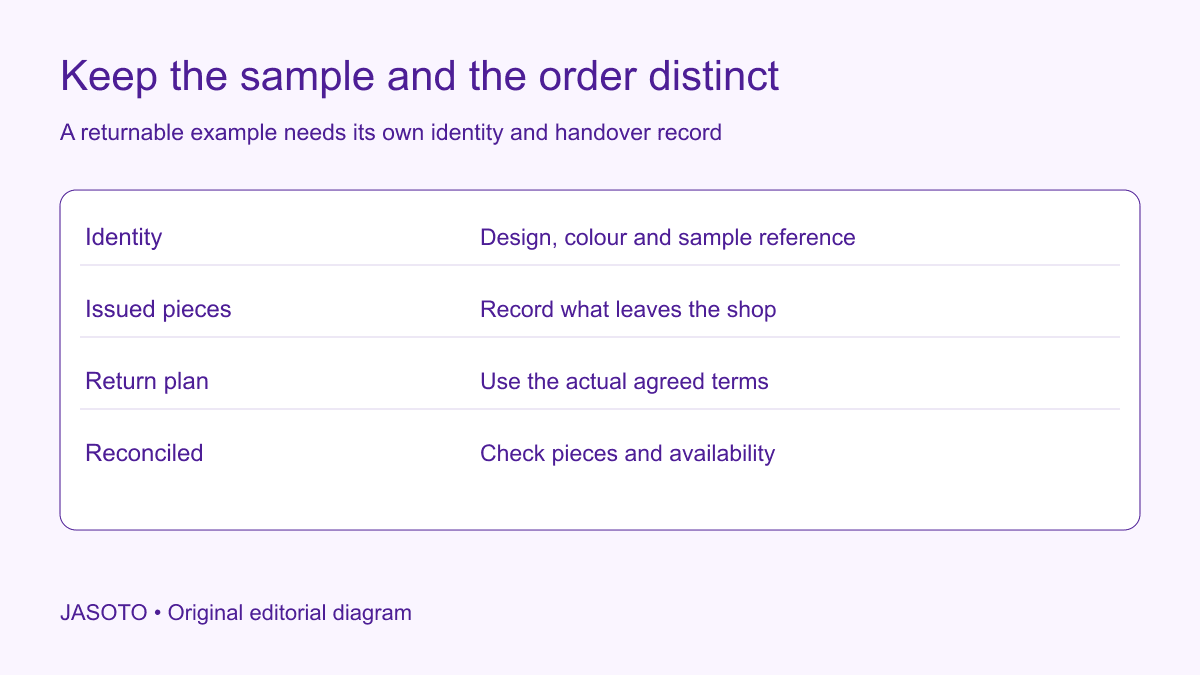
Original JASOTO editorial diagram. Its complete workflow is explained in the article; no actual customer outcome is depicted.
Manage loan samples by identifying each piece, explaining the actual return terms and recording both issue and checked return. For fabric and other interiors samples, keep the borrowed example distinct from a final product order. A customer may use a sample to compare colour, scale or texture at home while further specification and purchasing decisions remain open.
This guide is an original administrative method for UK shops offering returnable fabric samples. The examples use invented design references and make no claim about a particular provider's service. Verify the terms and appropriate product guidance for the actual range. A sample record should help customer and shop understand what was borrowed, what it represents and how it becomes available for the next enquiry.
The practical answer
- Identify each sample by design, colour and individual reference.
- Explain the actual loan and return arrangement before handover.
- Keep sample observations separate from approval of a production order.
- Reconcile returned samples and update their availability.
Separate loan samples from samples the customer keeps
Identify which pieces are returnable, which are purchased and which are provided to keep under the business's actual service. Do not let similar packaging conceal a different arrangement. A customer receiving a small cutting and a larger returnable piece should understand which one must come back. Record the distinction on the relevant handover information rather than relying on a verbal explanation alone.
Provider services vary. [Soane Britain's terms](https://www.soane.co.uk/terms-conditions/) describe returnable samples in its own offering, while [Balineum's sample information](https://www.balineum.co.uk/products/hanley-colour-swatch) distinguishes samples to keep from some loan arrangements. These are examples of specific providers, not standard terms for every shop. Use the actual service agreed with your customer and check current details directly where necessary.
Give each sample a useful identity
Record the manufacturer or range, design, colour reference and an individual sample identifier where the shop uses one. Keep labels attached through the appropriate product process. A customer comparing several similar shades needs to connect their preference to the correct reference later. A photograph of three unlabeled swatches on a table may be hard to interpret after the pieces return to the shop.
Use the same identifiers in the loan record, customer message and sample library. Preserve supplier codes accurately alongside readable names. Avoid replacing a precise colour reference with a staff nickname that could refer to several options. If a label is missing or uncertain, resolve the identity before offering the piece as a dependable reference for a purchasing decision.
Record the actual pieces leaving the shop
List the sample pieces, books or boards included in the handover. For a fabric book, identify the relevant item rather than assuming a general range name accounts for every component. Use the business's appropriate condition and custody process. The person checking the return should be able to establish what is expected without remembering the original customer conversation.
Keep the record proportionate. An ordinary sample handover may need a concise list and relevant observations, not an excessive photographic record. If a condition matters, describe it factually and connect it to the specific piece. Avoid presenting a cosmetic note as a technical guarantee or recording unrelated personal information just because an old loan form includes space for it.
Explain the sample's representational limits
Ask the appropriate supplier what the sample can establish and what variation or further approval may matter for the final goods. A sample can help the customer understand a design without proving that every production piece will be identical. Communicate the actual relevant guidance accurately. Do not invent a universal variation disclaimer or use one to excuse a description that does not match the offered product.
For pattern decisions, identify whether the piece shows the full repeat or only a limited area. For colour decisions, preserve the exact reference and any supplier-provided conditions. If another approval step is appropriate, explain how the customer requests it through the actual process. Keep the sample loan record connected to those questions without turning the act of borrowing into final acceptance of production goods.
Agree the return arrangement before issue
State the actual return date or process, receiving location and relevant contact. Explain any confirmed charge, deposit or other term through the business's proper agreement process. Do not copy another supplier's price or period as though it governs your service. The customer should know what they are agreeing before taking the sample away, including how to ask about a change.
Check that the return route is practical. A shop may have limited receiving hours or a different address for posted returns. Provide the current relevant information and ask the responsible person how mailed samples should be handled. Do not assume that proof of posting, physical receipt and condition review are the same event. Record the actual status and use the applicable terms for any consequences.
Give the customer a usable reminder
Connect the reminder to the current library record rather than a separate unreviewed calendar. A parcel may arrive before the receiving colleague completes reconciliation, or an authorised extension may already have changed the due date. Check those facts before sending an overdue message. Record the actual contact and response so the next employee does not repeat the same request. If the shop uses automated reminders, the responsible person should verify how status updates affect them through the appropriate system. Automation does not remove the need for a current, accurate account of which pieces remain outstanding.
A concise reminder can identify the samples, the agreed return arrangement and the contact for questions. Use ordinary language and the relevant reference. Avoid sending a generic overdue message when the shop has already received the parcel but has not reconciled it. Check the current status before contacting the customer so the message reflects the actual situation.
If an extension is requested, route it to the authorised person and record the response. The sample may already be needed for another appointment. Do not promise availability to the next customer while an extension remains unresolved, or assume an unanswered request has changed the loan terms. Keep the current agreed position visible to both showroom and administrative staff.
Keep customer observations useful and limited
Invite the customer to record which reference they preferred and what question remains. A note such as preferred in the intended room is useful context, but should not become a technical suitability finding or a final order instruction. Ask whether the customer wants further advice or a quote through the actual sales process. Preserve their uncertainty where they are still comparing options.
Handle photographs or room information appropriately. The shop may need a design question answered without retaining unrelated private details about the customer's home. Use the business's suitable privacy and sharing arrangements. Do not forward a complete conversation to every supplier when a concise product question would suffice. The sample record should support the decision while keeping personal information proportionate to that purpose.
Worked example: three returnable fabric pieces
Imagine a showroom loaning three identified fabric pieces for a customer to compare in one room. The record lists the design and colour of each piece, the relevant supplier context and the actual return arrangement. The customer receives the same references and knows how to ask for clarification. A separate request for a quotation remains a sales enquiry rather than an assumed order.
When the customer returns the pieces, staff reconcile them against the issued list and update availability. One preference is recorded for the later conversation, with any required final specification still open. This invented example claims no successful interior design outcome or exact production match. It shows how a small shared record can preserve identity across the shop, home comparison and subsequent purchasing discussion.
Check return and availability as separate steps
Record physical receipt, then complete the appropriate review before marking a sample available for the next loan. A returned parcel may contain fewer pieces than expected or need a condition check under the business's process. Avoid promising the sample to another customer solely because the courier tracking says delivered. The receiving team should confirm the actual library status.
If something is missing or changed, preserve the facts and contact the relevant person through the agreed process. Do not make unsupported accusations or silently alter the issue list to match what returned. Commercial questions about charges or deposits need the applicable terms and appropriate advice. The administrative record should make the evidence clear without pretending to decide every disputed consequence.
Maintain the sample library after the loan
Check whether the sample remains current for the range. Designs, references or supplier offerings may change while pieces circulate. An old sample can still be useful for historical support, but should not automatically be offered as evidence of a current available product. Mark the status clearly and give staff an appropriate source for checking current supply.
Review repeated handover problems. If customers confuse similar references, improve labels and the issued list. If returns arrive at the wrong location, revise the reminder. Keep the earlier template and compare later comparable loans before claiming an improvement. A useful process addresses the actual information gap while remaining practical for ordinary showroom work.
Use JASOTO businesses to discover relevant interiors providers and ask about their actual sample service. If sample administration becomes continuing work, explore showroom support roles within a staffing review. For an agreed return visit, research travel after checking the receiving location and hours. A good sample record preserves the identity, agreement and next decision while keeping the borrowed example separate from the eventual order.
Put the guide into practice
- Confirm which samples can be loaned and under which terms.
- Record the exact pieces and their condition appropriately.
- Give the customer clear return and question routes.
- Check return, current availability and any separate purchasing decision.
Frequently asked questions
Does choosing a sample approve the final order?
Keep those decisions distinct through the actual sales process. A customer can borrow or prefer a sample without placing a final order. Confirm the relevant design, colour, quantities and any appropriate approval evidence before treating the choice as an instruction to supply.
Should every shop charge the same deposit?
Use the actual business arrangement and applicable requirements. Providers can have different sample services, eligibility and return terms. Explain any confirmed charge or deposit clearly before agreement rather than copying another company's policy as a universal rule.
What if a customer cannot return a sample on the agreed date?
Give them a clear contact route and use the shop's actual process to discuss the request. Record any authorised change and update availability. Do not assume an extension is agreed simply because a message was sent or because another customer has not yet asked for the sample.
Explore JASOTO tools
Discuss the actual design range and sample service directly.
Explore showroom support roles →Consider staffing where sample records and customer follow-up become ongoing work.
Research a confirmed sample return journey →Plan travel after checking the receiving location and opening arrangements.
Continue with JASOTO
Compare your next step
Discover UK businesses, compare services and request written quotes before making a decision.