
Travel · UK Guide 2026
Review an Itinerary After a Missed Connection
JASOTO · Updated 5 November 2026 · 1,609 words
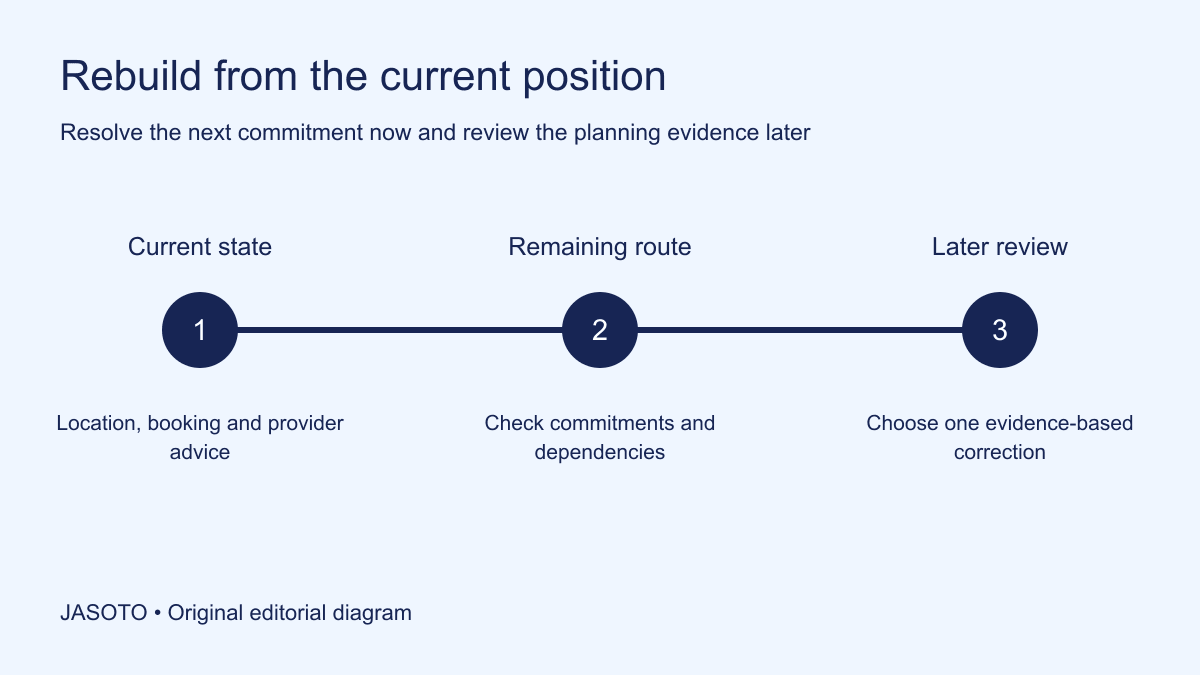
Original JASOTO editorial diagram. Its complete workflow is explained in the article; no actual customer outcome is depicted.
After a missed connection, rebuild the remaining itinerary from where you actually are and identify the next commitment that matters. Check the transport provider's instructions and your booking conditions, then contact affected hosts with the facts needed for a decision. Do not keep following an old sequence that is no longer possible simply because its bookings and calendar entries still look complete.
This guide offers an original review method for UK work travel. National Rail points passengers to the Conditions of Travel and other applicable information. The actual next option depends on the journey and circumstances, so obtain guidance from the relevant operator or retailer rather than assuming every missed connection creates the same entitlement. The method below separates immediate practical decisions from the later process review that can improve another trip.
The practical answer
- Start from the actual location and booking.
- Use provider guidance for the next travel option.
- Review every dependent appointment and service.
- Separate immediate decisions from later lessons.
Establish the current position calmly
Identify your actual station or other location, the service missed and the next relevant transport information source. Keep the original booking and route available through an appropriate private record. A short factual account helps staff or the provider understand the problem. Avoid beginning with an unverified diagnosis about who caused the miss when the immediate question is what travel is now appropriate and possible.
Distinguish facts from uncertainty. You may know the arrival time and that the onward service has departed, while still needing confirmation of what the ticket permits next. Keep those separate. Do not buy, board or cancel another arrangement solely because an old itinerary app proposes a route. Use the relevant provider's actual instructions and current service information. The planning task begins with a reliable current state rather than several competing screenshots of what the original journey was supposed to do.
Check the provider and booking route for help
Use the established operator, retailer or appropriate staffed assistance route for the actual journey. Explain the booking, missed connection and relevant circumstances. Ask what the correct next travel option is under the applicable arrangement. National Rail's passenger-rights page links the Conditions of Travel, but a general page does not settle every individual ticket or situation without the relevant details.
Record important advice accurately, including its source where practical. If you do not understand whether a proposed service is authorized or requires another purchase, ask before relying on it. Keep a proposal distinct from confirmation. The objective is a usable next step with the responsible provider, rather than a broad legal conclusion made in the middle of a disrupted trip. Any later complaint or expense question should preserve the actual facts and follow the relevant process.
Identify the next fixed commitment
Look at the remaining itinerary and choose the appointment, pickup or access requirement that now drives the decision. A client meeting may matter more immediately than an optional stop, while a storage collection or site closing arrangement can create another constraint. List what is essential and who can authorize a change. Do not assume the traveler can privately discard a business commitment to simplify the route.
Confirm which details remain valid. A venue or host contact may be unchanged, while the arrival time is no longer feasible. The next decision should use the actual appointment requirement rather than a generic instruction to arrive as soon as possible. This helps the host consider whether a later arrival still serves the purpose, whether the activity can be shortened appropriately or whether another arrangement needs approval.
Build one feasible remaining route
Use current transport information and the provider's guidance to check a plausible complete route from the present location. Include the local leg and actual destination entrance. A new main service is insufficient if its arrival misses the final local connection or falls outside the host's receiving window. Keep the whole path visible before promising a revised appointment arrival.
Avoid creating a large collection of speculative alternatives that makes the decision harder. Identify the meaningful choice and the facts it depends on. If a local pickup or additional arrangement is required, label it unconfirmed until the relevant provider responds. A disrupted itinerary can become more fragile when every gap is filled with an assumed taxi, informal lift or available room. The revised route should be as evidence-based as the original plan should have been.
Contact the host with a decision-ready update
State where you are, what has changed and which appointment is affected. Give a revised estimate only to the extent it is supported by the checked route, and identify remaining uncertainty. Ask the host or business owner the specific question needed: whether the activity can proceed later, move to another format or be rearranged. Keep the message concise enough for them to act on while you are still traveling.
An invented update might say that the planned connection has been missed, the operator is advising on onward travel and the original meeting arrival is no longer possible. The traveler asks whether a later discussion would still be useful before committing to an additional local transfer. This avoids an unsupported promise and gives the host a practical decision. Replace the scenario with the actual facts and the organization's agreed contact process.
Review every dependent booking
Check transfers, accommodation, equipment handling, storage and return transport that depend on the original timing. Name who contacts each provider and what decision or confirmation is needed. A changed train plan does not automatically amend a local vehicle booking, and telling the host you are late does not notify every supplier. Keep those handoffs explicit.
Read the relevant actual conditions and obtain appropriate advice for unclear changes, costs or claims. This guide does not decide which provider must pay for an alternative or whether a charge is recoverable. The practical record should show the original arrangement, the requested change and the response. A dependency remains open until the appropriate owner has resolved it, even if the traveler's main journey is moving again and the immediate pressure has eased.
Update one current itinerary
Mark the unusable leg and any replaced appointment clearly. Add the confirmed revised route with a visible update time and preserve pending items as pending. Keep the historical evidence where appropriately needed, while the active view tells the traveler what to do next. An old departure displayed beside a new one without status can create another avoidable mistake.
Update shared and offline copies used by other people. A coordinator's live record does not automatically change a traveler's downloaded document. Tell affected contacts which instruction is current. If responsibility transfers to another colleague, give them the actual status and unresolved decisions rather than only forwarding the full message history. A clear current handoff can prevent a second round of duplicate calls or conflicting bookings while everyone is trying to help.
Preserve useful evidence without inventing precision
Retain the relevant confirmations, provider messages and actual observations through the appropriate process. Record times you know and label estimates honestly. Keep necessary receipts or additional booking evidence connected to the relevant transaction. Do not change a record to make the sequence look simpler or create an exact timestamp from a vague memory because a later form has a neat field for it.
Separate the factual record from a process lesson. “We reached the transfer point after the onward service departed” is an observation; “the interchange was impossible” needs more evidence. This distinction helps both an administrative review and your own planning. Avoid collecting unnecessary personal data about staff or other travelers to make the account feel authoritative. A concise sequence with relevant sources is more useful than a broad narrative containing unsupported motives or blame.
Review the cause after the immediate trip
Once practical arrangements are settled, compare the original plan with what happened. Ask whether the connection depended on an unrealistic transfer, a service disruption, unclear instructions or another factor. Use the actual evidence and preserve uncertainty. Several factors may have contributed, and the most visible event may not be the only planning issue worth improving.
Choose a specific corrective action. It might be checking the station exit earlier, assigning a local booking owner or setting a decision point for the next appointment. Describe the expected benefit without claiming a measured improvement before another suitable trip provides evidence. If a proposed fix introduces cost or changes the business plan, use the appropriate approval route. A review should produce a practical action that someone can test, rather than a universal rule based on one difficult journey.
Keep the lesson proportionate to future trips
Use travel research to explore alternatives while verifying actual conditions with providers. A service found through business listings still needs suitability and booking confirmation. If disruption coordination is part of a recurring responsibility, describe it accurately in relevant roles, including which decisions belong to operators, business approvers and hosts. Clear boundaries help people respond without pretending one coordinator controls every part of a journey.
If the revised plan becomes confused, return to the current location, next fixed commitment and provider-confirmed travel option. Remove obsolete active instructions and restore one reliable view. After the trip, revise the original planning method only where the evidence justifies it. A useful missed-connection review gives you two concrete outcomes: an appropriate next action during the disruption and a specific lesson for the next itinerary, without manufacturing certainty about rights, cause or future reliability.
Put the guide into practice
- Contact the appropriate operator route.
- Give hosts a decision-ready update.
- Maintain one confirmed current itinerary.
- Preserve facts and assign a specific improvement.
Frequently asked questions
Can I simply board the next service?
Check the actual booking and obtain appropriate operator or retailer guidance for the circumstances. A missed connection does not produce one universal rule for every ticket or transport mode. Clarify whether the proposed service is authorized or needs another arrangement before relying on it.
What should I tell the meeting host?
Give your current position, the change affecting arrival and the specific decision needed. Use a revised estimate only where supported by the checked remaining route. Keep unconfirmed local arrangements visible and ask whether the later appointment still serves the business purpose.
What belongs in the later review?
Compare the original plan with the factual sequence and identify a specific improvement. Separate observations from assumptions about cause or entitlement. Assign an owner to a practical correction and describe its expected benefit without claiming a result that has not been measured.
Explore JASOTO tools
Discover providers and check support for your specific task.
Explore roles and responsibilities →Consider the practical responsibilities involved when recruiting or joining a team.
Plan work-related travel →Research a journey when joining, training or meeting colleagues in person.
Continue with JASOTO
Compare your next step
Discover UK businesses, compare services and request written quotes before making a decision.